
What Is Liquid Staking?
Liquid staking lets you stake ETH and get a token you can trade or use while it stays staked. How it works, why the token can trade below ETH and the risks.
Liquid staking lets you stake ether through a protocol and receive a token, called a liquid staking token, that represents your staked ETH and its rewards. You can trade that token or use it in other applications while the underlying ether stays staked. The trade-off is extra risk: smart-contract bugs, concentration, and the token trading below the ETH it represents.
The problem it solves
Staking ETH directly locks it up. Leaving takes time in an exit queue, and running a validator needs 32 ETH and reliable hardware. Liquid staking pools deposits from many users, has professional operators run the validators, and issues a token that can be sold at any moment instead of waiting to unstake.
How it works
- You deposit ETH into the liquid staking protocol’s smart contract.
- The protocol stakes it through a set of node operators running validators.
- You receive a token, such as stETH from Lido, that tracks your share of the pool.
- Rewards accrue either as a growing token balance or as a rising exchange rate between the token and ETH.
- To exit, you either sell the token on the market or redeem it through the protocol’s withdrawal queue.
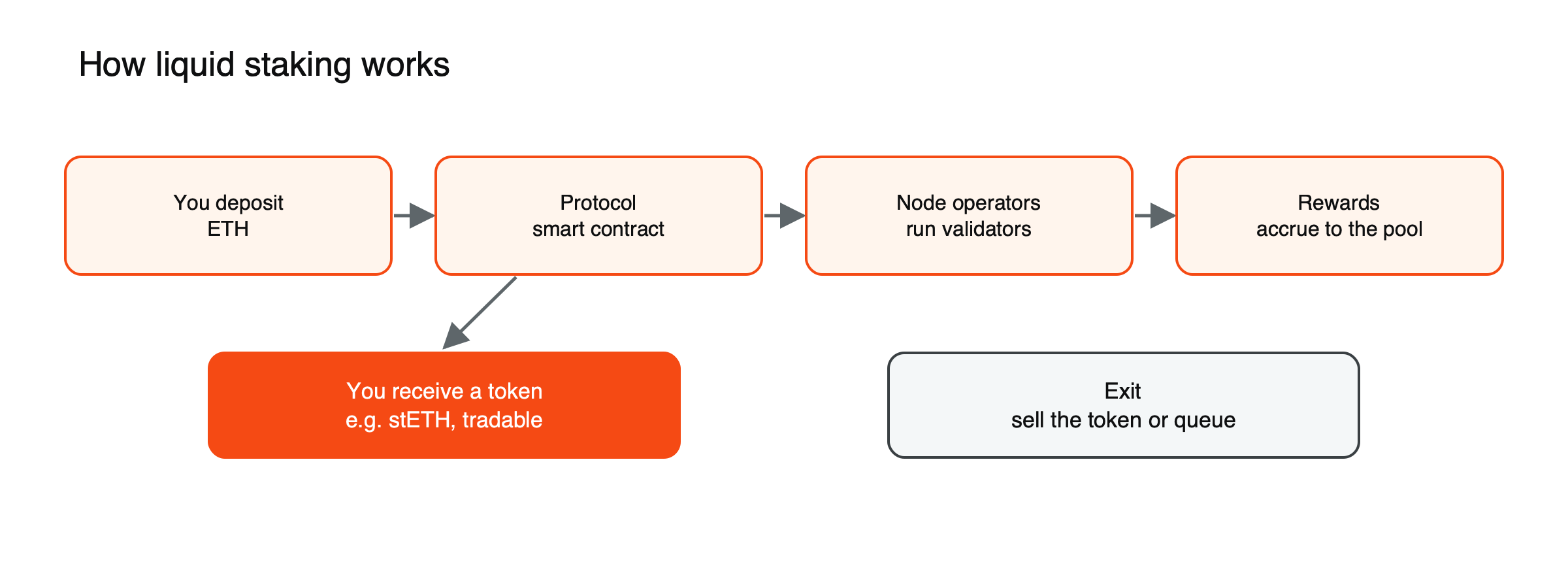
Figure: How liquid staking turns locked ETH into a tradable token.
Two kinds of token: rebasing and value-accruing
Liquid staking tokens pass on rewards in one of two ways. A rebasing token, such as stETH, keeps its value roughly equal to one ETH and increases the number of tokens in your wallet as rewards arrive. A value-accruing token keeps your balance fixed and lets each token become worth more ETH over time. Some applications cannot handle balances that change on their own, so rebasing tokens often come with a wrapped, value-accruing version, such as wstETH, for use in lending markets and other contracts. Both represent the same staked ether; they simply show the rewards differently.
Selling vs redeeming: two ways out
There are two exits. Selling the token on an exchange or trading pool is fast, but you receive whatever the market will pay at that moment, which may be below the ETH the token represents. Redeeming through the protocol’s withdrawal queue returns the full amount of ether, but only after the protocol unstakes it, which can take days or longer when many users leave at once. In calm markets the two routes give nearly the same result; in a rush to exit, the gap between them is the price of speed.
Why the token can trade below ETH
A liquid staking token is a claim on ETH, not ETH itself. Its market price depends on how many people want to buy or sell it at a given moment. If many holders sell at once and redemption takes time, the price can drop below the value of the ETH behind it.
That happened in July 2025, when rising borrowing costs on the lending platform Aave made a popular strategy unprofitable. Traders had been borrowing ETH against stETH to stake more; as they unwound those positions, the ETH/stETH pool became unbalanced and stETH slipped below its peg, according to Glassnode.
The concentration question
Liquid staking has concentrated a large share of staked ETH in a few protocols. Lido was the largest single staking entity, with about 27% of staked ETH in April 2025, and its share fell to about 25% by July 2025. Because one protocol’s operators run so many validators, a bug or a coordinated failure there would affect a meaningful part of Ethereum’s security.
Who runs the validators
A liquid staking protocol does not run validators itself; it chooses node operators to do it. Some protocols use a curated set of professional operators approved by governance. Others let anyone become an operator by posting a bond of their own ether, which can be used to cover losses if they are slashed. Newer designs split each validator’s key across several operators using distributed validator technology, so that no single operator can cause a slashing alone. The operator model decides how much the protocol depends on a few companies and how losses are shared.
Fees: what the protocol keeps
Protocols take a share of staking rewards, usually divided between the node operators and the protocol’s own treasury, and pass the rest to token holders. The fee is applied to rewards, not to the deposit, so it reduces the yield rather than the amount staked. Comparing protocols means comparing net rewards after fees alongside their risks, not just the headline rate.
The risks to weigh
- Smart-contract risk: a bug in the protocol’s contracts could lose deposited funds.
- Slashing: if an operator is penalized, the loss is usually shared across all holders of the token. See what slashing is.
- Depeg risk: the token can trade below its underlying value, especially in a rush to exit.
- Leverage loops: using the token as collateral to borrow and stake more multiplies both rewards and losses.
- Variable rewards: rates change with network activity and the total amount staked; no rate is guaranteed.
Questions to ask before choosing a protocol
- How long has it run, and how much has it held without incident?
- Who are the node operators, and how are they chosen and bonded?
- How is a slashing loss shared, and is there an insurance fund?
- How deep is the market for its token, and how long does redemption take?
- Who can upgrade its contracts, and is there a delay before changes take effect?
How it differs from other ways to stake
Compared with solo staking, you give up control of the validator and add protocol risk in exchange for flexibility. Compared with an exchange’s staking product, the token is on-chain and transferable, but there is no company standing behind it. Our guide to what staking is in crypto compares the main options, and how to stake ETH walks through each one.
For the next layer of this stack, read what restaking is. For the network itself, see what Ethereum is.
This article is educational content and does not constitute financial, investment, legal or tax advice. Digital assets are volatile and you may lose the amount you invest.
Sources
- Lido’s Share in Ethereum Staking Drops to 25% (July 2025 stETH depeg from unwinding leverage loops, per Glassnode) — ForkLog, July 2025
- Staking Penalties on Ethereum’s Consensus Layer: Implications for wstETH and Other LSTs (Lido ~27% of staked ETH, April 2025; slashing losses socialized) — Aave Governance, April 2025