
How Stocks Have Behaved in Past Rate-Cutting Cycles
Stocks have usually risen after the Fed's first cut when no recession followed and fallen when one did. The record since the 1980s and what it means.
In past rate-cutting cycles, stocks’ path depended on whether a recession followed. Since the 1980s, the S&P 500 has averaged about 14% in the 12 months after the Fed’s first cut, mostly without a recession. But eight of the last 12 easing episodes came with one, and stocks then often fell, as in 2001 and 2007–2008.
Timeline of notable cycles
- 1995 and 1998: cuts without a recession, the soft-landing cases.
- January 2001: cuts began as the dot-com bust deepened; the S&P 500 fell 13% that month and the bear market continued.
- September 2007: cuts began; the S&P 500 then fell sharply in the 2008 crisis.
- July 2019: a “mid-cycle adjustment”; stocks rose about 8.7% over the next year despite the 2020 crash.
- September 2024: a half-point first cut amid soft-landing hopes; stocks hit records.
Average versus typical
The average gain of about 14% in the 12 months after a first cut hides wide differences. In cycles without a recession, such as 1995, 1998 and 2019, shares generally rose. In cycles with one, such as 2001 and 2007, shares fell, sometimes for a long time. An investor buying shares on the first cut is effectively betting on which kind of cycle is under way.
Two cycles, illustrated
Suppose an investor buys an index fund on the day of the first cut, with the index at 4,000. (Illustrative scenarios.) In a soft-landing cycle, the index might reach 4,500 a year later, a gain of 12.5%, as earnings hold up and valuations rise. In a recession cycle, earnings might fall 20% while valuations rise only slightly, leaving the index near 3,200 a year later, a loss of 20%. The rate cut is the same; the outcome depends on earnings.
Why the recession matters
Rate cuts lower borrowing costs and support valuations, but if profits are collapsing in a recession, cheaper money cannot offset falling earnings. Cuts that respond to a crisis often arrive after markets have already started falling.
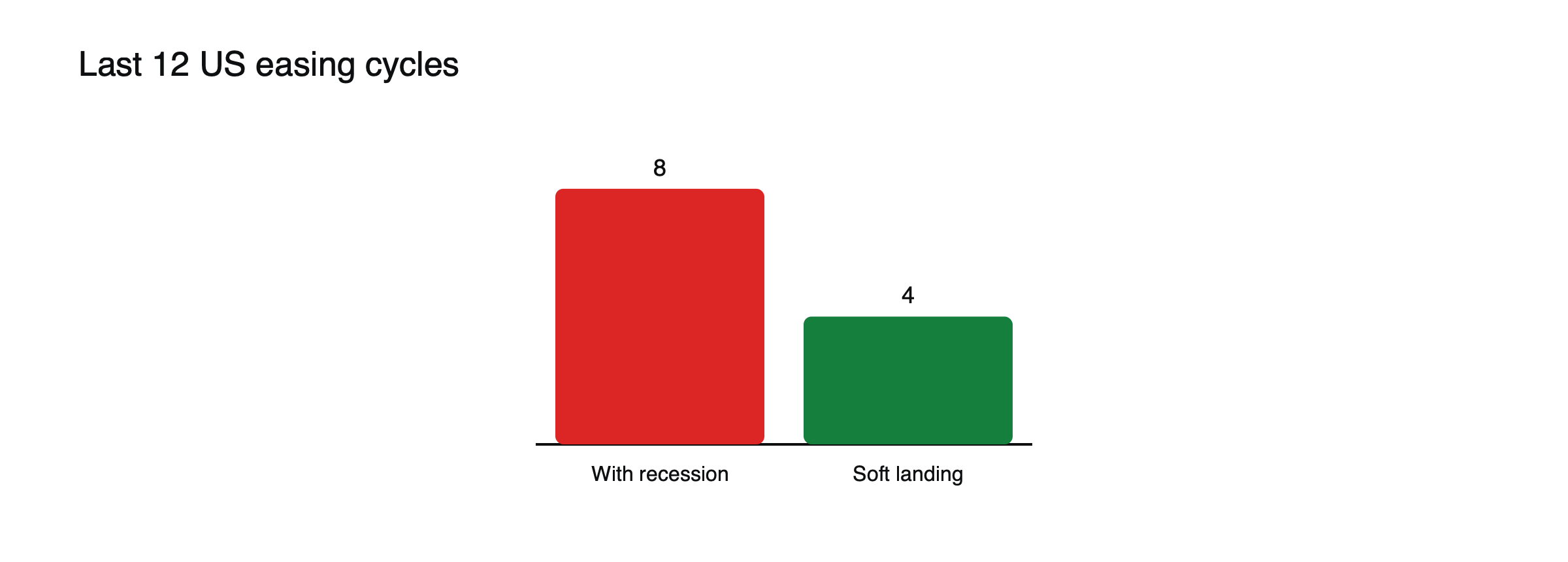
Figure: Most easing cycles came with recessions. Source: LGT.
Sectors and sizes
Utilities have historically been the best-performing sector in the six months after a first cut. Large caps beat small caps in the year after the first cut in four of the six cycles before 2024. See small caps vs large caps when rates start falling.
The 2001 and 2007 cycles
In January 2001, the Fed began cutting as the technology bubble deflated; shares kept falling into 2002 despite aggressive cuts, as technology profits collapsed. In September 2007, cuts began as the housing downturn spread; the S&P 500 then fell sharply through the 2008 financial crisis, bottoming in March 2009. In both cases, cuts arrived early in a downturn that rate cuts alone could not stop. See what happened across markets in 2008.
Bonds and gold in the same cycles
Bonds have generally gained after first cuts, especially in recession cycles, as yields fall. Gold has averaged gains of about 15.5% in the 12 months after a first cut when a recession followed. Both have often done better than shares in hard-landing cycles. See what usually happens to gold when the Fed starts cutting.
What to take from history
The first cut is not a buy signal by itself; the economy’s direction is the deciding factor. See soft landing vs hard landing vs no landing and stocks, bonds and commodities across the rate cycle.
Cycles at a glance
| First cut | Recession followed? | Share market path |
|---|---|---|
| 1995 | No | Strong gains |
| 1998 | No | Gains despite volatility |
| January 2001 | Yes | Bear market continued |
| September 2007 | Yes | Deep fall through 2008 |
| July 2019 | No (pandemic shock in 2020) | About +8.7% after 12 months |
| September 2024 | No, as of 2026 | Records soon after |
What markets price before the first cut
Markets usually price the first cut weeks or months before it happens, so much of the support from lower rates may already be in prices. In 2024, the Fed’s half-point cut in September came after months of anticipation, and shares had already rallied. The surprise element, whether the cut is larger or smaller than expected, often matters more for the immediate reaction.
Lessons for traders
Watching earnings forecasts, unemployment and credit spreads around the first cut gives a better guide than the cut itself. Rising unemployment and widening spreads suggest a recession cycle; stable employment and tight spreads suggest a soft landing. Sector choices matter too: defensive sectors and large companies have historically held up better in uncertain cycles. See soft landing vs hard landing vs no landing.
Valuations at the first cut
Starting valuations shape outcomes. When shares are already expensive at the first cut, as in 2024, much of the benefit of lower rates may already be priced, leaving less room for gains if earnings disappoint. When valuations are modest, rate cuts can lift them more. Comparing price-to-earnings ratios with their history gives context for how much good news is already in prices.
Small caps and large caps
Smaller companies, more reliant on floating-rate debt, are often expected to benefit most from cuts. Yet large caps outperformed in the year after the first cut in four of the six cycles before 2024, partly because cuts often came as growth weakened and investors favored stronger balance sheets. See small caps vs large caps when rates start falling.
Growth and value
Growth shares, whose value depends on distant profits, tend to benefit from falling long-term yields, while banks and other value sectors can suffer if cuts flatten lending margins. In recession cycles, however, defensive sectors often beat both.
The dollar in cutting cycles
Fed cuts tend to weaken the dollar if other central banks cut more slowly, which can lift US multinationals’ overseas earnings and support emerging market shares.
Common misreadings
- Treating the first cut as an automatic buy signal.
- Ignoring how much was already priced in.
Earnings revisions around the first cut
Analysts’ earnings forecasts often tell more than the cut itself. If forecasts are still rising when the Fed starts cutting, the cycle has usually been a soft landing; if they are falling sharply, a recession is more likely. Watching the direction of revisions in the weeks around the first cut helps judge which history is likely to repeat.
Emergency cuts versus planned cuts
Some cutting cycles begin with planned moves at scheduled meetings, signaled in advance, as in 2019 and 2024. Others begin with emergency cuts between meetings, as in January 2001 and March 2020, which usually signal that something has gone badly wrong. Emergency cuts have tended to come during sharp sell-offs, and shares often kept falling for a time afterward, even though the cuts eventually helped the recovery.
Cutting cycles outside the US
Other central banks’ cutting cycles show similar patterns. When the ECB began cutting in June 2024, ahead of the Fed, European shares responded more to growth and earnings than to the cuts themselves. In countries where cuts came because of recession, shares generally struggled at first. The common thread is that rate cuts support markets most when the economy avoids a deep downturn. See how the ECB and the Fed differ in moving markets.
Positioning, illustrated
Suppose an investor is unsure whether a new cutting cycle will bring a soft landing or a recession. (Illustrative approach, not a recommendation.) Rather than moving fully into shares on the first cut, the investor might keep a balanced mix, adding to shares gradually as earnings forecasts and employment data confirm a soft landing, and holding high-quality bonds that would gain if a recession arrived. The approach gives up some upside in the best case in exchange for protection in the worst.
The second and third cuts
Markets often react more to the pace of subsequent cuts than to the first. A cycle that continues steadily signals confidence that inflation is under control; a sudden acceleration, with larger or more frequent cuts, can signal that policymakers see trouble ahead. Watching how the expected path changes after the first cut gives important clues about which kind of cycle is unfolding. Share markets usually reward steady, predictable easing and grow noticeably more nervous when cuts suddenly speed up.
Frequently asked questions
Should I buy shares when the Fed starts cutting?
History offers no simple answer: gains have been typical without a recession and losses common with one.
Which sector has done best after first cuts?
Utilities have historically led in the six months after a first cut, reflecting their bond-like nature.
This article is educational content and does not constitute financial, investment, legal or tax advice. Digital assets are volatile and you may lose the amount you invest.
Sources
- US Fed cuts rates: what does this mean for gold, equities and emerging markets? (S&P 500 average 14.2% in 12 months after the first cut since the 1980s) — Julius Baer
- Fed rate cuts: market implications (eight of the last 12 easing episodes accompanied by recession) — LGT
- Market Performance Review (S&P 500 +8.7% 12 months after the July 2019 cut; 2001 and 2007 declines) — Walks Wall Street
- Three investments that thrive after the Fed’s first rate cut (utilities best in the six months after) — Interactive Investor
- S&P 500 hits all-time high on soft-landing hopes (large caps outperformed in four of six prior instances) — ThinkAdvisor, September 2024
- US Fed cuts rates: what does this mean for gold, equities and emerging markets? (gold +15.5% on average 12 months after the first cut when a recession followed) — Julius Baer
- ECB kicks off rate-cutting cycle (June 6, 2024; ahead of the Fed) — KBC, June 2024