
What Happened When TerraUSD Lost Its Peg?
In May 2022 the TerraUSD stablecoin lost its peg and its sister token LUNA collapsed, erasing about $40 billion. How the death spiral unfolded and why.
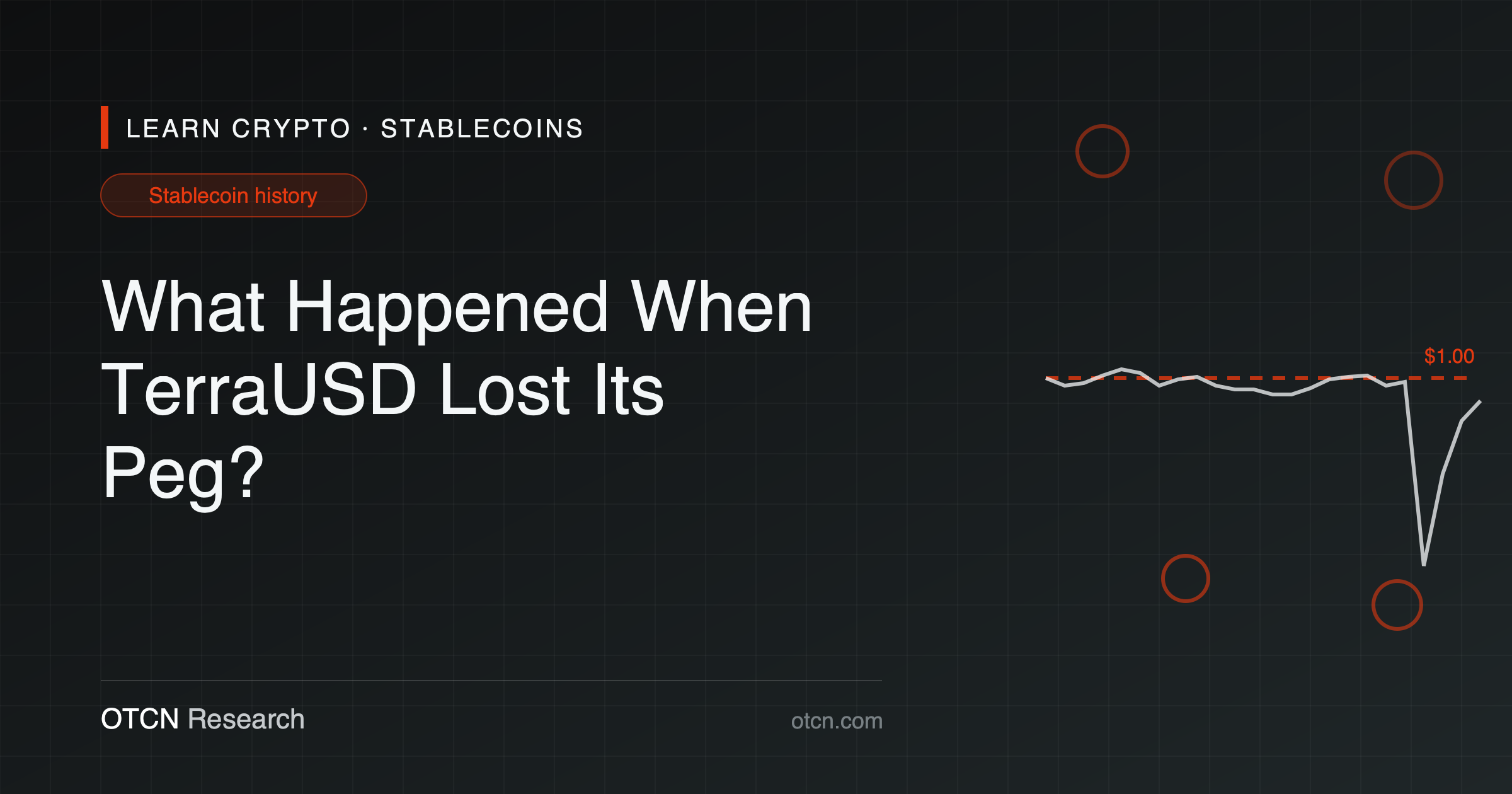
The TerraUSD collapse began on May 7, 2022, when heavy selling pushed the algorithmic stablecoin UST below $1. Within a week, UST and its sister token LUNA were nearly worthless, erasing roughly $40 billion to $45 billion and toppling crypto lenders. Terra’s co-founder Do Kwon was later sentenced to 15 years in prison for fraud.
How UST was supposed to hold $1
Most stablecoins hold reserves of cash and bonds. UST did not. It relied on an exchange mechanism with LUNA: anyone could always swap 1 UST for $1 worth of newly created LUNA, or $1 of LUNA for 1 UST. If UST fell below $1, traders could buy it cheaply and swap it for $1 of LUNA, removing UST from circulation. The design worked only as long as LUNA itself held value. Our guide to how stablecoins maintain their value compares this with reserve-backed designs.
A death spiral in simple numbers
Imagine 18 billion UST in circulation and LUNA worth $30 billion in total. (Illustrative figures.) While LUNA’s value comfortably exceeds the UST supply, the promise that each UST can be swapped for $1 of LUNA looks credible. Now suppose holders try to redeem $5 billion of UST. The protocol mints $5 billion worth of new LUNA, which those holders sell. LUNA’s price falls, so the next redemption requires even more new LUNA to deliver $1 of value, which pushes the price down further. Once LUNA’s total value drops below the remaining UST supply, there is no longer enough value in the system to honor every redemption, and the rush to get out first accelerates. Nothing external props the system up; its only backing is the token it keeps printing. A reserve-backed stablecoin under the same pressure can sell bonds or pay out cash; an algorithmic one can only create more of a token whose value is already falling.
The 20% yield that drove demand
Much of UST’s growth came from Anchor Protocol, a lending platform in the Terra ecosystem that offered depositors roughly 20% a year on UST. Analysts widely regarded that rate as unsustainable without outside subsidies. Large amounts of UST sat in Anchor, so confidence in the yield and confidence in the peg became linked.
Timeline
- May 7, 2022: large UST sales, including more than $285 million on Binance, push UST below its $1 peg.
- Following days: holders rush to exit. Swapping UST for LUNA floods the market with newly created LUNA, whose price collapses.
- Within about a week: UST and LUNA are close to worthless; about $40 billion to $45 billion of market value is gone.
- Weeks after: crypto lenders and funds with exposure to Terra fail, deepening the 2022 bear market.
- 2023: Do Kwon is arrested in Montenegro.
- December 2024: he is extradited to the United States.
- August 2025: he pleads guilty to two fraud counts and agrees to forfeit $19 million.
- December 2025: he is sentenced to 15 years in prison.
The bitcoin reserve that was not enough
Terra’s backers knew the design had a weak point and tried to build a buffer. In early 2022, the Luna Foundation Guard (LFG), a Singapore-based non-profit set up to support the Terra ecosystem, began accumulating bitcoin and other assets to defend UST in a crisis. By May 7 it held 80,394 BTC, worth more than $3 billion at the time.
When UST slipped, LFG announced on May 9 that it would deploy $1.5 billion, including $750 million in bitcoin lent to trading firms, to buy UST and restore the peg. It went much further. An audit later commissioned by LFG concluded that it spent 80,081 BTC and $49.8 million in stablecoins, about $2.8 billion in total, defending UST, while Terraform Labs spent a further $613 million of its own funds. By May 16, LFG held just 313 BTC. The selling of that much bitcoin into a falling market added pressure on bitcoin’s own price during the crash, and none of it saved the peg: UST sank below $0.15 and LUNA fell from about $80 to a tiny fraction of a cent.
Why it became a death spiral
The swap mechanism that was meant to restore the peg turned into an accelerant. Every UST redeemed created more LUNA, LUNA’s price fell, so each UST bought even more LUNA, and so on. Once holders lost faith that LUNA would keep its value, nothing stood behind UST. Prosecutors later said Kwon had misled investors, including about how the peg had been restored during an earlier wobble.
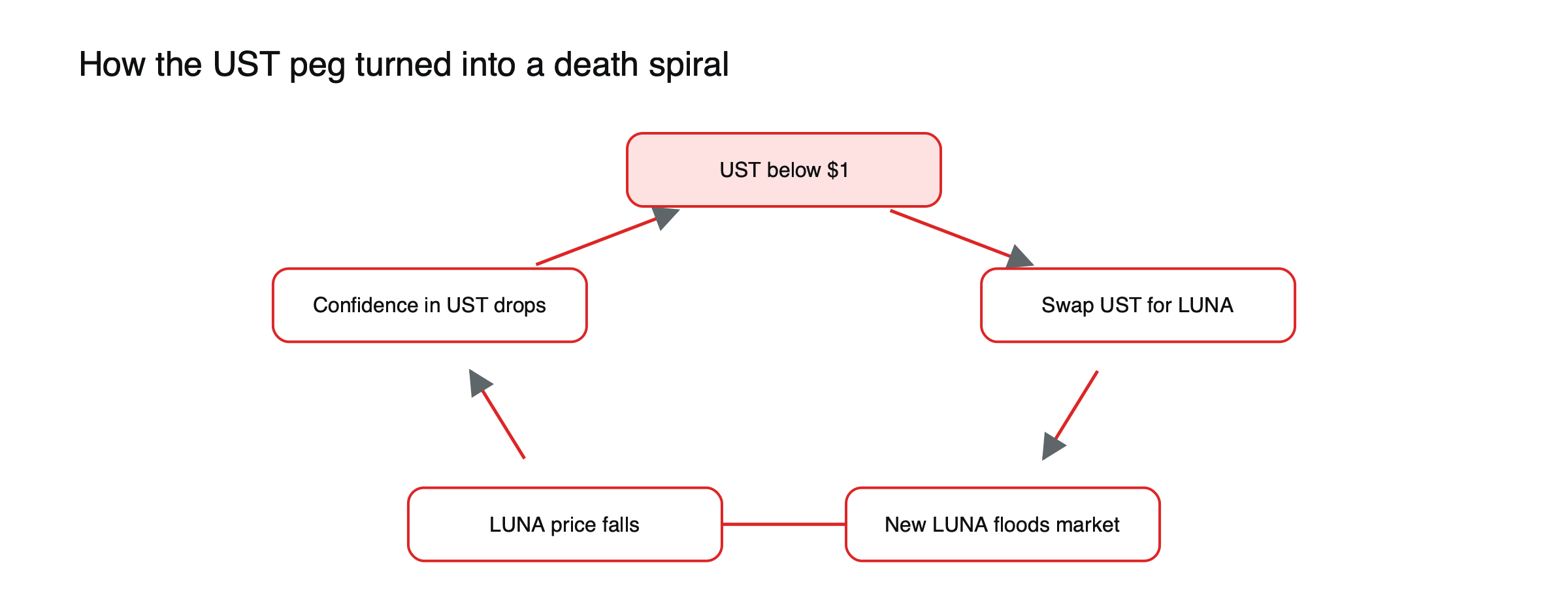
Figure: The feedback loop that broke UST in May 2022.
Warning signs that were visible beforehand
Several risks were visible to anyone who looked closely before May 2022:
- A yield with no clear source. Around 20% a year on a dollar token, paid steadily, implied subsidies that could not last forever.
- Reflexive backing. UST’s support came from LUNA, whose value depended largely on confidence in UST itself.
- Concentration. A large share of UST sat in a single protocol, Anchor, so a change in its yield could trigger mass exits.
- A buffer smaller than the risk. A few billion dollars of reserves stood behind a stablecoin supply several times larger.
None of these proved a collapse was coming, but together they described a system that worked only while confidence held.
What holders were left with
For ordinary holders, the collapse happened faster than most could react. Those who held UST through the crash were left with a token worth a few cents; those who held LUNA saw it fall to almost nothing. LFG said it would try to compensate users, starting with the smallest holders, but its remaining reserves were a tiny fraction of the losses. A new Terra chain was launched weeks later with a new LUNA token distributed to former holders, while the original chain continued as Terra Classic. Neither restored what had been lost, and the new token never approached the old LUNA’s value or role.
The damage spread beyond Terra’s own users. Lenders, funds and trading firms that held UST or LUNA, or had lent to those who did, faced losses that contributed to a wave of failures across the crypto industry later in 2022.
Why the idea keeps coming back
Despite Terra, the appeal of a stablecoin that does not depend on banks remains. Reserve-backed stablecoins need a company holding dollars and Treasuries in the traditional financial system, with the custody, regulation and freezing powers that implies. An algorithmic or crypto-native design promises independence from all of that and can be more capital efficient. Later designs try to capture those benefits with safeguards Terra lacked, such as overcollateralization with outside assets or hedged positions in derivatives markets, but each carries its own failure modes. See what a synthetic dollar stablecoin is.
What it changed
Algorithmic stablecoins lost credibility. Most new stablecoins since then rely on reserves of cash and short-term government bonds.
Yield got more scrutiny. A high, steady yield with no clear source became a red flag rather than a selling point.
Regulation accelerated. Lawmakers in several jurisdictions moved to require reserves and redemption rights for stablecoins.
For the ongoing risks of stablecoins, read stablecoin risks. For the basics, see what a stablecoin is.
This article is educational content and does not constitute financial, investment, legal or tax advice. Digital assets are volatile and you may lose the amount you invest.
Sources
- The Terra/Luna Collapse: A Stablecoin Failure Case Study (May 7, 2022; $285 million on Binance; ~$45 billion; Anchor ~20%; Kwon timeline) — LearnSignal
- How an Algorithmic Stablecoin Wiped Out $40 Billion (December 2025 15-year sentence) — Netcoins
- Do Kwon’s Guilty Plea: Terra’s «Algorithmic» Dream Ends in Fraud (mint-burn design; $40–60 billion) — FinTelegram, 2025
- Luna Foundation Guard says it spent $2.8 billion to defend UST peg (80,081 BTC and $49.8 million in stablecoins; Terraform Labs $613 million; JS Held audit) — The Block
- LFG unpacks bitcoin activity during LUNA/UST collapse (80,394 BTC on May 7; 313 BTC remaining; $1.5 billion deployment announced May 9; UST below $0.15; LUNA from about $80) — Decrypt, May 2022
- Luna Foundation Guard depleted its $3 billion reserves to try to save UST (compensation for smallest holders first) — The Block, May 2022