
Black Wednesday: How the Pound Was Forced Out of the ERM
On September 16, 1992, the UK raised rates from 10% toward 15% in a day but still had to pull sterling out of the ERM. What happened and why the peg failed.
Black Wednesday was September 16, 1992, when the UK was forced to take the pound out of the European Exchange Rate Mechanism. It raised rates from 10% to 12%, promised 15% and spent billions buying sterling, but could not hold the peg. Speculators such as George Soros profited; the cost was later put at about £3.3 billion.
What the ERM was
The European Exchange Rate Mechanism, set up in 1979, kept member currencies within trading bands against each other as a step toward monetary union. If a currency threatened to break out of its band, central banks were expected to intervene, buying the weak currency and selling the strong one, and governments could raise interest rates to support it. In practice the system revolved around the Deutsche Mark, because the Bundesbank was the anchor of low inflation in Europe.
Background
The UK joined the ERM in 1990, committing to keep sterling within a band against other European currencies, effectively the Deutsche Mark. German interest rates were high after reunification, forcing the UK to keep rates high during a recession. Many investors believed the pound was fixed too high.
Why the pound was vulnerable
The UK entered on October 8, 1990, at 2.95 Deutsche Marks to the pound, with room to move about 6% either side, roughly between DM 2.77 and DM 3.13. Membership helped bring inflation down, from about 8.1% in October 1990 to around 3% by September 1992. But German reunification had pushed the Bundesbank to raise rates repeatedly to contain inflation at home, and ERM members had to follow. For a British economy sliding into recession with falling house prices, high interest rates were increasingly painful, and many investors doubted the government could keep them high for long. A currency that markets believe is overvalued, defended by a policy that hurts the domestic economy, is a natural target.
The days before
By the summer of 1992 sterling was trading near the bottom of its band. On Monday, September 14, the Prime Minister, John Major, and the Chancellor, Norman Lamont, discussed the pressure and the coming French referendum on the Maastricht Treaty, due on September 20; the Chancellor said the government would fight to stay in the ERM even if interest rates had to rise. On September 15, remarks attributed to the Bundesbank’s president suggesting that further realignments could not be ruled out convinced many traders that the pound would have to give way.
Timeline
- October 1990: the UK joins the ERM.
- September 15, 1992: comments from the Bundesbank’s president about realignments add pressure.
- September 16, morning: the Bank of England buys sterling heavily; rates rise from 10% to 12%.
- Afternoon: a further rise to 15% is announced; selling continues.
- Evening: the Chancellor announces the UK is leaving the ERM; rates stay at 12% and are soon cut.
- Afterward: the pound falls about 15% against the Deutsche Mark.
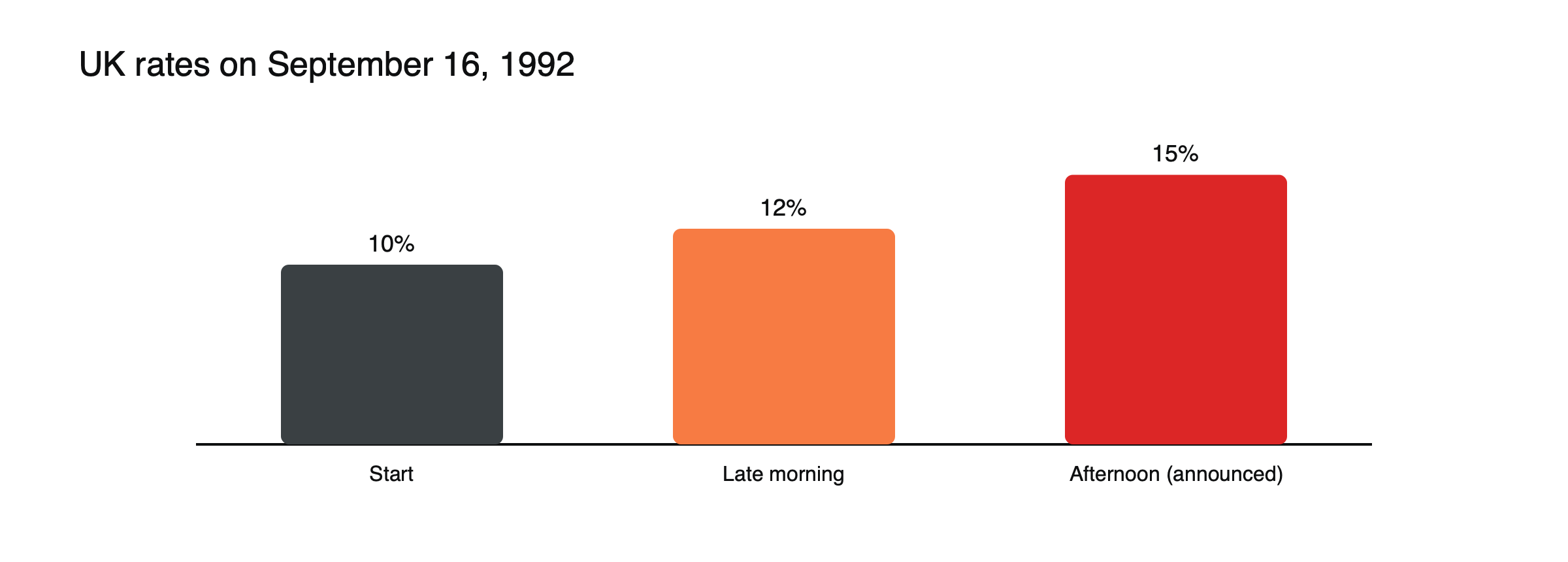
Figure: Rates on Black Wednesday.
The day itself
Selling began early on Wednesday, September 16. By mid-morning the Bank of England was reportedly buying about £2 billion of its own currency an hour, with little effect. The rise from 10% to 12% failed to impress traders, who reasoned that a recession-hit economy could not live with such rates. The promise of 15% in the afternoon looked even less credible, and the selling continued. At around 7 p.m., the Chancellor announced that Britain was leaving the ERM. The planned rise to 15% was abandoned, and within weeks rates were heading lower.
Soros and the speculators
George Soros’s Quantum Fund, with its London head of office Stanley Druckenmiller, had built a very large short position against sterling, reported at about $10 billion. Other funds and banks made similar bets. The trade was attractive because the downside was limited: if the peg held, sterling could rise only a little within its band, while if it broke, the fall could be large. Soros Fund Management was reported to have made between $1 billion and $2 billion, earning its founder the label “the man who broke the Bank of England.”
Why the peg failed
The required interest rates were too painful for a weak economy, reserves were limited and markets saw the commitment as unsustainable. Soros’s fund reportedly made over $1 billion betting against sterling.
Lessons
Defending a peg the market doubts can be very costly. The UK economy recovered after leaving, with lower rates and, later, an inflation-targeting regime. See fixed vs floating exchange rates, what moves GBP/USD and what moves currency prices.
How a peg is defended, and why defenses fail
A central bank defending a currency has two main tools. It can sell foreign reserves to buy its own currency, absorbing the selling directly, and it can raise interest rates, making it more expensive for speculators to borrow the currency in order to sell it. Both have limits. Reserves can run out, and markets can see roughly how much is left. Higher rates hurt borrowers, companies and homeowners, so traders judge whether the government can tolerate them. Once markets conclude that a defense cannot be sustained, every rate rise looks like a sign of desperation rather than strength, and selling accelerates. Central banks have studied that episode closely ever since.
The aftermath
Outside the ERM, the pound fell sharply against the mark and later traded as low as about DM 2.16 in 1995. Interest rates came down, and the economy began to recover. In October 1992 the government adopted an explicit inflation target, and in 1997 the Bank of England was given independence to set rates. The episode damaged the governing party’s reputation for economic competence for years, and the UK Treasury later estimated the cost of the failed defense at about £3.3 billion. Some economists have since called the day “White Wednesday,” arguing that leaving the ERM set the stage for a long period of steady growth.
What it means for traders today
Black Wednesday shows the forces that decide whether a currency peg survives: whether the required interest rates suit the domestic economy, how much in reserves the central bank can spend and whether markets believe the commitment. When those conditions weaken, pressure tends to build gradually and then break suddenly. For traders holding positions in currencies with pegs or tightly managed rates, the lesson is that apparent stability can end in a single session, with gaps far larger than normal daily moves. The same pattern appeared later in Asia in 1997 and in Switzerland in 2015. See the Asian financial crisis of 1997 and the Swiss franc floor removal in 2015.
Frequently asked questions
Why is it called Black Wednesday?
Because the UK government suffered a humiliating defeat on Wednesday, September 16, 1992, when it was forced to abandon its central economic policy in a single day.
Did Soros alone break the pound?
No. Many funds and banks sold sterling, and the economic pressures behind the peg’s failure were already in place. Soros’s fund was the most famous of many sellers.
This article is educational content and does not constitute financial, investment, legal or tax advice. Digital assets are volatile and you may lose the amount you invest.
Sources
- What is Black Wednesday? (rates from 10% to 12% then 15%; cost later estimated at £3.3 billion) — FXCM
- Black Wednesday: the day speculators beat the Bank of England (UK joined in 1990; Soros over £1 billion) — The Boar, 2025
- Sterling attacked (pound fell about 15% against the mark; Soros $1–2 billion) — Inside the House of Money excerpt
- How Soros broke the Bank of England (Bundesbank president’s comment on September 15) — Economics Help
- Why Black Wednesday still matters (DM 2.95 ± 6%, band DM 2.77–3.13; rates 10% to 12%; exit announced at 7 p.m.; inflation targeting from October 1992; Bank of England independence 1997) — The Conversation via University of Portsmouth
- Declassified file releases: Black Wednesday (Major–Lamont meeting on September 14; French Maastricht referendum on September 20; inflation 8.1% to 3%) — The Strand Group, King’s College London
- Britain’s Black Wednesday (Quantum Fund position of about $10 billion; Bundesbank raised rates repeatedly after reunification) — Korea JoongAng Daily
- Six Days in September review (ERM entry at DM 2.95; Bank of England buying about £2 billion an hour on the morning of Black Wednesday) — Politeia