
How to Size a CFD Position Using Risk per Trade
Position size = risk amount ÷ (stop distance × value per point). Worked examples for a currency pair and an index CFD, and why margin is not the guide.
CFD position sizing starts with how much you will lose if your stop is hit, not with your margin. Position size = risk amount ÷ (stop distance × value per point). A $10,000 account risking 1%, or $100, with a 50-pip EUR/USD stop worth $10 per pip per lot, gives 0.2 lots.
The formula
- Risk amount = account balance × risk per trade (for example 1%).
- Stop distance = entry price − stop price, in points or pips.
- Value per point = how much one point is worth for one unit of the position.
- Position size = risk amount ÷ (stop distance × value per point)
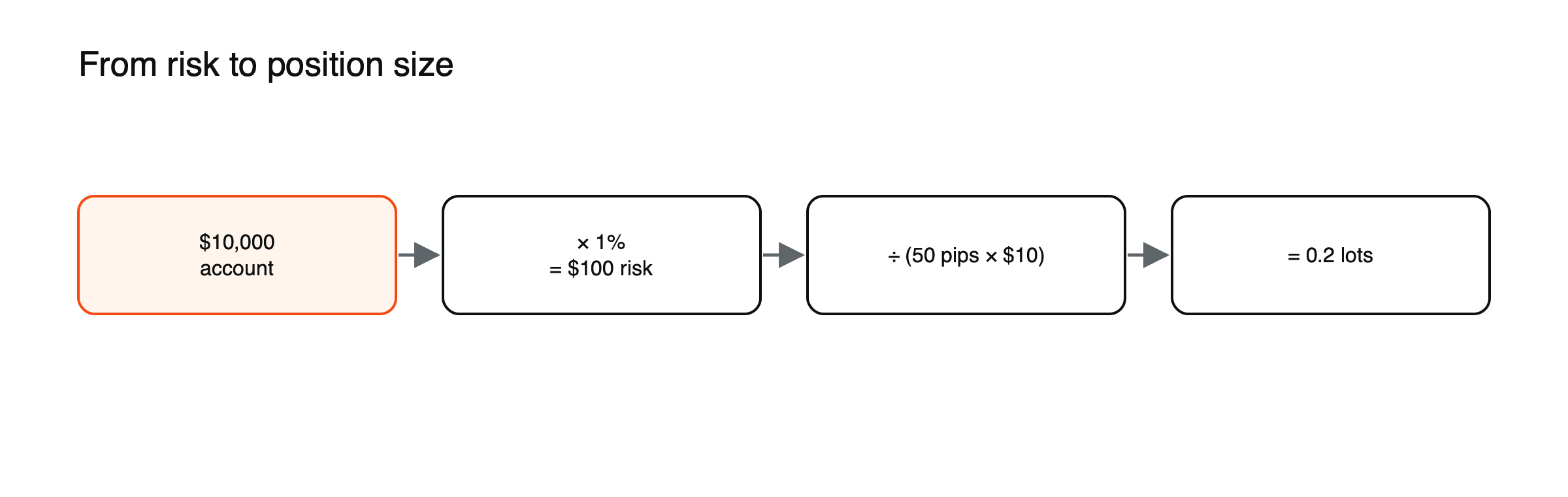
Figure: Sizing from risk, not from margin (example values).
Worked example 1: currency pair
- Account: $10,000; risk: 1% = $100
- EUR/USD stop: 50 pips
- Value per pip for 1 standard lot: $10
Size = $100 ÷ (50 × $10) = 0.2 lots.
Worked example 2: index CFD
- Risk: $100
- Stop: 40 points
- Value per point per contract: $1 (example value)
Size = $100 ÷ (40 × $1) = 2.5 contracts.
Worked example 3: share CFD
- Risk: $100
- Share entry $50, stop $48: stop distance $2 per share
- Value per point: $1 per share
Size = $100 ÷ ($2 × $1) = 50 shares, a $2,500 position.
Worked example 4: an account in euros
- Account: €10,000; risk: 1% = €100
- EUR/USD stop: 50 pips; one lot is worth $10 a pip, about €9.09 at 1.1000
Size = €100 ÷ (50 × €9.09) ≈ 0.22 lots. Converting the pip value into your account currency matters; skipping it would make the position about 10% too small or too large.
Worked example 5: gold
- Risk: $200
- Stop: $15 per ounce below entry
Size = $200 ÷ $15 ≈ 13.3 ounces, rounded down to the nearest size the provider allows.
Then check margin
At 0.2 lots, EUR/USD at 1.1000 is a $22,000 position; at 30:1 that needs about $733 of margin, well within the account. If margin would be too high, reduce size or widen the plan, not the risk.
Why this works better than sizing by margin
Margin tells you what you can open, not what you can afford to lose. Sizing by risk keeps each loss small and consistent, so a string of losses does not empty the account. Remember that stops can slip in gaps, so real losses can exceed the plan. See how stop-loss orders work, what leverage is in CFD trading and how to calculate the margin for a CFD trade.
Choosing your risk per trade
Many traders risk between 0.5% and 2% of their account on each trade. The reason is losing streaks: ten losses in a row at 1% each leave the account down about 9.6%, while ten losses at 5% leave it down about 40%, a hole that needs a gain of about 67% to recover. Streaks of that length happen to sound strategies more often than people expect, so the risk per trade should be small enough to survive them comfortably.
Correlated positions
Risk per trade assumes each trade is independent. Three long positions in different stock indices, or in EUR/USD, GBP/USD and gold against the dollar, can all lose together on one piece of news. Treating related positions as one combined risk, and sizing them so the total stays within your limit, avoids taking three times the intended risk without noticing.
Allowing for gaps
The formula assumes the stop fills at its level. Around earnings, weekends and major announcements, a gap can make the real loss larger. Some traders reduce position size before such events, or use guaranteed stops, so that a gap does not turn a 1% planned loss into a 5% actual one. See why prices gap over the weekend.
Scaling in and out
Entering a position in parts, or taking profit in parts, changes the average entry or exit but not the principle: the total loss if the final stop is hit should stay within your risk limit. Calculate the combined risk of all parts before adding to a position.
A full sizing walk-through
An account holds $25,000, and the trader risks 0.75% per trade, about $187.50. (Example values.) The setup is a long index CFD with a stop 60 points below entry, on a contract worth $1 a point. Size = $187.50 ÷ (60 × $1) ≈ 3.1 contracts, rounded down to 3, which caps the loss at about $180. With the index at 5,000, three contracts are worth about $15,000, needing about $750 of margin at 20:1, well within the account. The trader already holds a long position in a related index, so before entering they check that the combined loss if both stops are hit stays within their overall limit. Only then is the order placed.
Fixed percentage or fixed amount?
Risking a fixed percentage of the account means position sizes shrink after losses and grow after gains, which slows drawdowns and lets winners compound. Risking a fixed money amount keeps sizes constant, which is simpler but means each loss takes a growing share of a shrinking account. Most risk frameworks favor a fixed percentage, recalculated regularly rather than after every trade.
Tools that help
Many platforms include position-size calculators, and a simple spreadsheet with columns for account size, risk percentage, entry, stop and value per point does the same job. Building the calculation into the routine before every trade removes the temptation to guess, which is when position sizes tend to creep up.
Sizing when volatility changes
Market volatility changes over time, and stop distances should change with it. When a currency pair is calm, a 50-pip stop may sit comfortably outside normal noise; when it is volatile, the same stop could be hit by random swings, so traders widen it to 100 pips. With the same $100 risk, the position size then halves, from 0.2 lots to 0.1 lots. Sizing this way keeps the money at risk constant while letting the stop respect the market’s current behavior. It also means that in turbulent periods, positions automatically become smaller, which is usually exactly when smaller positions are wise. Measures such as the average daily range over recent weeks give a simple, objective guide to how wide stops need to be. Recalculating the average range once a week, rather than before every trade, keeps the whole process simple while still adapting quickly to changing conditions in the markets you trade most often, without adding much work.
Frequently asked questions
Should risk per trade be based on balance or equity?
Many traders use the account balance for simplicity, but equity, which includes open profits and losses, gives a more current picture of what can be lost. Using the smaller of the two is the cautious choice.
What if the calculated size is smaller than the minimum trade size?
Then the stop is too wide for the account and risk level, or the market is too large a step for the account. Waiting for a tighter setup, choosing a smaller contract or skipping the trade keeps the risk within limits.
Leverage, margin and cost figures in this article are example values for illustration. Actual terms depend on the provider, the instrument and the rules in your country.
This article is educational content and does not constitute financial, investment, legal or tax advice. Digital assets are volatile and you may lose the amount you invest.