
How to Choose Currency Pairs That Fit Your Schedule
List your free hours, match them to sessions, pick pairs active then, check spreads and volatility, and test first: choosing currency pairs for your schedule.
To choose currency pairs that fit your schedule, list the hours you can trade, see which sessions they fall in, pick pairs active then, check that spreads and typical moves suit your account, and test on a demo or small size first. A pair that moves while you sleep is hard to manage.
Before you start
Know the main sessions: Asian, European and US, with the London–New York overlap the busiest. See forex trading sessions.
Narrowing it down
List your trading hours
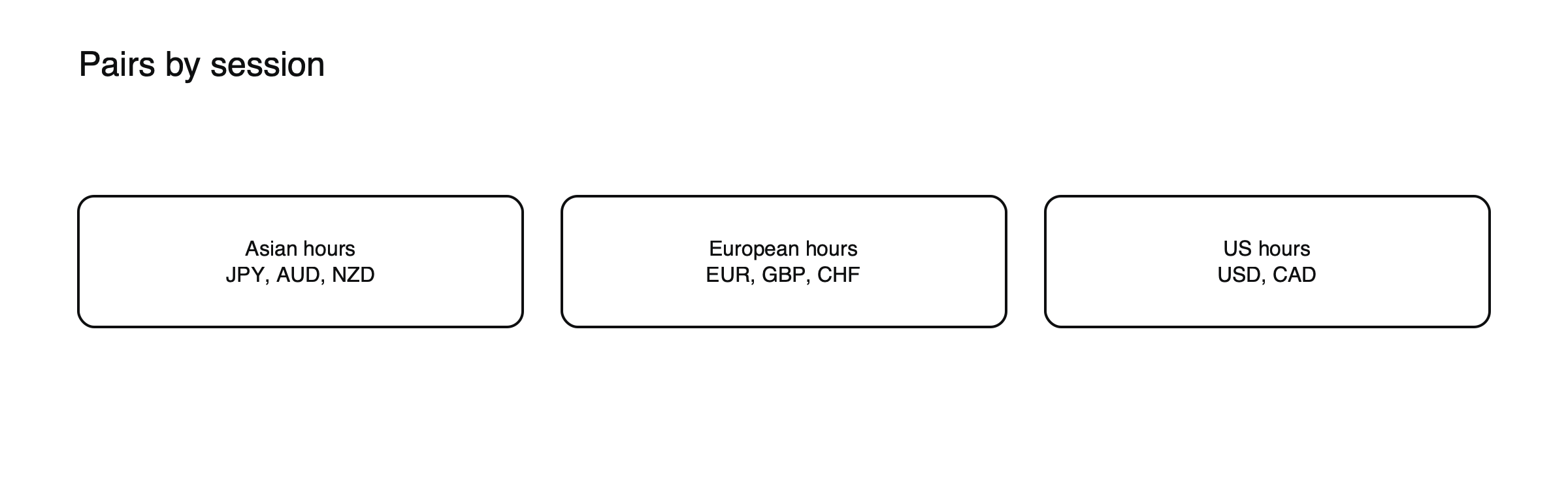
Figure: Matching pairs to the hours you trade.
Write down the times you can watch the market, in your own time zone.
Match them to sessions
- Asian hours: JPY, AUD and NZD pairs are most active.
- European hours: EUR, GBP and CHF pairs.
- US hours: USD and CAD pairs, especially during the overlap.
Prefer liquid pairs at first
Majors such as EUR/USD have the tightest spreads. See major, minor and exotic currency pairs.
Check volatility and costs
Make sure typical daily moves fit your stop sizes and that spreads are small relative to targets. See which currency pairs are the most volatile.
Avoid doubling up
Two pairs that move together add risk, not diversification. See how currency correlations work.
Test before committing
Trade small or on a demo for several weeks and review results.
Three trader profiles
| Trader | Available hours | Pairs that often fit |
|---|---|---|
| Office worker in Europe, trading early mornings and evenings | European open, US afternoon | EUR/USD, GBP/USD, EUR/GBP |
| Trader in Asia, trading after work | Late Asian and early European hours | USD/JPY, AUD/USD, EUR/JPY |
| Trader in North America, trading mornings | London–New York overlap | EUR/USD, USD/CAD, GBP/USD |
(Illustrative profiles.) The point is not the exact list but the match between the hours you are actually present and the hours your pairs are active.
Cost compared with the typical move
A useful test is to divide a pair’s usual spread by its average daily range. EUR/USD with a 0.8-pip spread and an 80-pip range gives about 1%; GBP/JPY with a 2.5-pip spread and a 150-pip range about 1.7%; an exotic pair with a 100-pip spread and a 1,200-pip range about 8%. (Illustrative figures.) The higher the ratio, the more of each day’s movement goes to costs, which matters most for short-term strategies.
When each pair’s news arrives
Every pair has its own important releases. Australian and Japanese data usually arrive during Asian hours, European data in the European morning and US data in the US morning. Choosing pairs whose key releases fall when you are awake and able to manage positions avoids waking up to a large move you could not react to. See how to read an economic calendar.
How many pairs to follow
Most traders do better following a handful of pairs well than many superficially. Two to four pairs are enough to learn their typical behavior, the releases that move them and how they react to news. Adding pairs later is easy; unlearning bad habits from spreading attention too thin is harder.
Matching pairs to your approach
Short-term traders benefit most from tight spreads and steady liquidity, which points to majors during their busiest hours. Traders who hold positions for days or weeks care more about trends and rollover, so the interest rate gap between the two currencies matters. Traders following economic themes may prefer pairs that isolate the two economies they have a view on, such as EUR/GBP.
Common mistakes
Trading exotic pairs for their big moves without accounting for spreads, or trading pairs whose key data releases fall while you are asleep. See how the forex market works.
Reviewing your choice
After a month or two, compare results by pair in your trading journal. If one pair consistently costs more in spreads, produces more stopped-out trades or moves mostly while you are away, it may not suit your schedule after all. Replacing it is a normal part of refining a plan. See how to keep a trading journal.
A shortlist, worked through
Suppose a trader in central Europe can trade only between 7 p.m. and 10 p.m. local time on weekdays. (Illustrative example.) Those hours fall in the US afternoon, after London has closed, when EUR/USD and GBP/USD are still liquid but quieter than in the morning, and before the Asian session gets going. US data have usually already been released, and most European news is out of the way. A sensible shortlist might be EUR/USD and USD/CAD, with tight spreads and North American news already digested, while avoiding AUD/USD and USD/JPY, whose important Asian releases would arrive after the trader has stopped for the night. The choice comes from the clock, not from which pair seems most exciting.
Fit with your account size
Pairs with very wide daily ranges need wider stops, which forces smaller positions for the same risk. On a small account, sizing a GBP/JPY or exotic trade correctly may mean a position close to the broker’s minimum, leaving no room to adjust. Calmer major pairs allow more flexible sizing. Choosing pairs whose typical moves fit comfortably within your risk per trade makes good habits easier to keep. See how to calculate forex position size.
Rollover and holding periods
If you plan to hold positions overnight or for days, the interest rate gap between the two currencies matters. Some pairs pay rollover in one direction and charge it in the other, and the amounts can be large on high-yielding currencies. Checking long and short swap values before choosing pairs for longer holds avoids a slow drain on results. See what forex rollover is.
Leverage limits by pair
Under EU retail rules, pairs made up of two of the six main currencies carry a 30:1 cap, while others, including Australian dollar pairs and exotics, are capped at 20:1. Lower caps mean more margin per position, which affects how many positions an account can carry. Checking the caps for your shortlist helps plan margin use. See major, minor and exotic currency pairs.
Signs a pair does not suit you
- Most of its big moves happen while you are asleep or at work.
- Its spread is a large share of your typical target.
- You rarely understand why it moved.
- Your results on it lag your other pairs over a meaningful number of trades.
Testing a shortlist
Before committing, trade the shortlist on a demo account or with very small positions for four to six weeks during your real available hours. Record the spread paid on each trade, how far each pair typically moved while you were watching and how often important news arrived when you could not react. At the end, compare the pairs: one may turn out to be quiet during your hours, another expensive relative to its moves. Dropping a pair at this stage costs little; discovering the mismatch after months of live trading costs far more. Keeping notes in the same format for each pair, such as the spread paid, the range during your hours and the number of trades taken, makes the comparison quick and objective once the test period ends. A pair failing the test can be replaced.
Frequently asked questions
Which pair is best for beginners?
Many start with EUR/USD because of its tight spreads, deep liquidity and wealth of information, but the best choice also depends on when you can trade.
Should I trade the same pairs every day?
Consistency helps, because you learn how those pairs behave. Changing pairs often makes it harder to judge what is working.
This article is educational content and does not constitute financial, investment, legal or tax advice. Digital assets are volatile and you may lose the amount you invest.