
Forex Trading Sessions and When Each Market Is Busiest
The forex day runs through Sydney, Tokyo, London and New York. When each is active, why the London–New York overlap is busiest and how sessions affect spreads.
Forex trading sessions follow the business day around the world: Sydney and Tokyo, then London, then New York, from about 5 p.m. New York time on Sunday to 5 p.m. on Friday. It is busiest when London and New York overlap, roughly 8 a.m. to noon New York time, with the deepest liquidity and tightest spreads.
The four sessions (approximate, New York time)
| Session | Opens | Character |
|---|---|---|
| Sydney | 5 p.m. | Starts the week; quieter |
| Tokyo | 7 p.m. | Asia’s main hub; yen and Australian dollar active |
| London | 3 a.m. | World’s largest FX center; volume rises sharply |
| New York | 8 a.m. | US data and the dollar dominate |
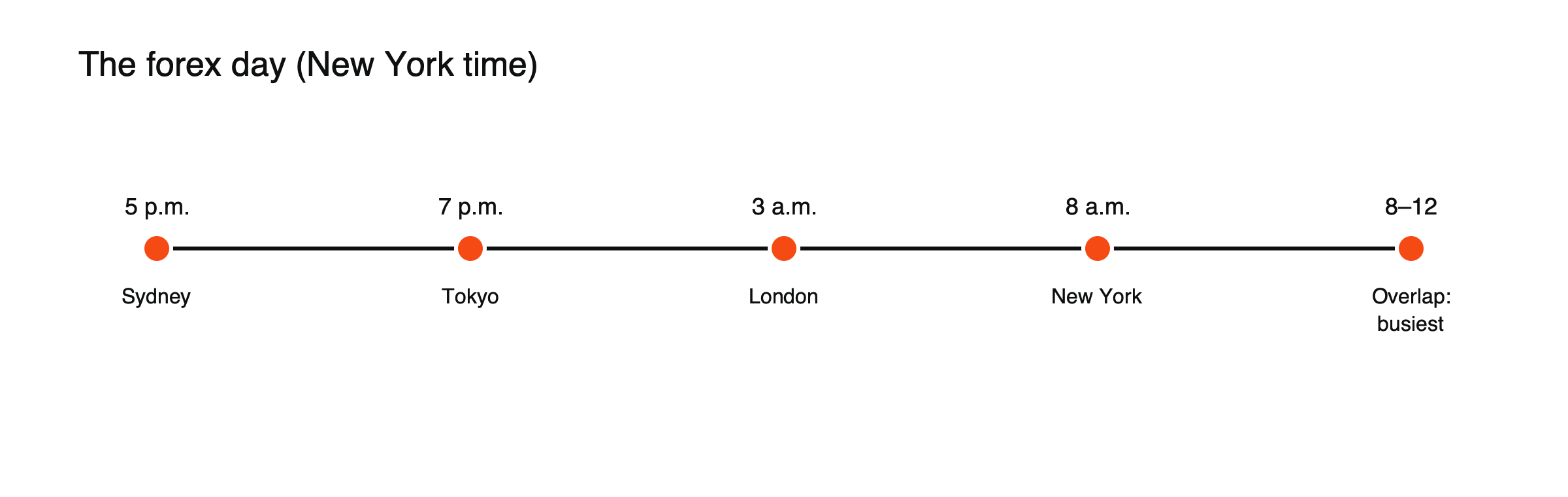
Figure: Session openings in New York time (shift with daylight saving).
Times shift with daylight saving changes in each region.
A trading day, hour by hour
Times below are approximate and in New York time. (Illustrative outline.)
- 5 p.m.: the trading day begins as Wellington and Sydney open; markets are thin and spreads wide.
- 7 p.m. to 3 a.m.: Tokyo leads, along with Singapore and Hong Kong. Yen, Australian and New Zealand dollar pairs are most active; Japanese and Australian data come out.
- 3 a.m.: London opens, and volume jumps across almost all pairs. European data and central bank decisions often arrive in the following hours.
- 8 a.m. to noon: New York and London overlap. Major US data, often released at 8:30 a.m., can move the dollar sharply.
- Noon to 5 p.m.: London closes, activity fades, and the market drifts toward the daily rollover.
The London–New York overlap
From about 8 a.m. to noon New York time, both major centers trade at once. The UK alone accounted for 38% of global FX turnover in April 2025, and the US is the second-largest center, so this window brings the highest volume, tightest spreads and often the biggest moves, especially around US data releases.
Quieter periods
Late New York afternoon and the early Asian session are thinner. Spreads can widen and prices can jump on small orders. Around 5 p.m. New York time, when daily rollover occurs, spreads often widen briefly. See what forex rollover is.
Daylight saving shifts
The United States and Europe change their clocks on different dates, usually a few weeks apart in spring and autumn, and Australia’s seasons run the other way. For a few weeks each year, session openings move by an hour relative to each other, and data release times shift for traders in other time zones. Checking session times against your own clock after each change avoids being caught by an event an hour earlier than expected.
Which pairs move when
- Asian session: JPY, AUD and NZD pairs.
- European session: EUR, GBP and CHF pairs.
- US session: USD and CAD pairs.
Why it matters
The time you trade affects your costs and how much a pair typically moves. See how much the spread costs on a forex trade and how the forex market works.
How much pairs move in each session
A pair’s range tends to be smallest when its home markets are closed and largest when they are open or overlapping. EUR/USD often moves less in the Asian session than in London and New York hours, while USD/JPY can see significant moves in Tokyo hours too. Breakouts that happen in quiet sessions are more likely to reverse once the larger centers open, which is why many traders wait for London or New York activity before acting on them.
Weekends and holidays
The market closes from Friday evening to Sunday evening, New York time. Prices can reopen at a different level after weekend news. On public holidays in one major center, such as a US holiday, volume drops and spreads widen even though other centers trade. See why prices gap over weekends.
Choosing when to trade
Most traders cannot watch the market around the clock, so it helps to match the pairs you trade to the hours you are available. Someone in Europe trading in the morning is well placed for EUR, GBP and CHF pairs; someone in Asia may focus on JPY, AUD and NZD pairs. Trading during a pair’s active hours usually means tighter spreads and more reliable price movement, while trading it in its quiet hours means higher costs and more random moves.
When central banks announce
Major central bank decisions arrive at fairly predictable times. The Federal Reserve usually releases its decisions in the New York afternoon, the European Central Bank and Bank of England during European hours, and the Bank of Japan and Reserve Bank of Australia during Asian hours. The session in which a decision lands is when its currency is most likely to make a large, sudden move. See how central bank decisions move currencies.
Session ranges, illustrated
Suppose EUR/USD moves within a range of about 25 pips during the Asian session, then breaks out and travels 60 pips after London opens. (Illustrative figures.) A stop placed just outside the Asian range might be fine for a trade during Asian hours but would be hit easily once Europe arrives. Matching stop distances to the session you are trading in reduces the chance of being stopped out by the normal increase in activity.
Building a routine around sessions
A simple routine starts with knowing which sessions you can actually trade, checking the economic calendar for releases in those hours and deciding in advance whether to avoid them or trade around them. Reviewing open positions before the session in which their currencies are most active, and before the quiet hours around rollover, keeps surprises to a minimum.
Session times from London
For a trader in the UK, the trading day begins at about 10 p.m., when the new day starts in New York terms. London opens around 8 a.m. local time, and major US data released at 8:30 a.m. in New York usually arrives at 1:30 p.m. in London, except in the weeks when the two countries’ clock changes are out of step. The busy London–New York overlap falls in the UK afternoon. Translating session times into your own time zone, and writing them down, makes it much easier to plan around them. Many traders keep a simple table listing the sessions, the main data release times and the pairs they watch in each, updated promptly whenever clocks change in any of the regions involved.
Frequently asked questions
Is there a best time to trade forex?
For most major pairs, the London session and the London–New York overlap offer the highest liquidity and tightest spreads. The best time for an individual trader also depends on the pairs and their schedule.
Why are spreads wide on Sunday evenings?
Because only a few centers are open as the week begins, liquidity is thin, and prices may adjust to weekend news.
This article is educational content and does not constitute financial, investment, legal or tax advice. Digital assets are volatile and you may lose the amount you invest.
Sources
- Forex market trading sessions (Sydney 5 p.m., Tokyo 7 p.m., London 3 a.m., New York 8 a.m. EST; daylight saving shifts) — Axiory
- Forex trading hours (London–New York overlap 8 a.m. to noon EST; Sunday to Friday 5 p.m.) — Benzinga
- Global FX trading hits $9.6 trillion per day (UK 38% of turnover) — BIS, September 2025
- Forex 24/5 trading (narrower spreads in the overlap; 21:00 UTC rollover) — Capital.com