
What Is a Crypto CFD?
A crypto CFD tracks a cryptocurrency's price without owning coins or a wallet. How it works, leverage limits, costs, regulation and why its risks are high.
A crypto CFD tracks the price of a cryptocurrency such as bitcoin or ether, so you gain or lose from price moves without owning coins or a wallet, long or short, on margin. Because crypto is so volatile, regulators restrict these products: EU retail leverage is capped at 2:1, and the UK has banned them for retail clients since 2021.
How it works
- Choose a coin and a direction.
- Choose a size, for example 0.1 bitcoin.
- Post margin, at least 50% of position value at 2:1 in the EU.
- Close to realize the price difference in cash.
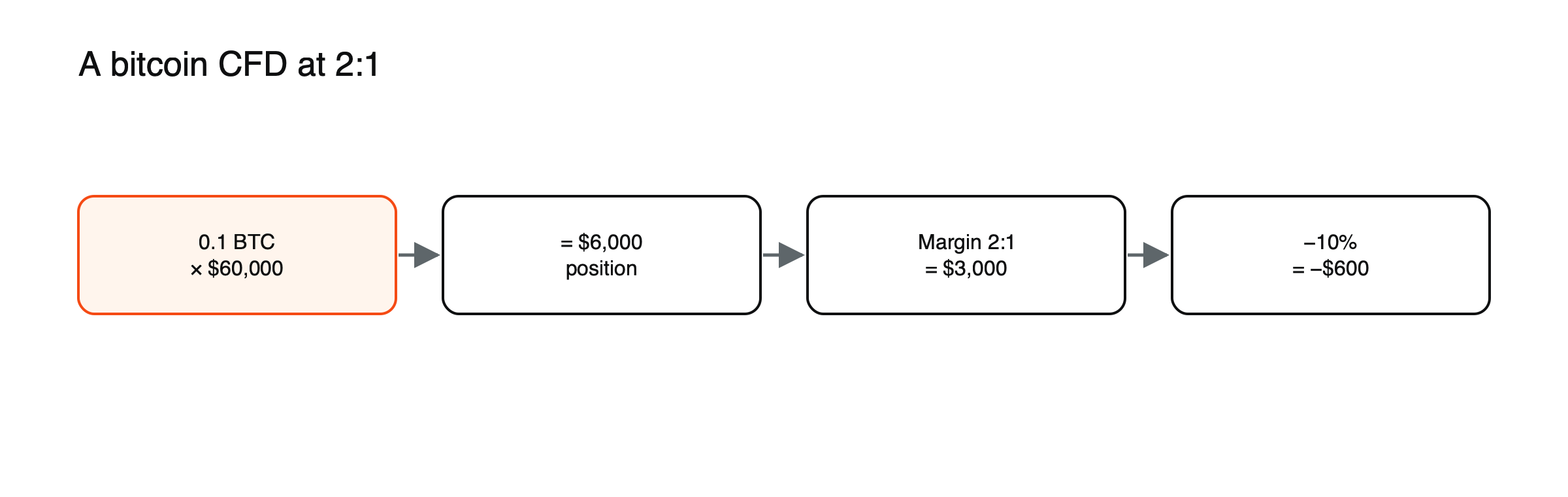
Figure: A bitcoin CFD trade at 2:1 (example values).
Example: 0.1 BTC at $60,000 = $6,000 position; at 2:1, margin is $3,000. A 10% fall loses $600. (Example values.)
Which cryptocurrencies are offered
Most providers offer CFDs on bitcoin and ether, and many add other large coins such as XRP, Solana, Cardano or Litecoin, plus sometimes baskets or indices of several coins. Smaller coins usually come with wider spreads, higher margins and more limited trading hours, because their markets are thinner and more volatile. Availability differs by provider and by country. See what a crypto index CFD is.
A full trade, worked through
A trader with a $4,000 account buys 0.1 BTC at $60,000 through a CFD, a $6,000 position. At the EU retail limit of 2:1, margin is $3,000. The spread is an illustrative $60, or $6 on this size. The position is held for 30 days with financing at an illustrative 8% a year, about $39. Bitcoin rises to $66,000, a gain of $600; after the spread and financing, the net is about $555. Had bitcoin fallen 10% instead, the loss would have been about $645. (Illustrative figures.)
Going short
Crypto CFDs make it as easy to sell as to buy. A trader expecting a fall sells 0.1 BTC at $60,000 and gains if the price drops, without borrowing coins or using a derivatives exchange. Shorts carry the same leverage limits and financing charges, sometimes at different rates from longs, and losses grow without a ceiling if the price rises. See how shorting bitcoin with CFDs works.
What you don’t get
No coins, no ability to transfer or use them, no staking rewards and no on-chain ownership. See crypto CFDs vs buying crypto.
Rules differ by country
Crypto CFDs are among the most tightly regulated leveraged products. In the EU, retail clients are limited to 2:1 leverage, a 50% margin, with positions closed when equity falls to half the required margin, and negative balance protection so losses cannot exceed the account. In the UK, the Financial Conduct Authority banned the sale of crypto derivatives, including CFDs, to retail clients from January 6, 2021. Other jurisdictions apply their own rules, and some providers do not offer crypto CFDs at all. Professional clients may face different limits. See how retail protections apply to crypto CFDs.
Costs
Spreads, which can widen at weekends and in volatile periods, and overnight financing on positions held. See how much it costs to hold a bitcoin CFD for a month.
Margin close-out, worked through
With $3,000 in the account and the 0.1 BTC position above, margin is $3,000, and positions are closed when equity falls to half of that, $1,500. That takes a loss of $1,500, a fall of 25% to about $45,000. Bitcoin has fallen that much within days on several occasions. Holding extra funds in the account, or trading a smaller size, leaves more room. See how margin and volatility interact on crypto CFDs.
Key risks
- Volatility: double-digit daily moves happen.
- Gaps and fast markets that skip stops.
- Regulatory limits that differ by country; availability depends on where you live.
See how bitcoin CFD prices track the spot market, what a CFD is and what cryptocurrency is.
Volatility in practice
Bitcoin’s daily moves of 5% or more are common, and smaller coins can move far more. Sudden crashes can be severe: on October 10, 2025, more than $19 billion of leveraged crypto positions were wiped out in a single sell-off, and prices on different venues diverged sharply for a time. Leverage magnifies these swings, which is why regulators set lower limits for crypto than for any other asset class.
Weekends and trading hours
Crypto markets trade every day, around the clock, but providers set their own hours for CFDs. Some quote prices at weekends with wider spreads; others close or reduce trading during maintenance. Prices can move sharply while stock and currency markets are shut. See what changes when you trade crypto CFDs on weekends.
Crypto CFDs, futures and ETFs compared
| Crypto CFD | Crypto futures | Bitcoin ETF | |
|---|---|---|---|
| Ownership of coins | No | No | No, but fund holds coins |
| Leverage | Up to 2:1 for EU retail | Varies by venue | None |
| Short selling | Straightforward | Straightforward | Difficult |
| Holding cost | Overnight financing | Funding or roll | Annual fee |
| Trading hours | Provider’s hours, often 24/7 | Venue’s hours | Stock exchange hours |
See bitcoin CFDs vs bitcoin ETFs and crypto CFDs vs crypto futures.
A checklist before a crypto CFD trade
- Is the product available to you, and what leverage applies?
- What does a 10% and a 25% adverse move cost?
- Where is the stop, and could a gap skip it?
- What are the spread and daily financing, including at weekends?
- Is there spare margin to survive normal volatility?
How crypto CFDs differ from stock and index CFDs
The mechanics are the same, but the conditions are not. Crypto trades around the clock, so prices can move sharply at weekends and overnight. Volatility is several times higher than for major indices, leverage limits are much lower and spreads are usually wider. There are no dividends, but financing rates on crypto CFDs are often higher than on stock or index CFDs. Some providers also apply different rules to crypto, such as limits on position size. See how stock index CFDs work for comparison.
Financing on crypto CFDs
Holding a crypto CFD overnight incurs a financing charge, usually calculated on the full position value. Many providers charge a fixed annual rate for crypto rather than a benchmark interest rate plus a markup, and the rate can differ for long and short positions. Because crypto trades seven days a week, financing usually applies every night, including weekends. Over weeks or months, these charges can add up to a meaningful share of the position. See how much it costs to hold a bitcoin CFD for a month.
Sizing a position from risk, worked through
A trader with a $10,000 account decides to risk 1%, $100, on a bitcoin trade, with a stop 5% below entry at $60,000. The position size is $100 ÷ 5% = $2,000, about 0.033 BTC. Margin at 2:1 is $1,000. If the stop is hit, the loss is about $100 plus costs; if bitcoin gaps through the stop, the loss could be larger. (Illustrative figures.) See how to size a crypto CFD position.
Financing compared with funding rates
On crypto exchanges, perpetual futures use funding payments between longs and shorts, which can change every few hours and sometimes reverse direction. Crypto CFDs instead charge overnight financing set by the provider. The two are often confused, but they work differently and can produce very different costs. See funding rates vs overnight financing.
Stop-outs and liquidations
On crypto exchanges, leveraged positions are liquidated automatically when collateral falls below a threshold. CFD accounts are closed out under the provider’s margin rules, with EU retail clients protected against negative balances. The triggers and consequences differ. See stop-outs vs liquidations.
Who crypto CFDs suit
Crypto CFDs suit traders who want short-term exposure, the ability to go short or a way to hedge existing holdings without moving coins. They suit long-term investors less well, because financing builds up over time and there are no ownership benefits. Anyone using them needs to be comfortable with high volatility and strict risk control.
Common mistakes
Frequent mistakes include using the maximum leverage available, placing stops too close for crypto’s volatility, ignoring weekend moves and financing, and treating a CFD as if it were ownership of coins. See mistakes traders make with crypto CFDs.
Altcoins and baskets
CFDs on smaller coins typically move even more than bitcoin and have wider spreads, so the same position size carries more risk. Crypto index CFDs, which track a basket of several coins, spread some of that risk across coins but remain highly volatile. See why altcoin CFDs are more volatile than bitcoin.
Choosing a provider
Checking that the provider is authorized in your country, offers crypto CFDs to your client category, explains its price sources, spreads and financing clearly and states how it handles exchange outages and weekend trading helps avoid surprises. Negative balance protection and segregated client money are important safeguards. See how to compare crypto CFD spreads.
Records and taxes
Keeping records of every trade, including financing charges, helps with tax reporting, which varies by country. Gains and losses on CFDs may be treated differently from those on directly held crypto, so checking local rules matters before trading.
Practicing first
Many providers offer demo accounts with virtual money. Practicing crypto CFD trades there, including weekend moves, wide spreads and margin close-outs, shows how positions behave before real money is at risk. Demo results tend to flatter, because there is no emotional pressure and fills may be smoother than in live markets, but they are a useful way to learn the mechanics and test a trading plan under realistic volatility. Moving to live trading with a small size, and increasing it only gradually, extends the lesson into real conditions.
Frequently asked questions
Can I lose more than my deposit?
EU retail clients have negative balance protection, so losses on the account cannot exceed its balance. Elsewhere, check the provider’s rules.
Why is leverage so low on crypto?
Because crypto prices are far more volatile than most other assets. EU rules cap retail leverage at 2:1, the lowest of any asset class.
Do I need a crypto wallet?
No. A crypto CFD is a contract with the provider, settled in cash, so no wallet or coins are involved.
Leverage, margin and cost figures in this article are example values for illustration. Actual terms depend on the provider, the instrument and the rules in your country.
This article is educational content and does not constitute financial, investment, legal or tax advice. Digital assets are volatile and you may lose the amount you invest.
Sources
- ESMA adopts CFD measures (2:1 for cryptocurrencies; 50% margin close-out; negative balance protection) — Finadium
- FCA bans the sale of crypto-derivatives to retail consumers (effective January 6, 2021; covers crypto CFDs, futures, options and ETNs) — FCA
- DeFi TVL drops 39% in 2026 (October 10, 2025 crash erased more than $19 billion in leveraged positions) — Cointelegraph, June 2026
- Ethena under pressure (prices diverged sharply between venues during the October 2025 crash) — Kaiko via Brainsum, December 2025