
How Crypto CFD Contract Sizes Work
Crypto CFDs are sized in coins or fractions, so position value = coins × price. How contract and lot sizes work, with a worked bitcoin example.
Crypto CFD contract sizes are usually set in coins or fractions of a coin, so position value is coins times price. Many providers allow small fractions, such as 0.01 bitcoin, which matters when one coin costs tens of thousands of dollars. At $60,000, 0.05 BTC is a $3,000 position needing $1,500 of margin at 2:1.
How sizes are defined
- Per coin: 1 contract = 1 coin, tradable in fractions.
- Per lot: a provider-defined lot, such as 1 lot = 1 BTC or 10 ETH; check the contract specification.
- Minimum size: often a small fraction of a coin.
See how to read a commodity contract specification for the same checks.
Worked example
- Bitcoin at $60,000 (example price)
- Size: 0.05 BTC → position $3,000
- Margin at 2:1: $1,500
- A $1,000 move in bitcoin changes the position by $50
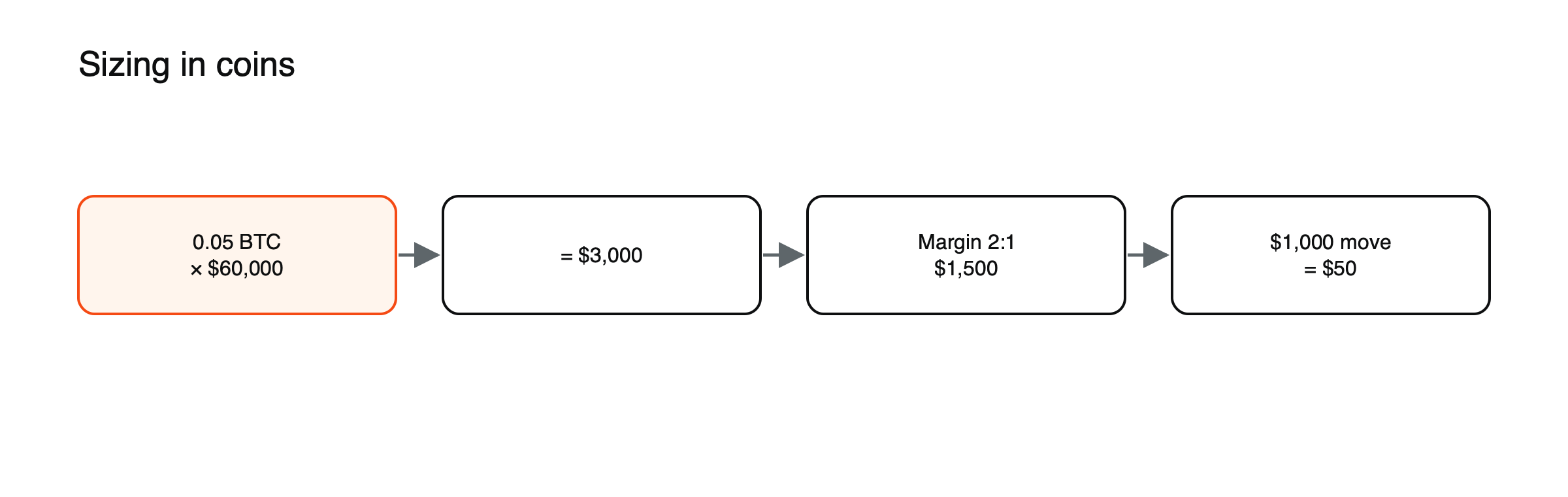
Figure: Size in coins (example values).
Sizes across coins, illustrated
| Coin | Example price | Example size | Position value | Margin at 2:1 |
|---|---|---|---|---|
| Bitcoin | $60,000 | 0.05 BTC | $3,000 | $1,500 |
| Ether | $3,000 | 1 ETH | $3,000 | $1,500 |
| Solana | $150 | 20 SOL | $3,000 | $1,500 |
(Illustrative prices.) The same $3,000 position needs very different numbers of coins. Thinking in position value, rather than in coins or lots, makes positions in different coins comparable.
From risk to size, worked through
A trader with a $10,000 account wants to risk $200 on an ether trade with a stop 6% below entry at $3,000. The position value is $200 ÷ 6%, about $3,333, which is about 1.11 ETH. If the provider’s minimum step is 0.01 ETH, the trader can open 1.11 ETH exactly. With coarser steps, the size would be rounded down to stay within the risk limit. (Illustrative figures.)
Why small sizes matter
Crypto moves 5% or more in a day in volatile periods. On a $3,000 position, a 10% move is $300. Fractional sizes let you keep risk per trade in proportion to your account. See how to size a crypto CFD position for high volatility.
Common confusion
- Lots differ by coin and provider: one lot of bitcoin is not the same as one lot of ether.
- Value changes with price: the same size is a bigger position after a rally.
See what a crypto CFD is.
Lots and coins, a common mix-up
Suppose a provider defines one ether lot as 10 ETH, while the trader assumes a lot is one coin. Opening “1 lot” at $3,000 creates a $30,000 position instead of $3,000, needing $15,000 of margin and moving $300 for every $30 change in ether’s price. Checking the contract specification before the first trade avoids this ten-fold error. (Illustrative figures.)
Minimum and maximum sizes
Providers set minimum sizes, which determine how small a position can be, and maximum sizes, which limit how large a single order or total position can be. Small coins may have higher minimums in coin terms but low values, while very large orders may be split or rejected in thin markets.
Size and margin change with price
Because position value is coins times price, a position grows when the price rises. A 0.05 BTC position opened at $60,000 is worth $3,000; if bitcoin rises to $80,000, it is worth $4,000 and needs $2,000 of margin at 2:1. Gains help equity, but traders adding to positions after rallies should recheck total exposure.
Checklist: contract specification
- What does one contract or lot represent?
- What are the minimum size and step size?
- Is there a maximum position size?
- In which currency is the CFD priced?
- What margin and financing rates apply?
Position value versus margin
The position value, coins times price, is what moves with the market; the margin is only the deposit required to hold it. A 0.05 BTC position at $60,000 has a value of $3,000 and needs $1,500 of margin at 2:1, but a 10% move changes its value by $300, not $150. Profit, loss and financing are all calculated on the position value. Sizing by margin rather than by value is one of the most common ways to take on more risk than intended.
Size and the spread cost, illustrated
If the spread on bitcoin is $60, a 0.05 BTC position starts about $3 behind; a 0.5 BTC position starts about $30 behind. (Illustrative figures.) The spread cost grows in proportion to size, so traders who trade often in large sizes pay much more in spreads over time. Checking the spread in money at your usual size, especially at weekends when it may widen, shows the true cost of each trade.
Building a position in steps
Small minimum sizes let traders build positions gradually, for example opening 0.02 BTC, adding 0.02 BTC if the trade moves favorably and adding again later. Each addition changes the total size and the average entry price, so recalculating the money at risk to the stop after each step keeps the overall risk within the plan.
Size and weekend risk
Because crypto trades at weekends, often with thinner liquidity, positions held over Saturday and Sunday face sharp moves while many traders are away from their screens. Some reduce size before weekends, accepting smaller gains in exchange for lower exposure to unexpected moves.
Accounts in other currencies
Most crypto CFDs are priced in dollars. For an account in euros or another currency, profits, losses and margin are converted at the current exchange rate, adding a small currency effect to every trade.
Common misreadings
- Treating margin as the size of the position.
- Assuming one lot means one coin for every coin.
Size across several coins
Bitcoin, ether and most other large coins tend to move together, especially in sell-offs. Positions of $3,000 in each of three coins therefore behave more like one $9,000 position than three separate bets. Sizing each position on its own, without adding up correlated exposure, can leave an account far more exposed to a crypto-wide fall than intended. See why altcoin CFDs are more volatile than bitcoin.
A size check before every trade
Before opening a crypto CFD, convert the size into position value, check the margin it needs, calculate the loss if the stop is hit and the loss if the price gaps twice as far, and add the new position to existing crypto exposure. These steps take a minute and catch most sizing errors before they cost money.
Size limits on smaller coins
For smaller coins, providers often set lower maximum position sizes and higher margins, because their markets are thinner and prices can move sharply on modest orders. A size that is easy to trade in bitcoin may be difficult to exit quickly in a small coin without moving the price. Checking the maximum size and typical spread before trading a small coin avoids being stuck in a position.
Frequently asked questions
Can I trade less than one bitcoin?
Yes. Most providers allow fractions such as 0.01 BTC or smaller.
Why does my position value change even when I do nothing?
Because position value moves with the coin’s price.
Leverage, margin and cost figures in this article are example values for illustration. Actual terms depend on the provider, the instrument and the rules in your country.
This article is educational content and does not constitute financial, investment, legal or tax advice. Digital assets are volatile and you may lose the amount you invest.