
What Retail Protections Apply to Crypto CFDs?
Retail crypto CFDs in the EU and Australia come with 2:1 leverage, 50% margin close-out, negative balance protection, risk warnings and an inducement ban.
Retail protections for crypto CFDs in the EU and Australia include a 2:1 leverage cap, automatic margin close-out when equity falls to 50% of the required margin, negative balance protection so losses cannot exceed the account, standardized risk warnings and a ban on bonuses or gifts that encourage trading. In the UK, retail clients cannot buy crypto CFDs at all.
The main protections
| Protection | What it does |
|---|---|
| 2:1 leverage cap | Limits position size relative to deposits |
| 50% margin close-out | Closes positions before most of the money is lost |
| Negative balance protection | Caps total losses at the account balance |
| Risk warnings | Disclose the share of retail accounts that lose money |
| Inducement ban | Prohibits trading credits, rebates and gifts |
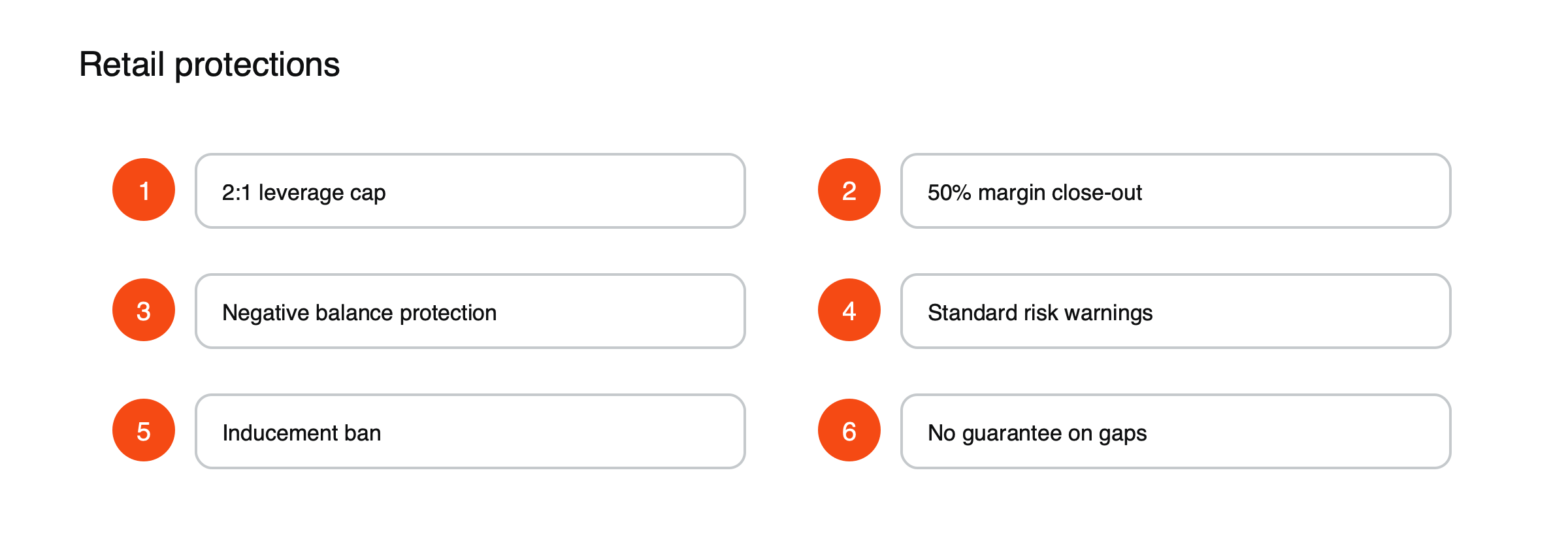
Figure: Retail protections in the EU and Australia.
The close-out rule, illustrated
A trader holds $4,000 of equity and a $6,000 bitcoin CFD position needing $3,000 of margin. The provider must close the position when equity falls to half the margin requirement, $1,500, which happens after a loss of $2,500, a fall of about 42% in bitcoin. Without the rule, the trader could keep losing until the account was empty. The rule cannot guarantee the exit price: if bitcoin gaps, the close happens at the first available price. (Illustrative figures.)
Negative balance protection, illustrated
Suppose a severe gap takes a position’s loss beyond the account balance, for example a $4,000 account losing $4,600 before the position can be closed. Under negative balance protection, the provider absorbs the extra $600, and the client loses no more than the $4,000 deposited. Without it, the client would owe the provider $600. (Illustrative figures.)
Why they were introduced
Regulators found that most retail CFD accounts lose money; EU studies put the share at 74% to 89%. In Australia, retail clients of 13 CFD issuers lost more than $774 million in five weeks in March and April 2020.
What the protections don’t do
They do not prevent losses, guarantee stop prices or protect against the provider failing. Gaps can still close positions well below the close-out level. See what negative balance protection is.
Professional clients. Clients classified as professional can trade with fewer protections; make sure you understand what you give up. See how leverage limits work for crypto CFDs and what a crypto CFD is.
How the rules came about
ESMA, the EU securities regulator, introduced temporary measures on CFDs in 2018, using new product intervention powers. National regulators in EU countries later adopted permanent rules along similar lines. Australia’s regulator, ASIC, introduced comparable rules from March 29, 2021, while the UK went further for crypto, banning the sale of crypto derivatives to retail clients from January 6, 2021.
The risk warning
Providers must display a warning stating the percentage of their retail client accounts that lose money on CFDs, updated regularly. The figures, often between about 70% and 80%, are a reminder of how difficult leveraged trading is. Comparing warnings across providers says more about their client base than about the provider’s quality, but the message is the same.
No bonuses or gifts
The ban on inducements means providers cannot offer trading credits, deposit bonuses or gifts to encourage retail clients to trade. Such incentives had been linked to excessive trading and larger losses. Offers of this kind from a provider claiming to serve EU or Australian retail clients are a warning sign.
Becoming a professional client
Clients who meet tests on trading experience, portfolio size and professional background can ask to be treated as professional, giving up some protections in exchange for higher leverage. The choice should be made deliberately, understanding that negative balance protection and the standardized close-out may no longer apply. See how leverage limits work for crypto CFDs.
Checking a provider
Confirm that the provider is authorized by a recognized regulator for your country, that client money is held in segregated accounts and that the risk warning and leverage limits match the rules where you live. See what client money segregation is.
Before the rules
Before the EU measures, some providers offered retail clients leverage of 100:1 or more on currencies and high leverage on crypto, often promoted with deposit bonuses. Many clients lost more than they deposited and ended up owing money to providers after sharp market moves. Regulators concluded that these products were being sold to people who did not understand the risks, and that limits were needed.
The protections in a crash, illustrated
Suppose bitcoin falls 30% over a weekend. (Illustrative scenario.) A retail client holding a 2:1 position with only the required margin would be closed out around a 25% fall, losing most of the margin but no more. A client with spare cash might survive the move. Without leverage limits, a client at 10:1 would have lost the entire margin after a 10% fall, and without negative balance protection, could have owed money after the gap. The rules did not prevent losses, but they capped how bad the outcome could be.
The limits of negative balance protection
Negative balance protection applies to the account as a whole, so losses on one position can consume money held for others. It does not refund losses up to zero, guarantee any particular exit price or protect against the provider’s failure. It covers retail clients only, and only where the rules apply.
If something goes wrong
Clients of regulated providers can usually complain to the provider and then to an independent ombudsman or dispute body. If a regulated provider fails, an investor compensation scheme may cover client money up to set limits, depending on the country. Knowing which bodies apply before trading is part of choosing a provider.
Common misreadings
- Believing the close-out level is a guaranteed exit price.
- Assuming protections follow you to any provider.
Retail and professional treatment compared
| Protection | Retail client | Professional client |
|---|---|---|
| Leverage cap on crypto | 2:1 | Set by provider, often higher |
| Standardized 50% close-out | Yes | Not required |
| Negative balance protection | Yes | Not required |
| Risk warnings | Yes | Fewer requirements |
| Ban on inducements | Yes | Not required |
(General EU framework; details vary by provider and country.)
Questions to ask a provider
Which regulator authorizes it, and does that authorization cover clients in your country? Does it apply retail protections to your account? How are client funds held? What happens if a price gaps through the close-out level? Is there a compensation scheme, and what are its limits? Clear answers to these questions, ideally in the provider’s published documents, show whether the protections described in rules actually apply to you.
Protections and weekend gaps
Crypto trades at weekends, but some providers reduce or pause trading then. If bitcoin moves sharply while a provider is not quoting, positions are closed at the first available price when trading resumes, which may be well beyond the close-out level. Negative balance protection still caps the loss at the account balance, but the close-out rule cannot ensure an exit near the intended level. Checking a provider’s weekend hours before holding positions over Saturday and Sunday shows whether this risk applies, and how large a position is sensible to carry then.
Frequently asked questions
Do these protections apply worldwide?
No. They apply where regulators have adopted them, such as the EU and Australia. Elsewhere, rules differ.
Do they make crypto CFDs safe?
No. They limit some of the worst outcomes, but losses can still be large.
This article is educational content and does not constitute financial, investment, legal or tax advice. Digital assets are volatile and you may lose the amount you invest.
Sources
- ESMA adopts CFD measures (2:1 for cryptocurrencies; 50% margin close-out; negative balance protection; risk warnings) — Finadium
- Read this before trading CFDs (2:1 for crypto-assets; margin close-out; negative balance protection; ban on inducements) — ASIC
- FCA bans the sale of crypto-derivatives to retail consumers (from January 6, 2021) — FCA