
How Earnings Reports Move Share Prices
Share prices react to earnings by comparing results and guidance with expectations. What investors look at, why gaps happen and how Meta lost $200 billion.
Earnings reports move share prices by comparing results and outlook with what investors expected. Beating on revenue and profit tends to lift a stock; misses or weak guidance push it down. Reports usually come outside trading hours, so shares often gap: Meta fell 26% the day after a weak forecast in 2022.
What investors look at
- Revenue and earnings per share against analyst estimates.
- Guidance for coming quarters, often the biggest driver. See what company guidance is.
- Margins and costs. See how to calculate gross, operating and net margin.
- Key business metrics, such as users, orders or subscribers.
- Management comments on the earnings call.
Why gaps happen
Most US companies report before the open or after the close. Overnight, investors reprice the stock, so it can open far from the last close, jumping past stop orders. See why prices gap over weekends.
Example: Meta, February 2022
Meta reported a rare profit decline and forecast weaker revenue, citing Apple’s privacy changes and competition. The stock fell 26.4% the next day, then the largest one-day loss of market value for a US company, and dragged other tech shares down.
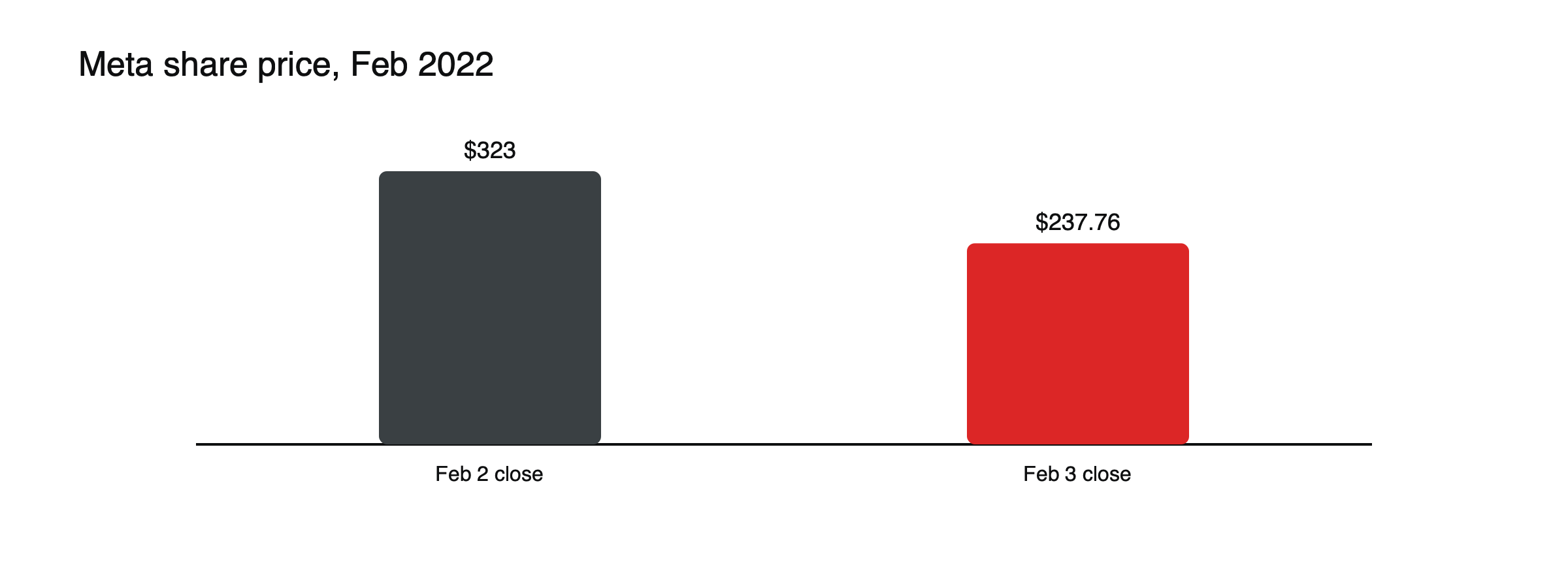
Figure: Meta’s one-day fall after its February 2022 report. Source: Benzinga.
Example: Nvidia, May 2023
The opposite reaction can be just as large. In May 2023, Nvidia beat forecasts for the quarter, reporting earnings of $1.09 a share against expectations of $0.92, but the bigger surprise was its outlook: it guided to about $11 billion of revenue for the next quarter, against an analyst consensus of about $7.2 billion. The shares jumped 24% the next day, and the report reshaped expectations for the whole artificial intelligence chip sector.
Example: Netflix, April 2022
Netflix reported that it had lost about 200,000 subscribers in the first quarter of 2022, its first decline in more than a decade, against its own forecast of a gain of 2.5 million, and predicted a further loss of about 2 million. The shares fell 35% the next day, wiping out about $54 billion of market value. For subscription businesses, the key operating metric can move the share more than profit.
Spillovers
One company’s results can move its peers: after the close the same day, Snap and Pinterest rose sharply on strong reports.
The reaction, step by step
| Stage | What happens |
|---|---|
| Release, before the open or after the close | Headline numbers trigger fast moves in thin extended-hours trading |
| Earnings call, usually within an hour or two | Guidance details and management’s answers can extend or reverse the move |
| Next regular session | Full liquidity; the share opens at a new level, often with a gap |
| Following days | Analysts revise forecasts and price targets; the move may continue or fade |
How large earnings moves are
The size of a typical earnings move varies by company. Large, stable companies often move a few percent; fast-growing or heavily traded shares can move 10% to 20% or more. Options prices before the report imply an expected move, which gives a market-based estimate of how big the reaction might be. Actual moves are often larger or smaller than implied, but the estimate helps size positions.
Drift after the report
Research has long found that shares with large earnings surprises tend to keep drifting in the direction of the surprise for weeks afterward, as investors and analysts gradually adjust. The effect is not reliable enough to trade blindly, but it explains why the first day’s move is not always the last word. See why stocks sometimes fall after beating earnings.
A gap in a CFD position, worked through
A trader holds 200 CFD shares at $100, a $20,000 exposure on $4,000 of margin, with a stop at $95. After a weak report, the shares open at $82. The stop fills at the opening price, so the loss is about $3,600, 90% of the margin, instead of the $1,000 the stop was meant to cap. With 50 shares, the same gap would have cost about $900. (Illustrative figures.)
Profit warnings
Companies sometimes release bad news before their scheduled report, in a profit warning or pre-announcement, usually when results will fall well short of expectations. Such warnings can trigger moves as large as earnings themselves, at times traders do not expect. Shares in the same sector often fall too.
What it means for traders
Earnings bring the biggest single-stock moves. Reduce size or close positions before reports if you cannot accept a gap. See mistakes traders make around earnings season and what moves stock prices.
Earnings season as a whole
Most large companies report within a few weeks of each quarter’s end. US banks usually report first, followed by industrial, consumer and technology companies. Early reports set the tone for their sectors, and investors use them to adjust expectations for peers that have not yet reported. A strong season can lift the whole market; a weak one can weigh on it.
The implied move, illustrated
Suppose a share trades at $100 and options expiring just after its report are priced so that buying both a call and a put at $100 costs about $7. The market is roughly expecting a move of about 7% in either direction. (Illustrative figures.) If the share moves only 3%, the reaction was smaller than expected; if it moves 15%, the surprise was much larger than the market had priced. Comparing the actual move with the implied one helps judge whether a reaction was unusual.
Read-across, illustrated
Suppose a large semiconductor company reports strong demand and raises guidance. Its suppliers, customers and competitors often move the same day, even though they have reported nothing, as investors infer what the news means for them. A weak report from a major retailer can likewise pull down other retailers. Traders holding shares in a sector should watch the reports of its largest companies as closely as their own.
Earnings and the indices
The largest companies carry big weights in major indices, so their results can move the whole market. A strong report from one of the biggest technology companies can lift a technology-heavy index on its own. Index CFD traders therefore follow the earnings calendar too. See how stock index CFDs work.
Common misreadings
- Judging results without knowing what was expected.
- Ignoring guidance and key metrics.
- Assuming the first move will hold.
Extended hours and CFDs
Shares react to after-hours reports in extended trading, but many CFD providers quote share CFDs only during regular exchange hours. In that case, a CFD position does not move until the next open, when it reflects the full overnight reaction in one step. Some providers offer extended-hours trading on major shares, often with wider spreads. Knowing which applies to your provider tells you whether you can react before the open or must accept the opening price.
News released alongside results
Companies often announce other news with their results: new buyback programs, dividend changes, acquisitions, job cuts or management changes. These can move the shares as much as the figures themselves. A large new buyback can soften the reaction to weak guidance, while the departure of a chief executive can overshadow a strong quarter. Reading the whole release, not only the results section, avoids missing them. Checking the full release and the call for such announcements takes a few minutes and often explains reactions that the headline figures cannot.
Frequently asked questions
Why do shares sometimes fall on good results?
Because the price may already reflect even better expectations, guidance may disappoint or details such as margins may be weak. See why stocks sometimes fall after beating earnings.
When do companies usually report?
Most US companies report shortly before the market opens or after it closes. Companies publish the date in advance on their investor relations websites.
Should I hold a position through earnings?
It depends on how much of a gap you can accept. Many traders reduce or close positions before reports and decide afterward.
This article is educational content and does not constitute financial, investment, legal or tax advice. Digital assets are volatile and you may lose the amount you invest.
Sources
- How Meta Platforms made history (closed $323, opened $244.65, closed $237.76: −26.4%) — Benzinga, February 2022
- Meta share price fall shakes world tech stocks (biggest single-day market value slide; Snap +52%, Pinterest +17% after hours) — The Financial Express / Reuters
- Why Meta shares nosedived (rare profit decline; weak revenue forecast; rising costs) — The Week
- Why Nvidia stock skyrocketed 239% in 2023 (Q2 revenue guidance of $11 billion vs $7.2 billion consensus; shares +24% on May 25, 2023) — The Motley Fool, January 2024
- Nvidia Q1 beat (EPS $1.09 vs $0.92 expected; revenue $7.19 billion vs $6.52 billion) — StreetBeat / Benzinga, May 2023
- Netflix shares fall 35% after revealing drop in streaming subscribers ($54 billion of market value; closed at $226.19; forecast loss of another 2 million subscribers) — Bloomberg via The Irish Times, April 2022
- Netflix suffers first loss in worldwide subscribers in its history (200,000 lost vs a forecast gain of 2.5 million) — AP, April 2022