
ETF Mistakes Beginners Make
An X-ray of one beginner's ETF portfolio reveals seven common mistakes, from overlapping funds and late themes to leveraged ETFs held too long, with fixes.
Common ETF mistakes are chasing popular thematic funds after they have rallied, holding leveraged or inverse ETFs for weeks or months, owning several ETFs that hold the same stocks, choosing only on fees without checking tracking, trading at the open, ignoring premiums to NAV and forgetting currency risk. An X-ray of one beginner’s portfolio shows how they stack up.
The portfolio under the X-ray
A new investor has built this $20,000 portfolio over a few months. (Hypothetical portfolio and figures.)
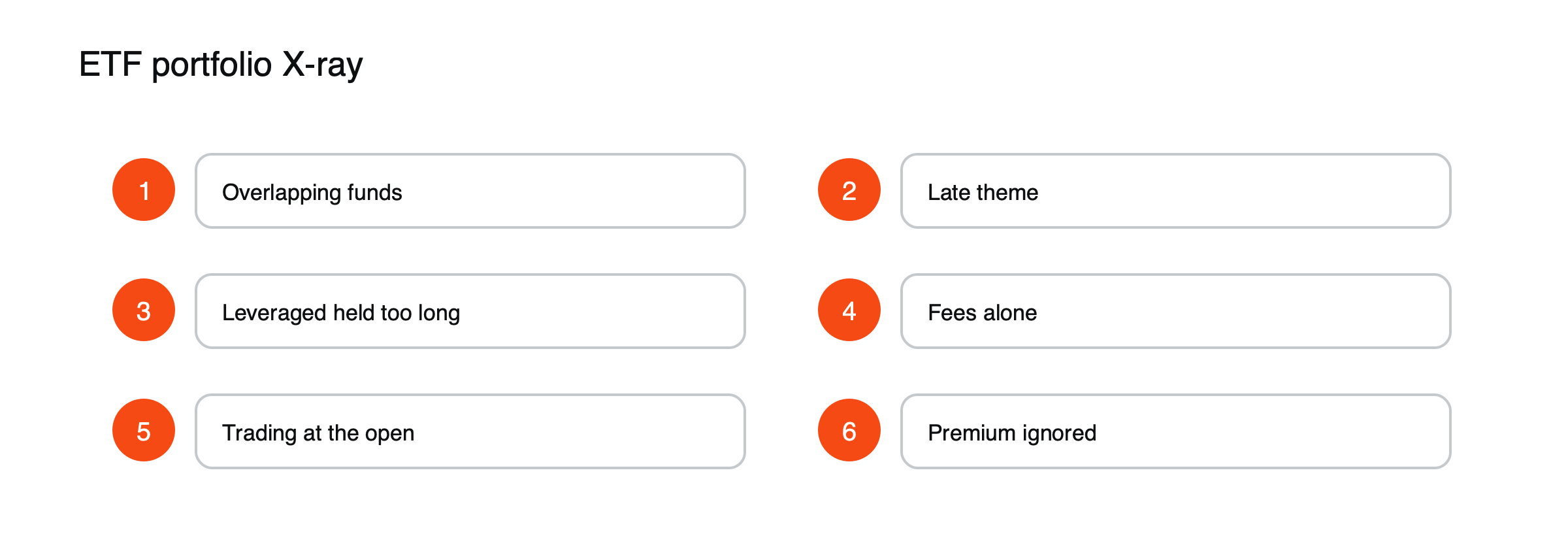
Figure: What the portfolio X-ray found.
| Holding | Amount | Fee a year |
|---|---|---|
| S&P 500 ETF | $6,000 | 0.0945% |
| Nasdaq 100 ETF | $4,000 | 0.20% |
| Artificial intelligence thematic ETF | $4,000 | 0.68% |
| 3x leveraged Nasdaq 100 ETF, held eight months | $3,000 | 0.95% |
| US corporate bond ETF, bought in euros | $3,000 | 0.15% |
On the surface it looks diversified: five funds, two asset classes, hundreds of underlying companies. Looking through each fund to what it actually holds, and at how it was bought, tells a different story. Each finding below is one common mistake.
Finding 1: the same companies, four times over
The S&P 500 ETF, the Nasdaq 100 ETF, the thematic fund and the leveraged fund all hold large weights in the same handful of technology giants. Suppose those companies are about 34% of the S&P 500 fund, 40% of the Nasdaq fund and 50% of the thematic fund, and the 3x fund carries three times the Nasdaq fund’s exposure. Their combined effective exposure comes to about $9,250, roughly 46% of the whole portfolio, in a few companies.
Mistake: ignoring overlap. Fix: compare the top holdings of every fund before buying, and add up exposure to the largest names across funds. See why a handful of stocks can drive an entire index.
Finding 2: a theme bought after the rally
The thematic fund was bought after artificial intelligence shares had already risen sharply and launched new funds at a record pace. It charges 0.68% a year, against 0.03% for some broad funds, and holds richly valued companies. Morningstar found that over 15 years more than three-quarters of thematic funds closed.
Mistake: chasing themes. Fix: check valuations, fees and overlap first, and keep any theme to a small, deliberate share of the portfolio. See what a thematic ETF is.
Finding 3: a daily product held for months
The 3x leveraged fund has been held for eight months through choppy markets. Even if the Nasdaq 100 ends roughly flat over a period of alternating moves, daily resetting erodes a 3x fund: ten days of alternating 3% moves leave the index down about 0.45% but a 3x fund down about 4%. Over months, the drag compounds.
Mistake: holding leveraged ETFs too long. Fix: use leveraged ETFs only for short periods, or not at all in a long-term portfolio. See how volatility decay erodes leveraged ETF returns.
Finding 4: the cheapest fund was not the best fund
For the Nasdaq exposure, the investor picked the fund with the lowest headline fee among several options. Its five-year tracking difference, however, was −0.35% a year, while a slightly more expensive rival lagged its index by only −0.22%. The cheaper fee did not produce the better result, because trading costs and taxes inside the fund mattered more.
Mistake: choosing on fees alone. Fix: compare tracking difference over several years, alongside fees, size and spreads. See how to compare ETFs that track the same index.
Finding 5: orders placed at the opening bell
The investor’s trade history shows every purchase placed with market orders at the moment the exchange opened. In the first minutes, spreads are often wider and prices less settled, so each purchase cost a little more than it needed to. On the thematic and bond funds, the opening spreads were several times their usual width.
Mistake: trading at the open. Fix: wait for trading to settle and use limit orders.
Finding 6: a bond fund bought at a premium
The bond ETF was bought during a week of heavy buying, at a price about 0.6% above the value of its holdings. When demand cooled, the premium disappeared, costing about $18 on $3,000 before the fund’s own returns. In stressed markets, the gap can be far larger: on March 12, 2020, one bond ETF traded about 6.2% below its NAV.
Mistake: ignoring premiums and discounts. Fix: compare the price with the fund’s indicative value before trading, especially for bond and international funds. See why ETF prices can trade away from their NAV.
Finding 7: a currency bet hidden in a bond fund
The investor’s home currency is the euro, but the bond ETF is priced in dollars and unhedged. If the euro rises 5% against the dollar in a year, the fund loses about 5% in euro terms from currency alone, more than its yield. The investor thought of it as the safe part of the portfolio.
Mistake: forgetting currency risk. Fix: choose a currency-hedged share class for bond holdings, or accept the currency exposure deliberately.
The X-ray report
| Finding | Mistake | Fix |
|---|---|---|
| About 46% in a few companies | Ignoring overlap | Check top holdings across funds |
| Late, expensive theme | Chasing themes | Small, deliberate allocation |
| 3x fund held for months | Holding leveraged ETFs too long | Short periods only |
| Cheapest fund lagged most | Fees alone | Compare tracking difference |
| Market orders at the open | Trading at the open | Limit orders after the open settles |
| Bond fund bought at 0.6% premium | Ignoring premiums | Check indicative value |
| Unhedged dollar bonds | Forgetting currency | Hedged class or deliberate choice |
The portfolio after treatment
A revised version might hold about 70% in a broad global equity ETF, 30% in a euro-hedged global bond ETF and nothing in leveraged or thematic funds, with a total fee of about 0.1% a year instead of about 0.37%. (Illustrative mix, not a recommendation.) It is less exciting, but it has no hidden concentration, no daily-reset products and no unintended currency bet.
ETFs are simple to buy but not all are simple to hold. See what an ETF is.
Why these mistakes are easy to make
ETFs are bought like shares, often in a few taps on a phone, and many look similar on the surface. Fund names describe themes and indices in appealing terms, and recent returns are displayed prominently. Little in the buying process prompts investors to look through to holdings, check tracking or consider currency. The mistakes above come less from carelessness than from a buying experience that makes every ETF look equally simple.
Running your own X-ray
- List every fund and the amount held.
- Note each fund’s fee and five-year tracking difference.
- Add up exposure to the ten largest companies across all funds.
- Flag any leveraged, inverse or thematic funds and how long they have been held.
- Note each fund’s currency and whether it is hedged.
- Review how recent purchases were placed and at what time of day.
The cost in fees alone
Before counting any of the other mistakes, the original portfolio’s fees came to about $74 a year, roughly 0.37% of its value. The revised version would cost about $20 a year. Over twenty years of compounding, that difference alone grows into a meaningful sum, and it is the easiest of the seven problems to fix. Cutting costs, unlike forecasting which markets will rise, is entirely within each individual investor’s own control.
Frequently asked questions
How many ETFs does a portfolio need?
Often fewer than people think. A broad global equity fund and a bond fund can cover thousands of securities; adding more funds frequently adds overlap rather than diversification.
How often should I review my ETFs?
Once a year is usually enough for long-term holdings, plus a quick check before any new purchase.
This article is educational content and does not constitute financial, investment, legal or tax advice. Digital assets are volatile and you may lose the amount you invest.