
How to Build a Simple Forex Trading Plan
Write down pairs and hours, entry and exit rules, risk per trade, news rules and how you will review results: a step-by-step guide to a one-page forex plan.
A forex trading plan is a one-page set of rules written before you trade: which pairs and hours, how you enter and exit, how much you risk, what you do around news and how you review results. Writing it down turns decisions made in the moment into decisions made in advance, avoiding many mistakes.
Before you start
Keep it to one page. A plan you can read in a minute is one you will actually use.
Building the plan
Set realistic goals
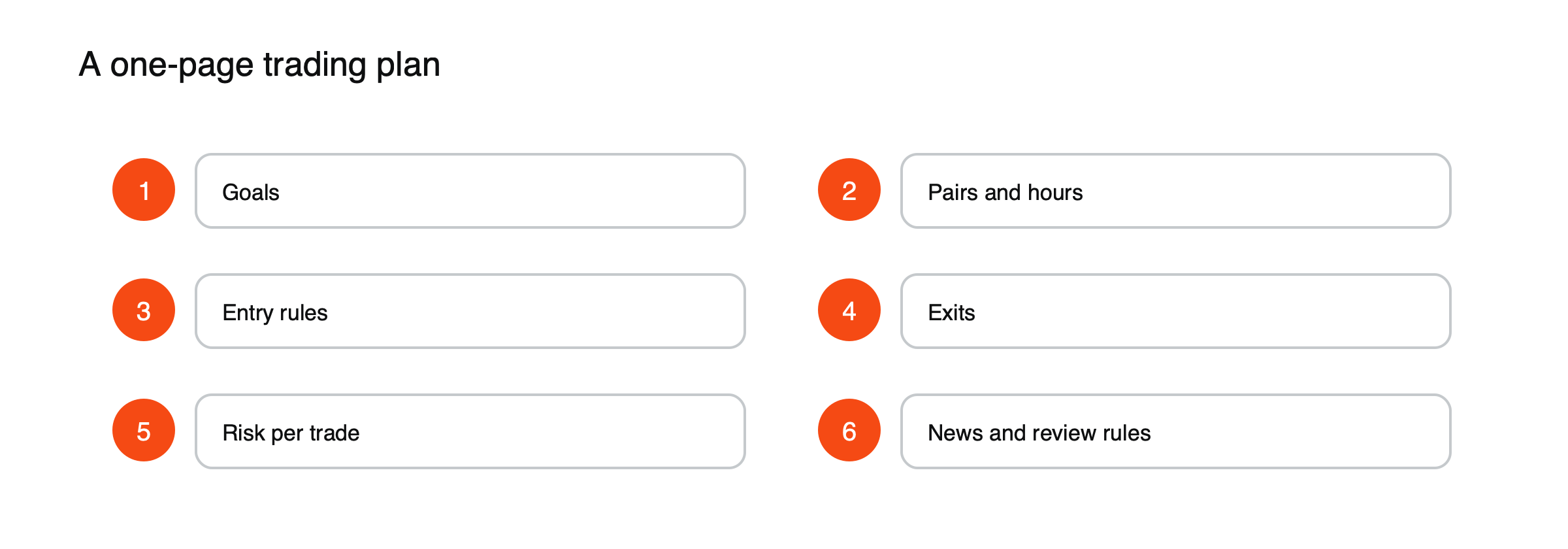
Figure: What a one-page plan covers.
Focus on following the process and limiting losses, not on a monthly profit target.
Choose pairs and hours
Pick a few liquid pairs active during your available time. See how to choose currency pairs that fit your schedule.
Define entry rules
State exactly what must happen before you enter, using the analysis you understand.
Define exits
Where the stop goes and why, and where you take profit. See how to set a take-profit level.
Fix risk per trade
A fixed percentage, such as 1% or less, with position size calculated each time. See how to calculate position size in forex.
Set news and weekend rules
Whether you trade through high-impact releases and hold over weekends. See how to prepare for high-impact news.
Plan your review
Keep a journal and review weekly. See how to keep a trading journal.
A sample one-page plan
Pairs and hours. EUR/USD and GBP/USD, traded between 8 a.m. and 11 a.m. London time on weekdays.
Setups. Trend continuation only: price above its 50-day average, a pullback to a support zone, entry when a candle closes back in the trend direction.
Exits. Stop beyond the support zone; first target at the previous swing high; move the stop to break-even after the first target.
Risk. 1% of the account per trade, maximum 2% open at once; position size calculated before every order.
News. No new trades from 15 minutes before to 15 minutes after high-impact releases for the euro, pound or dollar; positions halved before central bank decisions.
Bad days. Stop trading for the day after two losses or a 2% drawdown.
Weekends. No positions held from Friday’s close.
Review. Journal every trade; review every Sunday; change at most one rule a month.
(Illustrative plan; the content matters less than its clarity.)
Rules for bad days
Losses come in streaks, and decisions made during a streak tend to be worse. A plan should say when to stop: after a set number of losing trades in a day, after losing a set percentage of the account, or after breaking one of your own rules. Stopping protects both the account and judgment, and the market will still be there tomorrow.
A pre-trade checklist
- Is this one of my listed pairs, during my listed hours?
- Does the setup match my entry rules exactly?
- Where is the stop, and is the size calculated for 1% risk?
- Is a high-impact release due soon?
- Am I within my daily loss limit?
Plans for different styles
A day trader’s plan focuses on sessions, spreads and daily loss limits. A swing trader holding for days adds rules about rollover, weekends and news over several sessions. A position trader holding for weeks focuses more on central bank cycles and total exposure. The structure is the same, but the emphasis changes with the holding period.
Common mistakes
Writing a plan but not following it, changing rules after every loss, and leaving risk limits vague.
Review and adjust
Review the plan monthly against your journal. Change one rule at a time, and only after enough trades to judge it.
See common forex trading mistakes and how the forex market works.
Why plans fail
Most plans fail not because the rules are wrong but because they are not followed. Vague rules, such as “take good setups,” leave room for impulse. Rules that are too complex are abandoned under pressure. And plans that are never reviewed drift away from how the trader actually behaves. A short, specific plan, checked against a journal, is far more durable than a long one written once and forgotten.
Turning goals into process measures
Profit targets depend partly on luck, so they make poor goals. Process goals, such as following the entry rules on every trade, never risking more than 1% and journaling every position, are fully within your control. Tracking how often you meet them each week shows whether you are trading the plan. Over time, good process tends to produce better results than chasing a monthly number, which often leads to oversized or forced trades.
Writing rules that cannot be misread
| Vague rule | Specific rule |
|---|---|
| “Buy when the trend is up” | “Buy only when the daily close is above the 50-day average” |
| “Use a sensible stop” | “Stop 10 pips beyond the most recent swing low” |
| “Avoid big news” | “No new trades within 15 minutes of high-impact releases” |
| “Don’t risk too much” | “Risk 1% of equity per trade; 2% maximum open” |
A useful test is whether another person could follow the rule and make the same decision. If not, it leaves room for impulse.
Testing the plan before real money
Before trading a plan with real money, apply it to past charts and then to a demo account or very small positions for several weeks. Record every signal the rules produce, not just the attractive ones. The aim is not to prove the plan works but to find out how it behaves: how often it trades, how large its losing streaks are and whether you can follow it in real time. Plans that look good on past charts often prove harder to follow live.
A monthly review
- How many trades followed every rule?
- What were net results after all costs?
- What was the largest losing streak, and how did you respond?
- Which rule was broken most often, and why?
- Is one change justified, and how will you measure its effect?
Keeping the plan in view
A plan works best when it is in front of you while trading, printed beside the screen or pinned in the platform. Reading it before the session starts takes a minute and makes impulsive trades less likely. Some traders also reread it after any loss larger than usual, before placing the next order.
Plans and emotions
A written plan is mainly a defense against the moments when emotion takes over: after a large loss, during a winning streak or when a move is running without you. Deciding in advance what you will do in those situations, such as stopping for the day, keeping position size unchanged or letting a missed trade go, removes the need to decide under pressure.
Sharing the plan
Some traders share their plan with a mentor, a trading partner or a small group and report each week on whether they followed it. Knowing that someone will ask about broken rules makes them less likely to be broken. Even writing a short weekly summary for yourself, as if someone else would read it, can provide some of the same discipline.
When the plan stops working
Every plan goes through losing periods. A sensible rule is to decide in advance what happens if losses pass a set level, for example halving position size after a 6% drawdown and pausing all new trades for a full and honest review after 10%. Writing this down beforehand prevents both panic and denial when it actually happens to you.
Frequently asked questions
How long should a trading plan be?
One page is enough for most traders. If it does not fit on a page, it is probably too complicated to follow consistently.
How often should I change my plan?
Only after reviewing enough trades to judge a rule, and ideally one change at a time, so you can see what each change does.
This article is educational content and does not constitute financial, investment, legal or tax advice. Digital assets are volatile and you may lose the amount you invest.