
Equity, Free Margin and Margin Level Explained
Equity is balance plus open profit or loss; free margin is what is left after used margin; margin level is equity ÷ used margin. Formulas and an example.
Free margin is the money in your account not tied up as margin, available to absorb losses or open trades. It depends on equity: your balance plus open profits and losses. Margin level, equity ÷ used margin × 100, shows how close you are to a margin call. Providers commonly warn at 100% and close positions around 50%.
The formulas
- Equity = balance + open profit − open loss
- Free margin = equity − used margin (some providers do not count open profits until they are closed)
- Margin level = equity ÷ used margin × 100%
Worked example
- Balance: $5,000
- One EUR/USD position with used margin of $3,666.67 (example from a 1-lot trade at 30:1)
- Open loss: −$1,000
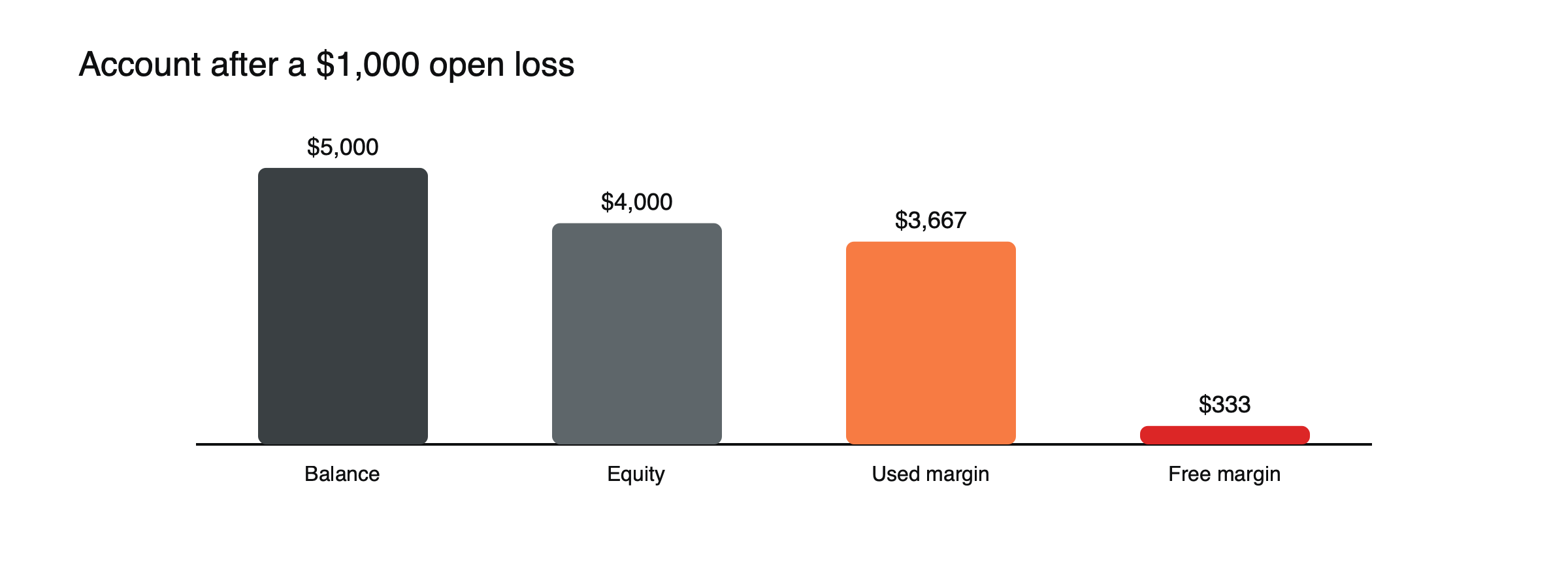
Figure: A 1,000 dollar open loss leaves little free margin (example values).
Equity = $5,000 − $1,000 = $4,000. Free margin = $4,000 − $3,666.67 = $333.33. Margin level = $4,000 ÷ $3,666.67 × 100 = 109.1%.
The account is just above a typical 100% margin-call level; a further loss of about $333 would reach it.
An account through a trading day
Start with a balance of $10,000 and no open positions. (Example values.)
- Morning: you open trade A, using $2,000 of margin, and trade B, using $1,500. Used margin is $3,500.
- Midday: A shows a loss of $600, B a profit of $200. Equity is $9,600, free margin $6,100 and margin level about 274%.
- Afternoon: A’s loss grows to $1,800, B is still up $200. Equity is $8,400, free margin $4,900, margin level 240%.
- Evening: after a sharp move, A is down $6,200 and B is back to break-even. Equity is $3,800, free margin $300 and margin level about 109%, just above a typical margin call.
The account went from very comfortable to the edge of a margin call in one day, mainly through one losing position. The balance stayed at $10,000 throughout; only equity and margin level showed the danger.
Where the stop-out would hit
Continue the example. Used margin is $3,500. If the provider’s stop-out level is 50%, positions start closing when equity falls to about $1,750. From the evening equity of $3,800, a further loss of about $2,050 would trigger it. Expressed as a price move, that depends on the size of trade A, but the point is clear: once margin level is near 100%, the distance to forced closing is short, and in a fast market it can be covered in minutes.
Equity, balance and the difference between them
Your balance changes only when positions close, deposits arrive or costs such as financing are charged. Equity changes with every price tick while positions are open. A large gap between the two, in either direction, is a sign that much of the account’s value depends on trades that have not yet been closed. When equity is far below balance, the account is carrying unrealized losses that will become real if closed at current prices; when it is far above, the profits are still exposed to a reversal. Watching equity, not balance, is the habit that matters most.
How to read margin level
| Margin level | What it usually means |
|---|---|
| Well above 100% | Room for losses and new trades |
| Around 100% | Margin call: no new positions; add funds or reduce risk |
| Around 50% | Stop-out: provider starts closing positions |
Exact thresholds depend on the provider and local rules. EU rules require retail positions to be closed by 50% of required margin.
Why it matters. Free margin is shared across all open positions, so a loss on one can force the closure of others. See what happens in a margin call and a stop-out, how to calculate the margin for a CFD trade and what leverage is in CFD trading.
Leverage, margin and cost figures in this article are example values for illustration. Actual terms depend on the provider, the instrument and the rules in your country.
This article is educational content and does not constitute financial, investment, legal or tax advice. Digital assets are volatile and you may lose the amount you invest.
Why free margin matters before you trade
New positions can only be opened from free margin. If free margin is low, a new trade may be rejected or, worse, accepted and leave the account with almost no buffer against losses on existing positions. Checking free margin before adding a trade, and leaving a large share unused, keeps room for normal price swings.
Open profits and free margin
Providers differ on whether open profits count toward free margin. Some include them, so a winning position lets you open more trades; others do not count profits until a position closes. Where profits count, using them to open new positions increases risk, because those profits can disappear quickly if prices reverse.
Margin level is not the margin rate
The margin rate is a property of an instrument, such as 3.33% for a major currency pair. Margin level is a property of your account, comparing equity with the margin your positions use. They are easy to confuse because both involve margin and percentages, but one tells you what a position requires and the other tells you how safe the whole account is.
Using alerts
Most platforms let you set alerts on margin level, not just on price. An alert at, say, 200% gives time to add funds or reduce positions well before a margin call. Because markets move outside working hours, alerts on a phone are often more useful than watching the screen.
Frequently asked questions
Which number should I watch most closely?
Margin level, because it combines your equity and the margin your positions use into one measure of how close the account is to a margin call.
Can free margin be negative?
Yes. If losses exceed the margin held, free margin turns negative, which usually means the account is at or near the stop-out level.
Habits that keep margin level high
- Use a fraction of available margin, so that normal losses barely move the margin level.
- Close or reduce losing positions before they dominate the account, rather than waiting for a margin call to decide for you.
- Avoid adding new trades when margin level is falling, since new positions add used margin at the worst moment.
- Check before weekends and major events, when providers may raise margin and prices may gap.
- Keep some funds outside the trading account, so that topping up is a choice rather than a rescue.