
How CFD Prices Track the Underlying Market
CFD prices come from the underlying market plus a spread. How cash and futures-based CFDs are priced, and why prices can differ from the exchange.
CFD pricing is based on the underlying market’s price, such as a share on its exchange or an index futures contract, with a spread added by the provider. Your result follows the underlying closely but not perfectly: the spread, trading hours and whether the CFD tracks the cash or futures market all affect the price.
Where the price comes from
The provider takes a reference price from the underlying market or its liquidity sources and quotes a buy (ask) and a sell (bid) price around it. You buy at the higher price and sell at the lower one; the gap is the spread.
A quote, step by step
Suppose a share trades on its exchange at a bid of 99.98 and an ask of 100.02. A provider might quote the CFD at 99.95 to sell and 100.05 to buy, a spread of 0.10 instead of 0.04. (Example prices.) Buying at 100.05 and selling immediately at 99.95 would lose 0.10 per share: the cost of crossing the spread. Some providers instead quote the exchange’s own prices and charge a separate commission; the total cost can be similar either way.
Cash CFDs vs futures-based CFDs
Cash CFDs track the current price of the underlying market and charge overnight financing for positions held past the daily cut-off. Futures-based CFDs track a futures contract with a set expiry date; there is no daily financing, because the cost of carry is already built into the futures price, but spreads are often wider and positions must be rolled to the next contract or closed at expiry. Cash CFDs usually suit shorter holding periods, futures-based ones longer holds. See how overnight financing works.
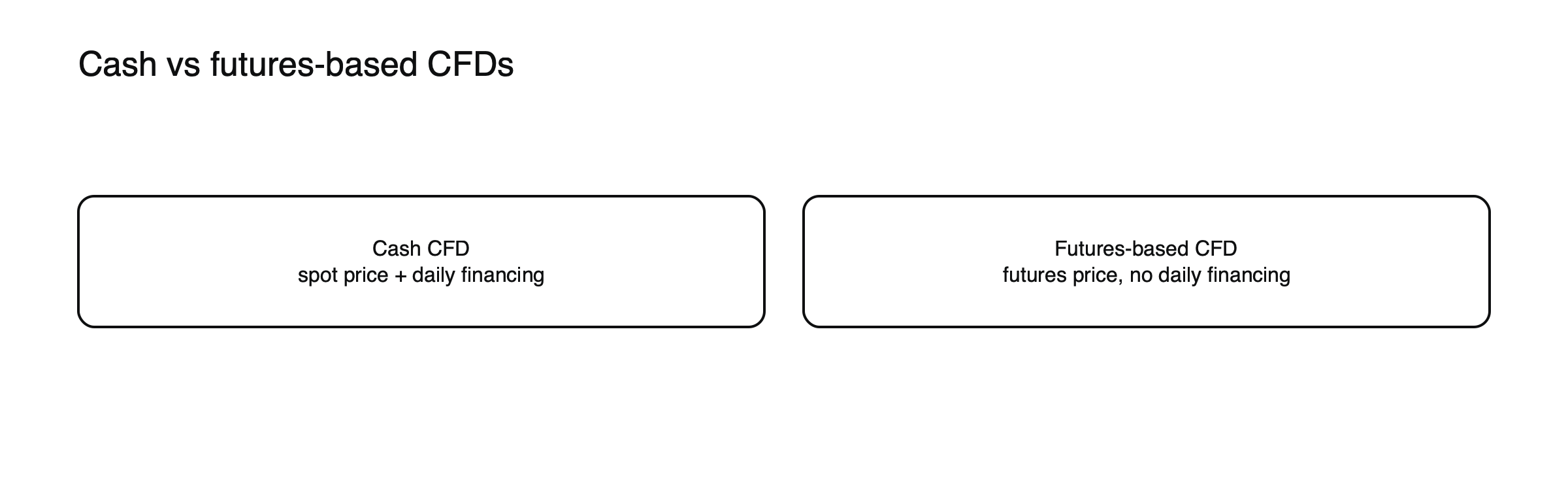
Figure: Two ways CFDs are priced.
Cash (or spot) CFDs track the current market price. Holding them overnight usually incurs a daily financing charge or credit. See how overnight financing works.
Futures-based CFDs track a futures contract with an expiry date. Financing is built into the futures price instead of charged daily, but positions may be rolled or closed at expiry.
Why prices can differ from the exchange
- The spread: quoted prices include the provider’s margin.
- Out-of-hours quotes: some providers quote when the underlying market is closed, based on related markets.
- Corporate actions: dividends and splits lead to cash adjustments on share CFDs.
- Currency conversion: if the market is priced in another currency, conversion affects your result.
Dividends and corporate actions
When a share pays a dividend, its price usually drops by about the dividend amount. To keep the CFD fair, providers make a cash adjustment: holders of long positions are credited, often net of a tax-related deduction, and holders of short positions are debited. For example, a $1 dividend on a 100-share long position might bring a credit of around $85 after a typical deduction. (Illustrative.) Stock splits, rights issues and mergers lead to adjustments to the position’s size or price. Index CFDs see similar adjustments for dividends paid by the companies in the index.
Who is on the other side
When you trade a CFD, your contract is with the provider, not with another trader on an exchange. Some providers act as market makers, quoting prices and taking the other side of client trades, often hedging the overall exposure in the underlying market. Others pass orders through to external liquidity providers. Either way, the provider’s pricing, execution policy and financial strength matter, since your positions depend on it.
Prices when the underlying market is closed
Some providers quote CFDs on indices and certain shares outside the underlying market’s hours, deriving prices from related futures or other markets. These quotes can have wider spreads and may differ noticeably from where the market reopens. Positions opened out of hours carry that extra uncertainty.
Checking a provider’s pricing
Compare the CFD’s quotes with the underlying market’s prices at the same moment, both in quiet periods and around busy times such as market opens. Check whether the provider publishes its execution statistics, how often it requotes and how it handles fast markets. Small differences add up over many trades.
What it means for traders
Compare quoted spreads in normal and busy markets, check which reference price a CFD uses, and remember the provider is your counterparty. See what a CFD is and what a CFD trade really costs.
Spreads as a share of the price
Spreads look different across markets until they are expressed as a percentage. A 1-pip spread on EUR/USD at 1.1000 is about 0.009% of the price. A 0.10 spread on a share priced at 100 is 0.1%, more than ten times as much. Index and crypto CFDs fall somewhere in between, varying with the provider and the time of day. Comparing spreads in percentage terms shows which markets are cheap to trade often and which reward holding for larger moves.
Prices around news
Around major announcements, such as central bank decisions or employment data, liquidity in the underlying market thins and providers widen their spreads, sometimes several times over. Quotes can also jump between prices without trading at the levels in between. Orders placed just before or during these moments face higher costs and a greater chance of slippage, which is why many traders avoid opening positions in the minutes around scheduled news.
Slippage in both directions
When prices move between placing an order and filling it, the fill can be better or worse than the quote. Some providers pass on both, while others may pass on adverse moves more readily than favorable ones. The provider’s order execution policy should explain how slippage is handled, and it is worth reading before trading in fast markets.
What the reference price is, by market
| CFD on | Usual reference price |
|---|---|
| Shares | The share’s price on its main exchange |
| Indices | Index futures or a calculated cash index level |
| Currencies | Prices from interbank and other liquidity providers |
| Commodities | Futures contracts, sometimes adjusted to a cash price |
| Cryptocurrencies | Prices from major crypto exchanges |
Knowing the reference helps explain why a CFD moves when the cash market seems quiet, or why it trades out of hours. If a quote looks wrong, comparing it with the reference market at that moment is the quickest check.
Frequently asked questions
Why does my CFD price differ slightly from the exchange price?
Because the provider adds its spread, may use a different reference price, such as a futures contract, and may quote outside exchange hours. Small differences are normal; large ones deserve a question to the provider.
Do I receive dividends on a share CFD?
You do not receive the dividend itself, but long positions usually receive a cash adjustment equivalent to it, often minus a tax-related deduction, and short positions pay one.
This article is educational content and does not constitute financial, investment, legal or tax advice. Digital assets are volatile and you may lose the amount you invest.