
How the Hunt Brothers Tried to Corner the Silver Market
In 1979–1980 the Hunt brothers built a huge silver position as prices rose from about $6 to $50. Rule changes and margin calls ended it on Silver Thursday.
The Hunt brothers, Texas oil heirs, built one of history’s largest silver positions in 1979–1980 as silver rose from about $6 to around $50 an ounce. Exchanges then restricted leveraged buying and allowed only liquidation orders. On March 27, 1980, «Silver Thursday,» silver closed at $10.80 as the Hunts missed margin calls.
Timeline
- 1970s: the Hunts buy silver as a hedge against inflation after the end of dollar-gold convertibility.
- 1979: their holdings grow sharply with partners; silver rises from about $6 to over $34 by year-end.
- January 7, 1980: COMEX imposes position limits («Silver Rule 7») on leveraged silver futures.
- January 1980: silver peaks near $50; exchanges then accept liquidation orders only.
- March 27, 1980: silver falls to $10.80; brokers liquidate Hunt positions; the Federal Reserve worries about bank losses.
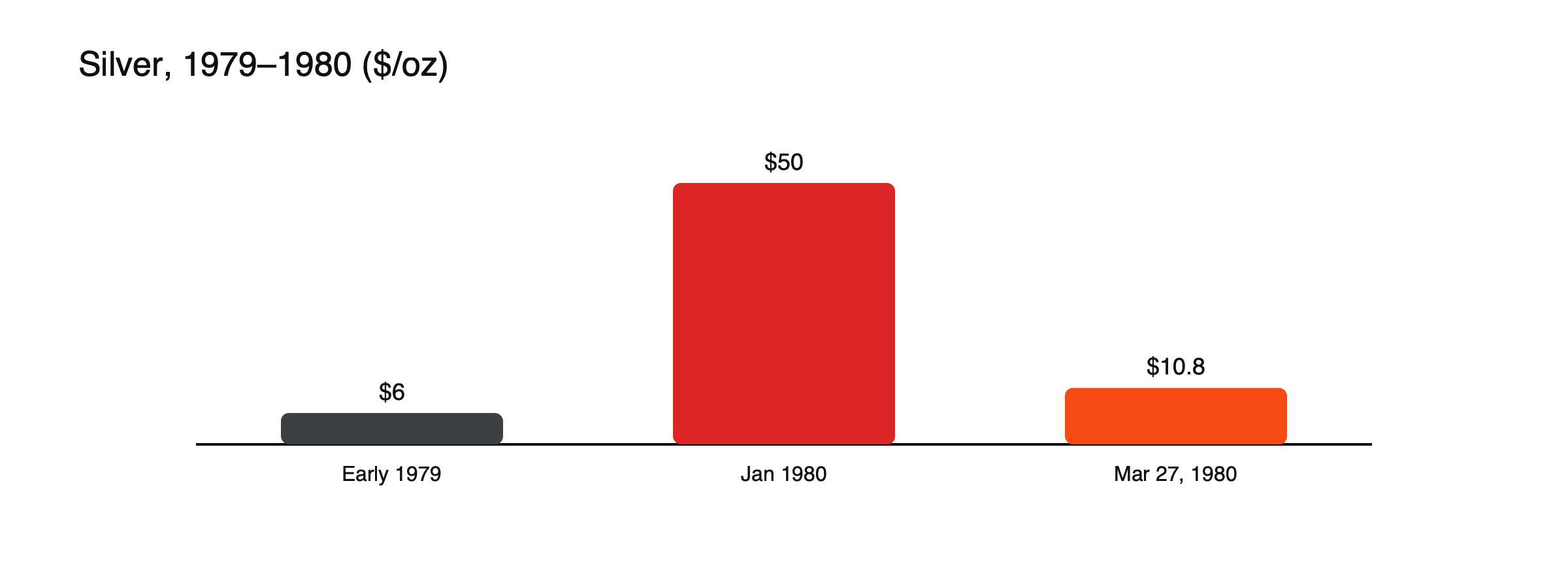
Figure: Silver’s rise and fall. Sources: Wikipedia; Greysheet.
Who the Hunts were
Nelson Bunker Hunt and William Herbert Hunt were sons of H. L. Hunt, a Texas oil tycoon who had built one of the largest fortunes in the United States. In the 1970s, worried that inflation and government spending would erode the value of paper money, they began buying silver, which they saw as a store of value at a time when US citizens were still not allowed to own gold bullion. Over time, their buying grew from an investment into an attempt to control a large share of the world’s available silver.
How the position was built
The brothers bought both physical silver and futures contracts, and instead of rolling or settling futures in cash, they often took delivery of the metal, removing it from the market. Joined by wealthy partners, including investors from the Middle East, they accumulated a very large share of the silver held in exchange warehouses and in private hands. Because much of the buying was financed with borrowed money and futures margin, the position grew far larger than their cash alone could support.
The rise to $50
As the Hunts and others kept buying, silver climbed from below $10 in the summer of 1979 to $34.45 by the end of that year and above $50 in January 1980. The surge drew in other speculators and pushed some households to sell family silverware for scrap, while industrial users such as photographic film makers faced soaring costs. The price had become disconnected from ordinary supply and demand, and exchanges and regulators grew alarmed.
Why it collapsed
- Leverage: much of the position was in futures and borrowed money.
- Rule changes: limits on new buying removed the demand driving prices.
- Margin calls: falling prices required cash the Hunts did not have.
Silver Thursday
By late March 1980, silver had already fallen sharply from its peak. On March 26, the Hunts’ broker demanded more margin that the brothers could not pay. The next day, Thursday, March 27, silver fell from $21.62 to $10.80 as brokers liquidated positions, and fears spread that losses could topple brokerage firms and banks that had lent to the Hunts. The Federal Reserve, led by Paul Volcker, monitored the situation closely because of the risk to the financial system.
Aftermath
Banks arranged a large loan to avoid wider losses; regulators and courts later pursued the brothers, who eventually went bankrupt.
Legal consequences
Regulators and private plaintiffs later pursued the brothers. In 1988, a New York jury found them liable for conspiring to manipulate the silver market, and they were ordered to pay large damages. Facing those claims and heavy debts from falling oil and silver prices, both brothers filed for bankruptcy that year. The family fortune that had financed the scheme was largely lost.
What changed
The episode led exchanges to make greater use of position limits and margin increases in extreme conditions, tools they still use today when markets become disorderly. It also strengthened the case for regulators to monitor large positions across exchanges. Modern rules make a corner of the kind the Hunts attempted far harder, though squeezes on smaller scales still happen.
Lessons
Leverage turns a winning trade into a forced sale; exchanges can change the rules in extreme conditions; thin markets are prone to squeezes. See what a short squeeze is, what moves silver prices and how commodity CFDs work.
Timeline at a glance
| Date | Event | Silver |
|---|---|---|
| Summer 1979 | Buying accelerates | Below $10 |
| December 31, 1979 | Year-end | $34.45 |
| January 7, 1980 | COMEX imposes position limits | Rising |
| January 1980 | Peak; liquidation-only trading follows | Above $50 |
| March 27, 1980 | Silver Thursday | $10.80 |
Lessons for traders
The Hunt episode shows that a position can be right about direction for a long time and still end in ruin when leverage meets a change in rules or a sharp reversal. Exchanges and providers can raise margins or restrict trading when markets become extreme, and those changes usually hit the most leveraged positions first. Thin markets like silver can move far beyond their fundamentals, in both directions. See what moves silver prices.
The 1970s context
The Hunts’ buying made sense to many investors at the time. Inflation was in double digits, the dollar had lost its link to gold and confidence in paper money was weak. Private ownership of gold bullion had been restricted in the United States until the end of 1974, which had made silver a popular alternative store of value. The brothers were not alone in buying precious metals; they were simply far larger, and far more leveraged, than anyone else.
The banks’ rescue
After Silver Thursday, the immediate danger was that the Hunts’ unpaid debts would cause losses at the brokerage firms and banks that had lent to them, possibly spreading to the wider financial system. A group of banks arranged a large loan, secured against the family’s other assets, including oil interests, so that the Hunts could pay what they owed and positions could be unwound in an orderly way. The rescue drew criticism for helping wealthy speculators, but officials argued it was needed to protect the system.
Silver after 1980
Silver never returned to its 1980 peak in that era. It fell through the early 1980s and spent much of the following two decades at a small fraction of its January 1980 high, as inflation fell and interest rates stayed high. It took more than three decades, until 2011, for silver to approach $50 again, and its later surge above $100 in January 2026 came in a very different market.
The users’ side
The spike also hurt businesses that relied on silver, such as makers of photographic film, electronics and silverware. Some cut production or sought substitutes, and jewelers complained publicly about the effects on their trade. The episode showed that extreme prices in a commodity hurt real economic users, not only the speculators on the other side.
The rule changes in detail
On January 7, 1980, COMEX introduced Silver Rule 7, which placed strict limits on the size of leveraged silver positions any single trader could hold. Soon afterward, exchanges allowed only orders that reduced existing positions, so no one could open new long positions. Margin requirements were raised as well. Together, these measures removed the steady buying that had driven prices up and forced the most leveraged holders, above all the Hunts, to find cash or sell. Within weeks, prices began a steep fall that culminated on Silver Thursday. The episode remains one of the clearest examples of an exchange suddenly changing its trading rules in the middle of a market move, and of how quickly a crowded, leveraged position unravels once the buying that supported it is removed by regulation rather than by the market itself.
Frequently asked questions
Did the Hunts actually corner the silver market?
They came close to controlling a large share of available silver, but rule changes, margin calls and falling prices ended the attempt before it could succeed.
Could something similar happen today?
A full corner is much harder because of position limits and surveillance, but squeezes in thin markets still occur, and exchanges still change margins in extreme conditions.
This article is educational content and does not constitute financial, investment, legal or tax advice. Digital assets are volatile and you may lose the amount you invest.
Sources
- Silver Thursday (silver from below $10 before August 1979 to $34.45 by December 31 and over $50 in January 1980; position limits January 7, 1980; $10.80 close on March 27, 1980) — Wikipedia
- Silver Thursday (from $21.62 to $10.80 on March 27, 1980; Silver Rule 7) — Sunshine Profits
- Fear meets physics (silver from $6 to $50; Silver Rule 7; liquidation-only trading) — Greysheet, March 2026