
Index Futures vs Index CFDs
Index futures trade on exchanges in fixed sizes with expiries and clearing; index CFDs offer flexible sizes and daily financing. A side-by-side comparison.
Index futures vs index CFDs differ in where they trade and how they are built. Futures trade on exchanges in standard contracts with fixed multipliers, quarterly expiries and central clearing. CFDs are provider contracts with flexible size per point, no expiry on cash versions and daily financing instead of built-in carry.
Side by side
| Index futures | Index CFDs | |
|---|---|---|
| Venue | Exchange | Provider (over the counter) |
| Size | Fixed contract multiplier; micro versions smaller | Flexible value per point |
| Expiry | Quarterly | None for cash CFDs; futures-based CFDs follow the future |
| Holding cost | Built into the futures price | Daily financing on cash CFDs |
| Dividends | Priced in | Adjustments on cash CFDs |
| Counterparty | Clearing house | The provider |
| Hours | Nearly 24 hours on major contracts | Depends on provider |
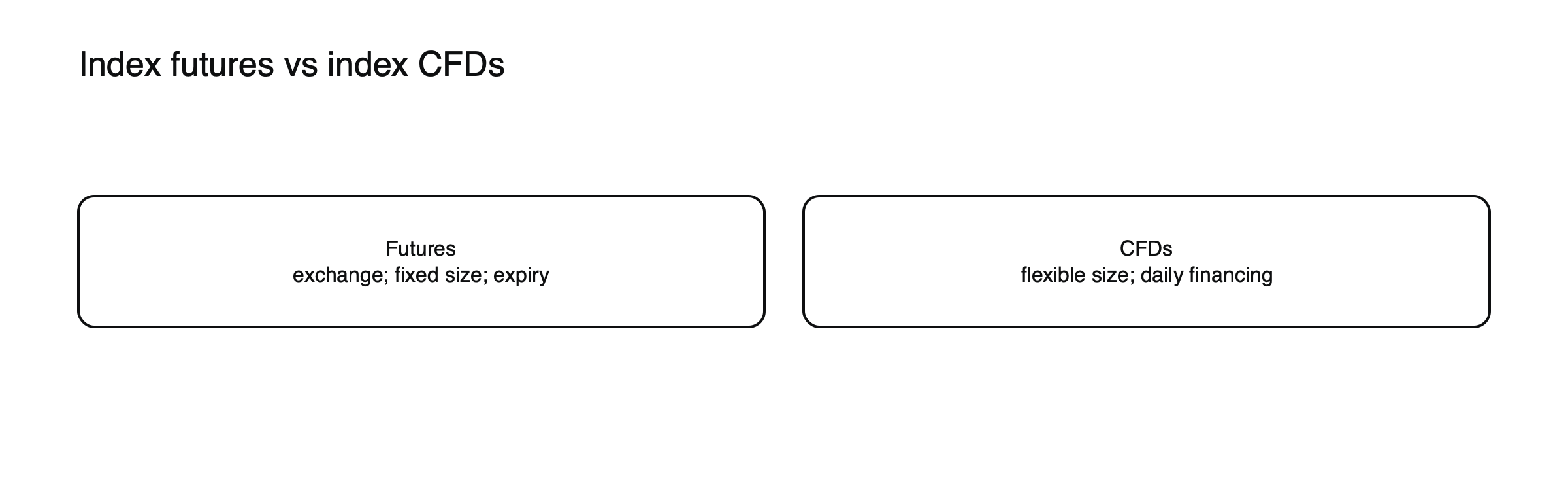
Figure: Two ways to trade an index.
Contract sizes, illustrated
The main US index future, the E-mini S&P 500, has a multiplier of $50 per index point, so with the index at 5,000, one contract controls about $250,000 of exposure. The Micro E-mini, at $5 per point, controls about $25,000. An index CFD can be traded at, say, $2 per point, about $10,000 of exposure, or less. (Index level illustrative.) For a small account, the futures contract sizes can be far larger than a sensible position, which is a key reason retail traders use CFDs.
Expiry and rolling
Index futures expire quarterly, usually in March, June, September and December. Traders holding positions beyond expiry must roll into the next contract, selling the expiring one and buying the next, which involves a price difference reflecting interest and dividends until the new expiry. Futures-based CFDs follow the same cycle and are rolled by the provider; cash CFDs avoid expiry altogether but charge daily financing instead.
Advantages of futures
Central clearing, one public price and transparent costs. They suit larger accounts and longer holding periods without daily financing.
Advantages of CFDs
Small, adjustable sizes and no expiry management on cash versions, accessible from one account across many markets.
Costs over three months, illustrated
Suppose the index is at 5,000, interest rates are 4.3% and expected dividends 1.3% a year. A three-month future trades near 5,037.5, about 37.5 points above the cash index, reflecting carry. A trader holding a cash CFD for the same three months at $2 per point would pay financing of roughly 6.8% a year on $10,000, about $170, and receive dividend adjustments of about $33, a net cost of about $137. Holding the futures position instead, the cost is embedded in the 37.5-point premium, about $75 at $2 per point, plus the provider’s or broker’s spreads and commissions. (Illustrative figures.) The futures route is often cheaper for long holds, partly because CFD financing adds a markup above the benchmark rate.
Where the costs converge
“Futures have no financing” is not quite right: the carry cost is in the futures price, which differs from the cash index. Over long holds, the costs can be comparable.
See spot FX vs currency futures for the same comparison in currencies, how index dividends are adjusted and how stock index CFDs work.
Margin and leverage
Futures margin is set by the exchange and clearing house, usually a few percent of the contract value, and can be raised in volatile markets. Retail index CFDs on major indices in the EU are limited to 20:1, a 5% margin. Both allow high leverage, but futures accounts typically require larger deposits because of the contract sizes, and futures losses can exceed the account balance, while EU retail CFD accounts carry negative balance protection.
Who uses which
Institutions, professional traders and larger accounts use futures for their low costs, central clearing and transparent pricing. Retail traders often use CFDs for flexible sizing, access to many markets from one account and simpler handling of expiries. Some use both: futures for core positions and CFDs for smaller or shorter-term trades.
Fair value before the open
Before a cash market opens, traders compare index futures with their fair value, the price the futures should have given the cash index, interest rates and expected dividends. If futures trade above fair value, the cash index is likely to open higher; below, lower. Television and news services often quote this comparison as an indication of the open. Cash index CFDs that derive prices from futures before the open effectively reflect the same information.
The basis
The difference between the futures price and the cash index is called the basis. It reflects interest and dividends until expiry and narrows as expiry approaches, reaching roughly zero at settlement. Large or unusual changes in the basis can reflect shifts in interest rates, dividend expectations or heavy demand for futures, for example during market stress.
Settlement at expiry
Major index futures are settled in cash, based on a special opening price on expiry day. Traders who do not want to be settled usually roll before expiry. Expiry days, especially those when index futures and options expire together, can bring heavy trading and sharp moves around the settlement time.
Practical differences for a retail trader
Futures require an account with a futures broker, larger deposits and the management of expiries; CFDs offer flexible sizes and many markets from one account, with negative balance protection for EU retail clients but daily financing on cash versions. Choosing between them is mostly about account size, holding period and the markets traded.
Common misreadings
- Comparing a futures price with the cash index without allowing for fair value.
- Assuming futures have no holding cost.
Smaller futures contracts
Exchanges have introduced smaller contracts to attract individual traders, such as the Micro E-mini series at a tenth of the standard size. These narrow the gap between futures and CFDs in accessibility, though even a micro contract on a major US index represents tens of thousands of dollars of exposure, still larger than many CFD positions. Fees, data costs and account requirements also differ between futures brokers and CFD providers.
Trading around the clock
Major index futures trade nearly 24 hours a day on weekdays, with a short daily break, while index CFDs from many providers follow similar hours by pricing from futures outside the cash session. Liquidity is deepest when the underlying cash market is open. Overnight, both futures and CFDs can see wider spreads and sharper moves on news, which matters for anyone holding positions while the home market is closed.
Choosing in practice
A simple way to decide is to estimate the total cost of the planned trade, including spreads, commissions and financing or carry, for both instruments at the realistic size you need, and also to check which offers the protections and trading hours you want most.
Frequently asked questions
Do index CFDs follow futures prices?
Outside the cash market’s hours, many index CFDs derive their prices from futures. During cash hours, cash CFDs follow the underlying index, while futures-based CFDs follow the futures contract.
Which is cheaper?
It depends on holding period and size. For short trades, CFD spreads are often competitive; for longer holds, futures are often cheaper because financing on cash CFDs builds up.
This article is educational content and does not constitute financial, investment, legal or tax advice. Digital assets are volatile and you may lose the amount you invest.