
How to Calculate Overnight Financing Before Holding a Trade
Daily CFD financing = position value × (benchmark ± fee) ÷ 365. Worked examples for long and short index positions, a 30-day hold and forex swaps.
An overnight financing calculation multiplies the position value by the annual rate and divides by 365, or 360 for some currencies. On a $100,000 long index position with a 4% benchmark and a 2.5% fee, that is about $17.81 a night, or $534 over 30 nights. Shorts use the benchmark minus the fee, here a small credit.
The formula
Daily financing = position value × annual rate ÷ 365
- Long rate = benchmark + fee
- Short rate = benchmark − fee (a credit if positive, a charge if negative)
Worked example: index CFD
- Position value: $100,000
- Benchmark rate: 4.0% (example value)
- Provider fee: 2.5% (example value)
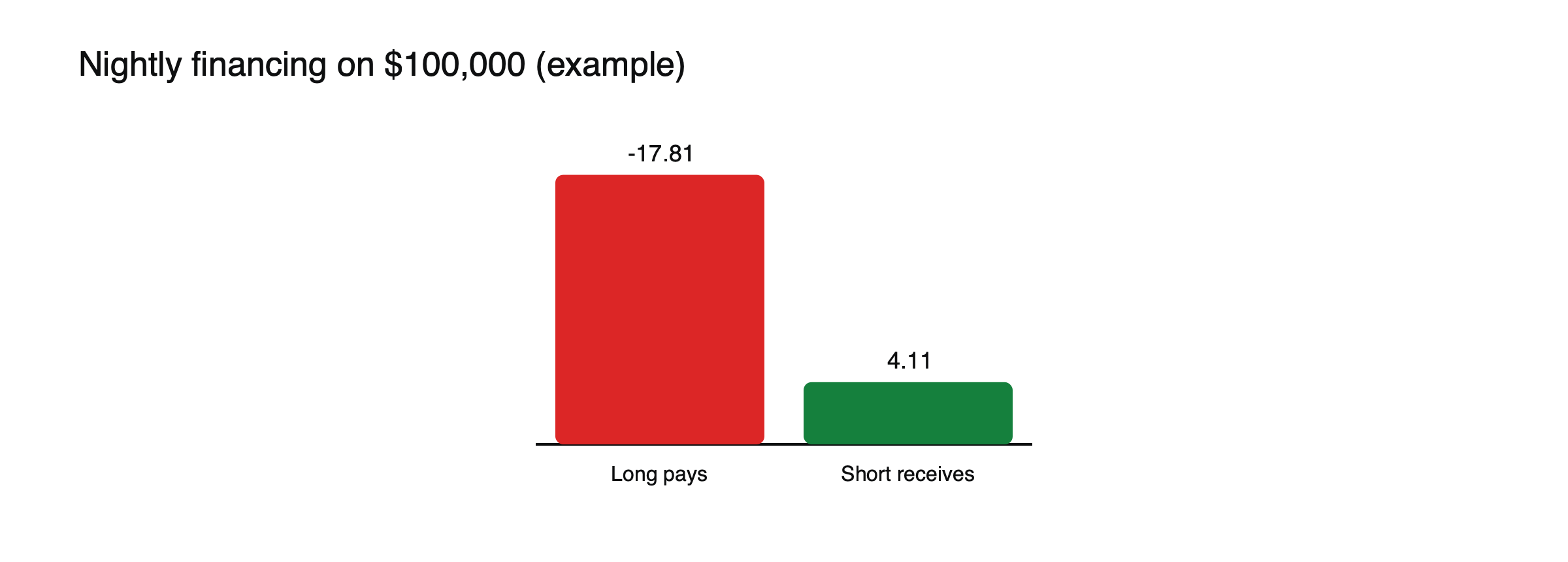
Figure: Nightly financing at a 4% benchmark and 2.5% fee (example values).
Long: $100,000 × 6.5% ÷ 365 = $17.81 charged per night.
Short: $100,000 × 1.5% ÷ 365 = $4.11 credited per night.
30 nights long: $17.81 × 30 ≈ $534, or 0.53% of the position.
Long rate = 4.0% + 2.5% = 6.5% a year. Nightly cost = $100,000 × 6.5% ÷ 365 ≈ $17.81. Over 30 nights, about $534.25.
A short position on the same index would earn 4.0% − 2.5% = 1.5% a year, about $4.11 a night.
Worked example: a currency that uses 360 days
Some currencies, including the US dollar, euro and Swiss franc, use a 360-day convention for financing, while sterling uses 365. The same $100,000 long at 6.5%, calculated on 360 days, costs about $18.06 a night instead of $17.81. The difference is small per night but adds up on large or long-held positions.
Worked example: a forex swap quoted per lot
Currency positions are often charged as a swap quoted per lot. Suppose your provider quotes −$7 a night for holding one lot of a pair long. (Example value.) Held from Monday to the following Monday, you are charged on five weekday cut-offs, with Wednesday’s charge tripled to cover the weekend: four nights at $7 plus one night at $21, about $49 for the week, the same as seven nights.
How rate changes affect it
If the benchmark falls to 1% while the fee stays at 2.5%, short positions pay: 1% − 2.5% = −1.5% a year. When rates are low, both sides can pay.
Forex positions
Currency financing uses the interest rate difference between the two currencies plus a fee, quoted as a swap in points. Positions held through Wednesday’s cut-off are typically charged three nights at once.
Before holding a trade
- Check the provider’s long and short rates for that market.
- Estimate the number of nights you plan to hold.
- Compare total financing with your expected profit and the spread.
See how overnight financing works, what a CFD trade really costs and what leverage is in CFD trading.
Worked example: shorting a share with a borrowing fee
You short a share CFD worth $20,000. The benchmark is 4% and the provider’s fee 2.5%, so the basic short rate is a 1.5% credit. But the stock is hard to borrow, and the provider adds a 3% borrowing charge. (Example values.) The net rate becomes 1.5% − 3% = −1.5% a year, a cost of about $0.82 a night instead of a credit. For heavily shorted stocks, borrowing charges can be far higher and can change without much notice.
When the benchmark changes mid-trade
Financing is recalculated as the benchmark moves. If a central bank cuts rates and the benchmark falls from 4% to 3% while you hold the $100,000 long index position, the long rate drops from 6.5% to 5.5% and the nightly cost from about $17.81 to about $15.07. Over a long holding period, rate decisions can change the total cost noticeably, in either direction.
Commodities and futures-based contracts
Cash commodity CFDs usually reflect the market’s cost of carry, derived from futures prices, plus the provider’s fee, so financing can differ sharply between commodities and over time. Futures-based CFDs carry no nightly charge at all; their cost appears in the futures price and at each rollover. See how overnight financing works.
A quick pre-trade checklist
- Find the long or short rate, or swap value, for the exact instrument.
- Note whether it uses 360 or 365 days, and which day carries weekend charges.
- Multiply by the position value and the expected number of nights.
- Compare the total with the spread and the profit you expect.
- Recheck rates if you hold through a central bank decision.
Worked example: gold held for two weeks
You hold a $24,000 long position in a cash gold CFD for 14 nights, and the provider’s long rate for gold is 7% a year. (Example values.) Financing is $24,000 × 7% ÷ 365 × 14 ≈ $64.44. If gold rises 1% over the two weeks, the position gains $240, so financing takes about a quarter of the profit. On a flat market, the same cost turns the trade into a loss.
Setting up a simple spreadsheet
A small spreadsheet makes these estimates quick. Use columns for the instrument, position value, long or short rate, day-count convention, expected nights and any borrowing charge, then a formula for the total: value × rate ÷ days in the year × nights. Adding a column for expected profit shows at a glance which trades financing would make uneconomic. Updating the rates once a week keeps the estimates realistic.
Financing estimates are only as good as the inputs. Rates change with central bank decisions, borrowing charges can jump for popular short targets, and holding periods often run longer than planned. Building in a margin of error, for example assuming a rate one percentage point higher than today’s, gives a more cautious and usually more realistic picture.
Financing as a share of your margin
Financing is charged on the full position, so it looks larger next to your margin. The $100,000 index position above, at 20:1, needs $5,000 of margin. Thirty nights of financing, about $534, is roughly 11% of that margin, before any price move or spread.
A break-even holding period
If you expect the trade to gain 2%, about $2,000, financing at $17.81 a night would consume the whole expected gain after about 112 nights. Long before that point, the trade’s expected return shrinks noticeably. Estimating this before entering helps decide whether a cash CFD suits the idea or whether a shorter holding period, or a futures-based contract, makes more sense.
Frequently asked questions
Where do I find my provider’s financing rates?
Most providers publish long and short rates or swap values for each instrument on their website and in the trading platform’s contract details. Rates can change daily.
Is financing calculated on the opening price or the current price?
Usually on the position’s value at each daily cut-off, so financing rises or falls as the position’s value changes.
Leverage, margin and cost figures in this article are example values for illustration. Actual terms depend on the provider, the instrument and the rules in your country.
This article is educational content and does not constitute financial, investment, legal or tax advice. Digital assets are volatile and you may lose the amount you invest.