
What Moves Gold Prices?
Gold moves on real yields, the dollar, central bank buying, investor flows and fear. How each driver works, and why gold rose about 60% in 2025.
Gold prices move mainly on real interest rates, the US dollar, central bank buying, investor demand and fear. Gold pays no interest, so it tends to do better when real yields fall, and a weaker dollar usually helps. Heavy central bank buying changed the picture: gold rose over 60% in 2025 and topped $5,100 in January 2026.
Real interest rates
When inflation-adjusted yields fall, the cost of holding gold instead of bonds falls too. The link was close from the late 1990s to 2020 but weakened as other buyers stepped in. See why gold falls when real yields rise.
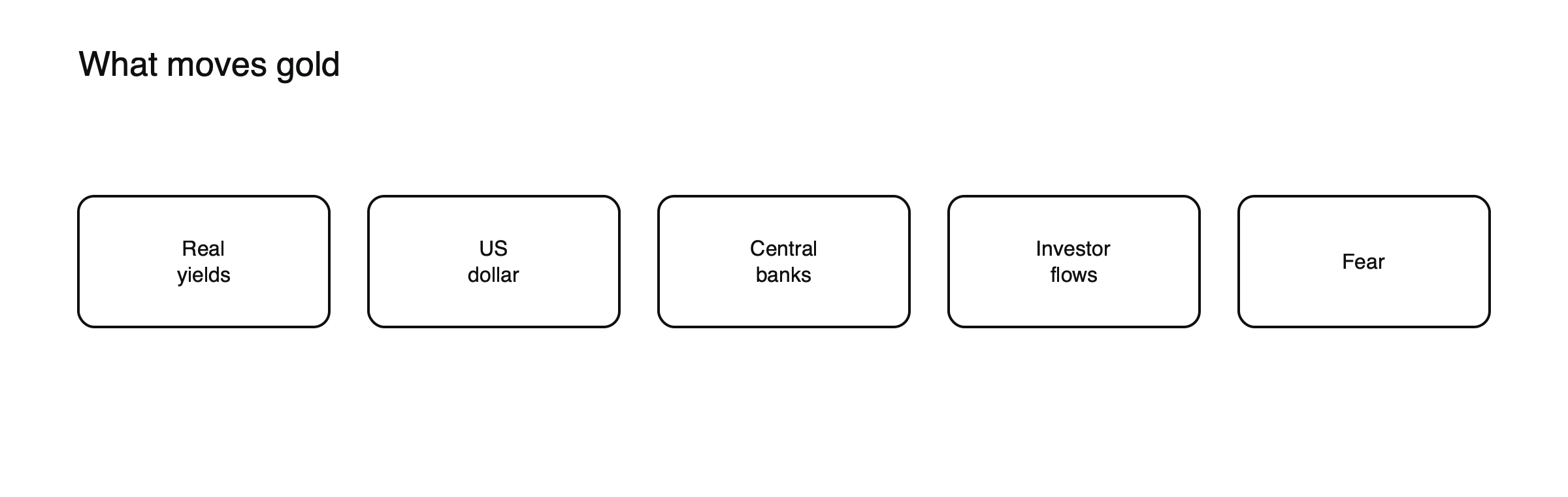
Figure: The main gold drivers.
The US dollar
A weaker dollar makes gold cheaper for other currencies, often lifting demand. See why gold and the US dollar usually move in opposite directions.
Central bank buying
Central banks bought 1,045 tonnes in 2024 and 863 tonnes in 2025, well above pre-2022 levels, diversifying reserves away from the dollar. See how central bank gold buying affects the price.
Physical demand and supply
Jewelry, especially in India and China, is one of the largest sources of gold demand, along with bars and coins bought by households and smaller amounts used in electronics. This demand tends to be price-sensitive: buyers often hold back when prices jump and return on dips. On the supply side, mine output changes slowly, because new mines take years to develop, while recycling of old jewelry rises when prices are high. Physical supply and demand rarely drive short-term moves, but they help set floors and ceilings over longer periods.
Exchange-traded funds
Funds holding physical gold allow investors to buy and sell gold exposure as easily as shares. Their holdings rise when investors pile in and fall when they leave, and large flows in either direction can move the price within days. Because these investors often respond to interest rates and market fear, ETF flows tend to amplify moves driven by those factors.
Investor flows and fear
ETF inflows, bar and coin demand and safe-haven buying during geopolitical stress can drive sharp moves.
Gold’s 2025–2026 swings
Recent years show how these drivers combine. Gold rose about 60% in 2025, passing $4,000 an ounce, and set a record above $5,100 in January 2026, supported by heavy central bank buying, strong investor demand and concerns about inflation and government debt. It traded above $5,200 in late February 2026, before falling back to around $4,060 by late June 2026. Moves of 20% or more within a few months are a reminder that gold, often seen as a safe asset, can be very volatile.
Gold in a crisis
Gold often rises when markets are frightened, but not always at first. In March 2020, as investors scrambled for cash, gold fell nearly 15% over five sessions before recovering strongly in the following months. In a sudden crisis, gold can be sold to meet margin calls elsewhere; once the panic eases, its safe-haven role usually reasserts itself. See why gold and the US dollar usually move in opposite directions.
Sharp reversals. Gold is volatile: after trading above $5,200 in late February 2026, it traded near $4,060 by late June 2026.
See how gold is priced and how commodity CFDs work.
Drivers by time horizon
| Horizon | Main drivers |
|---|---|
| Minutes to hours | US inflation and jobs data, central bank decisions, geopolitical headlines |
| Days to weeks | Real yield moves, the dollar, ETF flows, positioning |
| Months | Central bank buying, investor demand, interest rate cycles |
| Years | Reserve diversification, inflation trends, mine supply |
Gold and the other precious metals
Silver, platinum and palladium share some of gold’s drivers but depend much more on industrial demand, which makes them more sensitive to the economic cycle and usually more volatile. The gold/silver ratio, the number of ounces of silver one ounce of gold buys, is a common way to compare them. See gold vs silver.
A gold checklist
- What are real yields and the dollar doing?
- Are central banks still buying, and at what pace?
- Are ETF holdings rising or falling?
- Is fear rising, and is it the kind that lifts gold or forces selling?
- How far has the price moved recently, and how crowded is positioning?
Gold and stock markets
Gold’s relationship with stocks varies. In steady bull markets, the two can rise together if interest rates are falling. In sharp sell-offs, gold often holds up better than stocks, which is why some investors hold it as a diversifier. But in the first days of a panic, gold can fall alongside stocks as investors raise cash. Over long periods, its low correlation with stocks has made it useful in portfolios, even though the relationship is unstable in the short term.
Seasonal demand
Physical demand has seasonal patterns. In India, buying rises around festivals and the wedding season; in China, demand often picks up ahead of the Lunar New Year. These patterns influence physical premiums and local prices more than the global benchmark, and they are usually well known and priced in, but unusually strong or weak seasonal buying can add to price trends.
Positioning in futures
Speculative positioning in gold futures, shown in the weekly Commitments of Traders report, adds another layer. When money managers hold very large net long positions, the market can fall sharply if they sell together; very small or short positions can fuel rallies when they reverse. See how to use the Commitments of Traders report.
Common misreadings
- Assuming gold always rises in a crisis.
- Treating one driver, such as inflation, as the whole story.
- Forgetting how volatile gold can be, as 2026 showed.
Government debt and confidence
Concerns about high government debt, large budget deficits and the independence of central banks have become important drivers of gold demand. When investors worry that governments may tolerate higher inflation or that the value of paper money may erode, gold’s appeal as an asset that no government can print rises. These concerns were among the reasons analysts cited for gold’s rise in 2025, alongside central bank buying.
How gold reacts to US data
Major US releases, such as inflation and jobs reports, often move gold within minutes, because they change expectations for interest rates and the dollar. A hotter-than-expected inflation report that lifts real yields usually weighs on gold; a weak jobs report that raises the chance of rate cuts usually helps it. See how to prepare for high-impact news.
Volatility and position size
Because gold can move 2% or more in a day, position sizes should reflect its current volatility rather than its reputation as a safe asset. Sizing so that a normal adverse day costs no more than planned keeps trades in proportion. See how to size a CFD position using risk per trade.
Frequently asked questions
Is gold a good hedge against inflation?
Over long periods it has often held its value against inflation, but over shorter periods its link with inflation is weak. Real interest rates and other drivers usually matter more from year to year. See whether commodities are an inflation hedge.
Why can gold fall when markets panic?
Because some investors sell gold to raise cash or meet margin calls during the first stage of a crisis, as in March 2020. Haven buying often follows once the immediate scramble eases.
This article is educational content and does not constitute financial, investment, legal or tax advice. Digital assets are volatile and you may lose the amount you invest.
Sources
- Gold surges past $5,000 and silver tops $100 (record above $5,100 in January 2026; central bank buying about 60 tonnes a month; gold +60% in 2025) — Barchart, January 2026
- Gold price volatility (central banks bought 1,045 tonnes in 2024, 863 in 2025 and 2,971 in 2022–2024, per WGC) — Aerapass
- March 2020 review and outlook (gold gave back nearly 15% over five sessions) — Nasdaq
- What’s behind the divergence between gold and real Treasury yields? (tracked closely late 1990s–2020; central banks about 1,000 tonnes a year 2022–2024) — Janus Henderson
- Gold rebounds above $4,060 (gold $4,063.17 and silver $59.04, ratio near 68.8, June 26, 2026; WGC survey: almost 90% expect central bank reserves to rise) — USAGOLD, June 2026