
How to Prepare for High-Impact News as a Forex Trader
Check the calendar, decide whether to trade or stay out, cut size, plan for wider spreads and slippage, and let the first spike settle: a forex news guide.
To prepare for high-impact forex news, check the calendar daily, decide in advance whether to trade the release or stay out, reduce or close exposed positions, plan for wider spreads and slippage, and let the first spike settle before acting. Releases bring the day’s biggest moves, and the costs of being caught are higher.
Before you start
Know which events matter for your pairs, such as inflation, jobs and central bank decisions. See how to read an economic calendar.
A preparation routine
List the week’s high-impact events
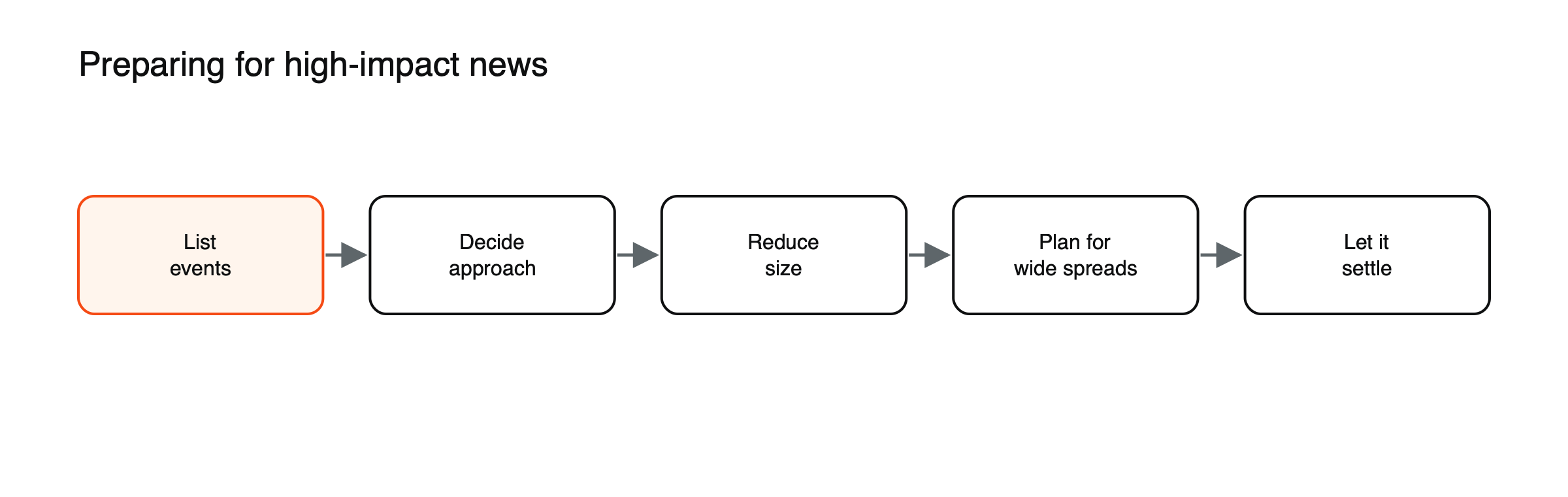
Figure: Preparing for a high-impact release.
Note dates, times in your time zone and the forecast for each.
Decide your approach
Three options: stay flat through the release, keep positions but smaller, or trade the reaction after the first move. Deciding beforehand avoids impulsive choices.
Reduce size on open positions
Price can jump many pips in seconds. Smaller positions keep a gap from becoming a large loss. See how to calculate position size in forex.
Plan for wider spreads and slippage
Spreads widen around releases, and stops may fill beyond their level. See what spread widening is.
Wait for the first move to settle
Initial reactions often reverse once traders digest details and revisions.
Three ways to handle a release
| Approach | How it works | Main risk |
|---|---|---|
| Stay flat | Close or avoid positions until after the release | Missing a move |
| Hold, smaller | Keep positions but reduce size and widen stops | Gaps beyond stops |
| Trade the reaction | Enter after the first move, once spreads settle | Reversals and false starts |
There is no single right choice; what matters is choosing in advance and sizing for the chosen approach.
Trading the reaction, illustrated
Suppose US inflation comes in well above forecast and EUR/USD drops 60 pips in the first two minutes. (Illustrative figures.) A trader who waits five minutes sees spreads return to normal and the pair holding near its low, with US two-year yields still higher. They enter short with a stop above the post-release high, about 40 pips away, risking a fixed amount. If instead the pair had bounced halfway back within minutes, the trader would have treated the first move as a false start and stayed out.
Why first moves reverse
Initial reactions are driven by headline numbers and automated systems. Within minutes, traders read the details, such as core inflation, wages or revisions, and the move can fade or reverse if the details tell a different story. Positioning matters too: if many traders were already betting on a strong number, a strong result may produce selling as they take profits.
Orders placed in advance
Some traders place buy and sell stop orders on either side of the price before a release, hoping to catch the breakout whichever way it goes. In practice, spreads widen and prices can jump through both levels, filling both orders or filling one far from its level. This approach needs very careful sizing and is often more expensive than it looks.
Common mistakes
- Placing tight stops just before a release.
- Trading the headline without checking revisions.
- Doubling size because a move “has to” continue.
See how nonfarm payrolls moves the dollar and how the forex market works.
Sizing for news
Because prices can move further and faster than usual, the same stop distance in pips carries more risk around news, and stops may fill beyond their level. A practical rule is to cut position size before high-impact releases, for example by half, so that a gap twice the normal stop distance still costs no more than the usual risk. See how stop-loss orders work and why they can slip.
After the release
Once the release is digested, the useful question is whether it changed the outlook for interest rates. If it did, the move may develop over days as other traders adjust. If it did not, prices often drift back toward where they started. Writing a short note on each major release, the surprise, the reaction and what followed, builds experience faster than trading on instinct.
Scheduled and unscheduled news
Scheduled releases, such as inflation reports and central bank decisions, can be planned for. Unscheduled news, such as political events, surprise comments by officials or geopolitical shocks, cannot. The preparation routine above covers the first; for the second, the main defense is position size and stop placement that would survive a sudden move at any time. Weekend gaps are a special case of unscheduled news, since prices reopen after events that happened while markets were closed.
Headlines and verification
Headlines can move markets before their details are confirmed, and some turn out to be inaccurate or misread. Reacting instantly to an unverified headline, especially on social media, can mean entering just as the move is about to reverse. Checking the original source, such as the central bank’s website or the official statistics release, takes seconds and avoids many costly mistakes.
News and correlated positions
A single US release can move every dollar pair at once, along with gold and stock indices. Holding several positions that all depend on the same release multiplies the risk of a surprise. Before a major event, it helps to add up the exposure across all positions linked to that currency and reduce it to a level you would accept if the release went against you. See currency correlation.
Building a personal news playbook
Over time, a record of how your pairs reacted to each type of release becomes a valuable guide. Note the forecast, the actual figure, the size of the first move, what happened over the next hour and whether the move lasted into the following days. After a few months, patterns emerge: which releases tend to produce lasting moves, which usually fade and how wide spreads typically become. That record is more useful than general rules because it reflects the markets you actually trade.
A short review after each release
- What was the surprise, and in which details?
- How far did the pair move in the first minute and the first hour?
- Did the move last or reverse?
- Did my plan work, and what would I change?
Common misreadings
- Assuming the first move shows the final direction.
- Treating every high-impact label as equally important.
- Forgetting that the same release can matter more or less depending on the economic story at the time.
Volatility after the release
Before a major release, uncertainty is high and option prices on the affected currency usually rise. Once the number is out, that uncertainty disappears and option prices often drop quickly, even if the currency has moved. For spot and CFD traders, the practical lesson is that the hours after a release can bring either a calm drift in the new direction or a sharp reversal, depending on whether the surprise changed the outlook for rates. Some releases trigger moves that continue for days as larger investors adjust portfolios, while others are forgotten by the next morning. Distinguishing between the two, by asking whether the release changed what markets expect central banks to do, matters more than catching the first spike. Keeping a note of which releases produced lasting moves in the recent past makes that judgment much easier, because similar surprises tend to have similar effects on the same pairs within a given period.
Frequently asked questions
Is it a good idea for beginners to trade the news?
News trading involves fast moves, wide spreads and slippage, so many beginners are better off staying flat or holding small positions through releases until they understand how their pairs react.
How long should I wait after a release?
There is no fixed rule, but waiting until spreads return to normal, often a few minutes, and until the details of the release are known avoids the most chaotic period.
This article is educational content and does not constitute financial, investment, legal or tax advice. Digital assets are volatile and you may lose the amount you invest.