
What Is the US Dollar Index (DXY)?
The DXY measures the dollar against six currencies, with the euro at 57.6% of the weight. How it is built, what moves it, its record highs and lows, and limits.
The US Dollar Index (DXY) measures the dollar’s value against a basket of six currencies: the euro, yen, pound, Canadian dollar, Swedish krona and Swiss franc. It started at 100 in March 1973. Because the euro makes up 57.6% of the weight, the DXY moves largely as the inverse of EUR/USD. A rising DXY means a stronger dollar.
The weights
| Currency | Weight |
|---|---|
| Euro | 57.6% |
| Japanese yen | 13.6% |
| British pound | 11.9% |
| Canadian dollar | 9.1% |
| Swedish krona | 4.2% |
| Swiss franc | 3.6% |
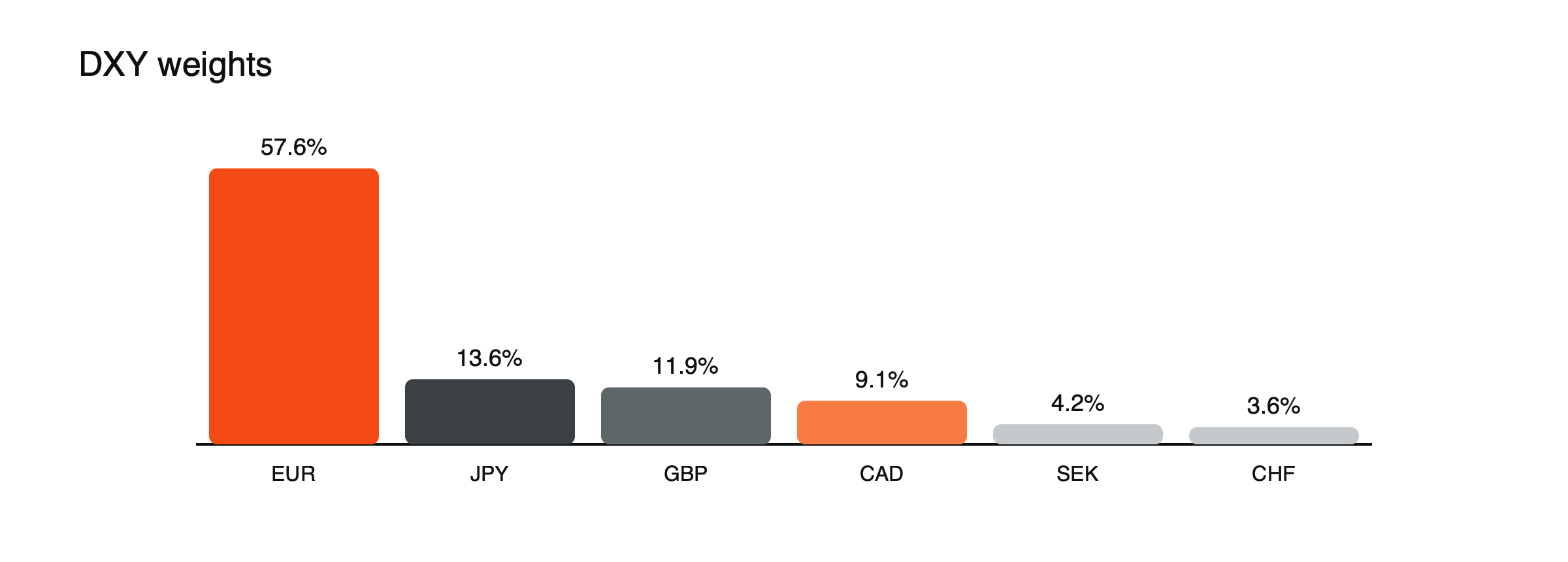
Figure: DXY currency weights. Source: ICE via Wikipedia.
How it is calculated
The index is a weighted geometric average of the dollar’s exchange rates against these currencies. It is published by ICE and traded as a futures contract.
The formula, worked through
The index multiplies a constant by each exchange rate raised to the power of its weight, with a minus sign for pairs in which the dollar is the quote currency, such as EUR/USD and GBP/USD, so that a stronger dollar always raises the index. The practical result is easy to estimate: if EUR/USD rises 1% while every other rate is unchanged, the index falls by about 0.57%. If USD/JPY rises 1% alone, the index rises by only about 0.14%. A 1% move in USD/SEK changes it by about 0.04%. The euro’s weight means European news can move the “dollar index” more than many US events.
History
- March 1973: set at 100 after the Bretton Woods system ended.
- February 1985: record high near 164, before the Plaza Accord. See the Plaza Accord.
- March 2008: record low near 71.
- September 2022: a 20-year high near 114 as the Fed raised rates fast.
Why the weights look the way they do
The basket was set when the index was launched in 1973 and originally included ten currencies. When the euro replaced the Deutsche Mark, French franc, Italian lira and others in 1999, their weights were combined into the euro’s, creating today’s six-currency basket. The weights have not been updated for decades, which is why the index says little about the dollar’s value against China, Mexico or other large trading partners of the United States.
Highs and lows in context
The record high near 164 in February 1985 came after years of high US interest rates, and the dollar’s fall afterward was helped along by the Plaza Accord. The low near 71 in March 2008 came as the US housing crisis deepened and the Federal Reserve cut rates. The 2022 high near 114 reflected rapid Fed rate rises, an energy shock in Europe and safe-haven demand. Each extreme matched a period when US interest rates were moving sharply relative to the rest of the world.
What it is used for
A quick gauge of broad dollar strength, which affects commodities, emerging markets and crypto. See how a strong dollar hits commodities, emerging markets and crypto.
How traders use the DXY
Traders use the index to check whether a move in one pair is about the dollar or about the other currency. If EUR/USD falls while the DXY rises and USD/JPY and GBP/USD also move in the dollar’s favor, the story is broad dollar strength. If EUR/USD falls but other dollar pairs are flat, the euro is the driver. The index is also watched by commodity, emerging market and crypto traders, because a stronger dollar tends to weigh on assets priced in dollars.
Trading the index itself
The DXY is traded as a futures contract on ICE, and some brokers offer CFDs on the index. Exchange-traded funds that track the dollar against a basket are also available. Because the index is dominated by the euro, a position in it behaves much like a short EUR/USD position with smaller additions from the yen, pound and others.
Limits
The weights reflect 1973 trade patterns. China and Mexico, now major US trading partners, are not included, and the euro dominates. The Federal Reserve publishes a broader trade-weighted index with many more currencies.
See what moves currency prices and what moves EUR/USD.
The Fed’s broad dollar index
The Federal Reserve publishes a broad trade-weighted dollar index covering the currencies of many more US trading partners, including China and Mexico, with weights updated to reflect current trade. It gives a more balanced picture of the dollar’s value for the US economy. The two usually move in the same direction, but the size of moves can differ noticeably, especially when the euro behaves differently from Asian and Latin American currencies.
Common misreadings
- Treating the DXY as a complete measure of the dollar’s value worldwide.
- Forgetting that European news can move the index as much as US news.
- Assuming a DXY record means the dollar is at a record against every currency.
A DXY move, broken down
Suppose on one day EUR/USD falls 1%, USD/JPY rises 0.5% and the other four rates are unchanged. (Illustrative moves.) The euro’s move lifts the index by about 0.58% and the yen’s by about 0.07%, for a total rise of about 0.65%. Almost nine-tenths of the change came from the euro. Breaking a DXY move down this way shows which currency is actually driving the headline dollar story.
Reading the DXY with yields and gold
The index is often read alongside US Treasury yields and gold. A rising DXY with rising yields usually reflects expectations of tighter US policy. A rising DXY with falling yields and rising gold more often signals fear and safe-haven buying. A falling DXY with rising gold can point to doubts about the dollar itself. The combination tells a more complete story than the index alone.
The DXY and emerging markets
A strong dollar tightens financial conditions for countries and companies that borrow in dollars, making their debts more expensive to service. Periods of a sharply rising DXY have often coincided with pressure on emerging market currencies and assets, while a weakening dollar has tended to ease it. See how a strong dollar hits commodities, emerging markets and crypto.
What moves the DXY
Because the index is mostly the euro, it responds to both sides of the Atlantic. US jobs and inflation data, Federal Reserve decisions and Treasury yields move it through the dollar side. ECB decisions and euro area data move it through the euro side, often just as strongly. Global risk mood matters too: in a broad sell-off, demand for dollars usually lifts the index, unless the shock comes from the United States itself. Japan’s policy and interventions add smaller effects through the yen’s weight. Watching both the Fed and the ECB calendars therefore explains more of the index’s moves than watching US news alone. A simple routine is to note, each morning before trading, whether the index is being moved mainly by the euro, the yen or broad demand for the dollar itself.
Frequently asked questions
Why does the DXY fall when EUR/USD rises?
Because the euro makes up 57.6% of the index and EUR/USD is quoted as dollars per euro. A rising EUR/USD means a weaker dollar against the euro, which pulls the index down.
Is the DXY the best measure of the dollar?
It is the most widely quoted, but broad trade-weighted indices that include more currencies, such as the Federal Reserve’s, better reflect the dollar’s value against all major US trading partners.
This article is educational content and does not constitute financial, investment, legal or tax advice. Digital assets are volatile and you may lose the amount you invest.
Sources
- U.S. Dollar Index (weights; started March 1973 at 100; ICE) — Wikipedia
- The US Dollar Index (formula; low about 70.7 in March 2008; high about 164.7 in February 1985; fixed 1973 weights) — Fin Still
- The Dollar Index (near 114 in September 2022) — BIT Knowledge Hub
- The dollar index is lying to you (Fed broad index includes China and Mexico; euro weight much lower) — No01 Substack