
What Moves Copper Prices?
Copper moves on Chinese demand, electrification and data centers, mine supply, inventories and the dollar. How each driver works, with the 2026 record.

Copper prices move on industrial demand, above all from China, which uses close to 60% of refined copper; on grids, electric vehicles and data centers; on mine supply and inventories; and on the dollar. New mines take years, so supply responds slowly. Copper hit a record near $14,600 a tonne in September 2026.
Where copper goes
| Use | Why it needs copper |
|---|---|
| Construction | Wiring, plumbing and fittings in buildings |
| Power grids | Cables, transformers and connections |
| Electronics and equipment | Circuits, motors and appliances |
| Transport | Wiring in vehicles; much more in electric vehicles |
| Industrial machinery | Motors, generators and heat exchangers |
Copper’s excellent conductivity and durability make it hard to replace, which is why demand follows building, manufacturing and the expansion of electricity systems so closely.
Chinese demand
Construction, manufacturing and grid investment in China dominate demand, so Chinese data and policy announcements move copper. See how China’s policy moves ripple into commodities.
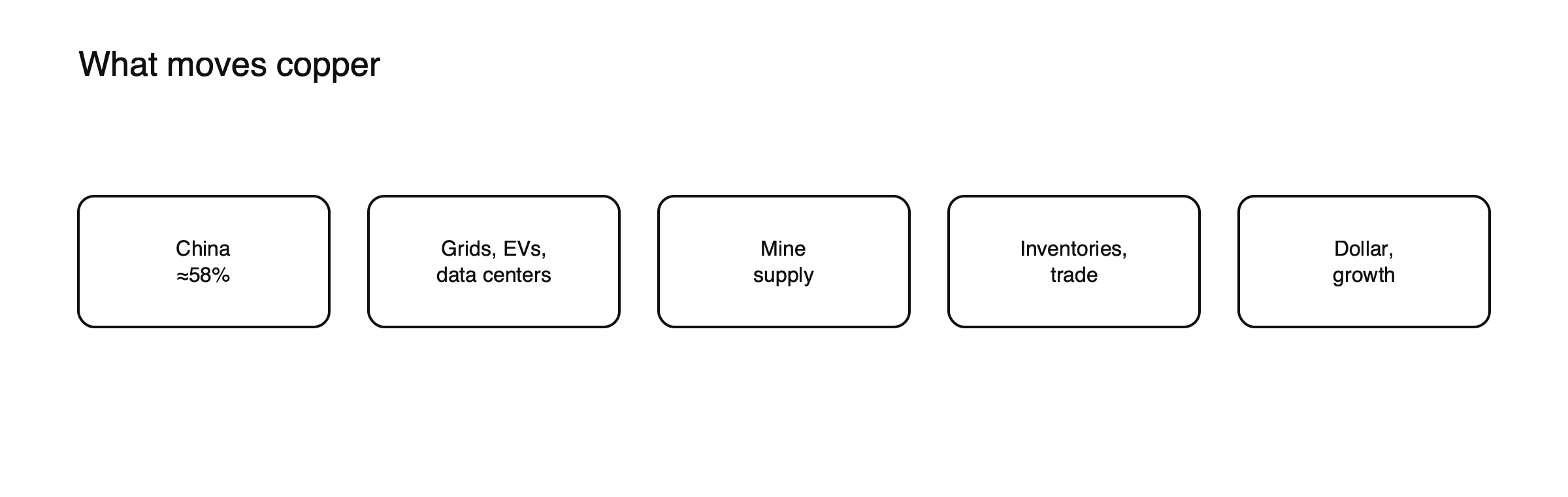
Figure: The main copper drivers.
Electrification and data centers
Power grids, renewables, electric vehicles and AI data centers are adding new demand; data-center construction alone may absorb roughly as much copper in 2026 as the whole year’s growth in global consumption.
Grids, electric vehicles and data centers
An electric vehicle uses several times as much copper as a conventional car, mostly in its motor, battery connections and wiring, and charging networks add more. Power grids need to expand and be upgraded to carry electricity from wind and solar farms, which is copper-intensive. Data centers built for artificial intelligence need large amounts of power infrastructure and cabling. Together, these sources of demand have changed copper’s story from one mainly about Chinese construction to one about the global energy system.
Mine supply
Disruptions at major mines and falling ore grades limit output. Production by major producers fell in the first half of 2026.
Why supply is slow to respond
Much of the world’s copper comes from a handful of countries, led by Chile and Peru in South America, with the Democratic Republic of Congo and others growing in importance. Ore grades at many older mines are falling, so more rock must be processed for the same output. Developing a new mine, from discovery through permits and construction, typically takes many years. That means higher prices cannot quickly bring new supply, and disruptions at large mines, from accidents, strikes or water shortages, can tighten the market for months.
Scrap and recycling
Copper can be recycled without losing its properties, and scrap supplies a significant share of the metal used each year. When prices rise, more scrap is collected and processed, adding supply faster than new mines can. Recycling therefore acts as a partial brake on price spikes, though it cannot fully offset a sustained shortage of mined metal.
Inventories and trade flows
Low exchange inventories and metal moving into the US ahead of possible tariffs have tightened supply elsewhere.
Tariffs and the US premium
In 2025 and 2026, concern that the United States might place tariffs on copper imports led traders to ship large amounts of metal into the country before any duties took effect. Copper prices on New York’s COMEX exchange traded at a premium to London prices at times, and stocks outside the US tightened. Trade policy, not only mining and demand, became a direct driver of where copper was located and what it cost in each market.
The dollar and growth
Copper is priced in dollars and is sensitive to the global economic cycle, earning the nickname “Dr. Copper.”
London, New York and Shanghai
Copper trades on three main exchanges: the London Metal Exchange, quoted in dollars per tonne; COMEX in New York, quoted in cents per pound; and the Shanghai Futures Exchange, quoted in yuan per tonne. Prices usually move together, but differences in local supply, tariffs and currency can open gaps between them. Copper CFDs follow one of these markets, so checking which, and in what units, avoids confusion when comparing prices with the news.
Volatility
Copper fell about 7% in March 2026 after the US–Iran conflict, then recovered to record highs. See what a commodity supercycle is and how commodity CFDs work.
Copper’s 2026 run
Copper’s path in 2026 showed most of these drivers at once. After the US–Iran conflict began in March, prices fell about 7% as investors worried about global growth. They then recovered and went on to a record of $14,624.50 a tonne on the London Metal Exchange, supported by demand from grids, electrification and data centers, falling output at major producers in the first half of the year and tight inventories outside the United States. The swing from a sharp fall to a record within months illustrates how quickly copper’s story can shift between growth fears and supply shortages.
Dr. Copper as a signal
Because copper is used across so much of the economy, its price is often read as a signal of global growth. Rising prices can point to strong industrial activity, and falling prices to a slowdown. The nickname has limits today: supply problems, tariffs and new sources of demand such as data centers can push copper up even when the broader economy is soft.
Trading copper CFDs
Copper CFDs usually follow futures and roll at expiry. Under EU retail rules they carry a maximum leverage of 10:1, like other commodities apart from gold. Daily moves of 2% to 3% are common in volatile periods, and Chinese data releases often arrive during Asian hours. Sizing positions from the stop and the contract’s value per point, rather than from available margin, keeps copper’s swings in proportion. See how to size a CFD position using risk per trade.
Copper inventories explained
Copper stocks held in warehouses approved by the London Metal Exchange, COMEX and the Shanghai Futures Exchange are published regularly. Low or falling inventories, especially when metal is being withdrawn for delivery, signal tight supply and can lift prices or create backwardation in the futures curve. Large inflows to one exchange, such as the movement of metal into the United States ahead of possible tariffs, can tighten supply elsewhere even if global stocks are unchanged.
Substitution
When copper becomes very expensive, some users switch to cheaper materials, such as aluminum in some cables and heat exchangers or plastic in plumbing. Substitution is slow and limited, because copper’s properties are hard to match, but it can gradually cap demand when prices stay high.
A copper checklist
- What are Chinese data and policy signals showing?
- Are major mines reporting disruptions?
- Are exchange inventories falling or rising?
- Is trade policy moving metal between markets?
Common misreadings
- Treating copper as a pure growth signal.
- Comparing prices across exchanges without converting units.
Seasonal rhythms
Chinese demand often slows around the Lunar New Year holiday and picks up afterward as factories and construction sites restart, which can affect inventories and prices in the first quarter. Such patterns are well known and usually priced in, but an unusually strong or weak restart after the holiday can move the market.
Copper and interest rates
Higher interest rates can weigh on copper by slowing construction and manufacturing and by raising the cost of holding inventories. Lower rates tend to support demand. The effect works with a delay and is often overshadowed by supply news, but it is part of why copper reacts to central bank decisions. Rate cuts in China, where most copper is used, can matter as much for copper as decisions by the US Federal Reserve. Chinese stimulus announcements, such as support for infrastructure or property, often move copper within hours.
Frequently asked questions
Why is copper called Dr. Copper?
Because its price has often tracked the health of the global economy, rising in expansions and falling in slowdowns, as if it had a doctorate in economics.
Can copper prices rise during a slowdown?
Yes, if supply is disrupted or new demand, such as grid investment, offsets weaker construction and manufacturing.
This article is educational content and does not constitute financial, investment, legal or tax advice. Digital assets are volatile and you may lose the amount you invest.
Sources
- Copper hits record amid weak output (LME record $14,624.50 a tonne; output fell 1.1% in the first half; grids, electrification and data centers) — Saxo, September 2026
- Copper: the perfect squeeze? (China about 58% of refined demand; data centers absorbing about a year’s demand growth) — Hellenic Shipping News, 2026
- Copper near record high as US tariff fears and AI demand tighten market (7% pullback in March after the US–Iran conflict) — Caixin, September 2026
- ESMA adopts CFD measures (gold 20:1; commodities other than gold 10:1) — Finadium