
How High-Frequency Trading Changed Spreads
Decimal prices and electronic markets let high-frequency traders compete on speed, narrowing spreads but raising new risks. A timeline from 2000 to today.
High-frequency trading (HFT) uses fast computers to quote and trade thousands of times per second. Helped by decimal pricing in 2000 and linked electronic markets from 2005, HFT firms became dominant market makers and competed spreads down to fractions of a cent. The trade-off: speed-driven crashes, spoofing and a costly technology race.
Timeline
- 2000: the SEC requires US exchanges to quote in decimals instead of fractions, allowing much tighter spreads.
- 2005: Regulation NMS links trading venues and pushes orders to the best displayed price, rewarding speed.
- May 6, 2010: the “flash crash” temporarily wipes nearly $1 trillion off US stock values within minutes.
- 2012: the SEC approves limit up–limit down bands that pause individual stocks moving too fast.
- 2016: a UK trader pleads guilty to spoofing linked to the 2010 flash crash.
- 2020: JPMorgan pays more than $920 million over spoofing, the largest such penalty.
- 2020s: most US share volume trades in stocks quoted at spreads under 1.5 cents.
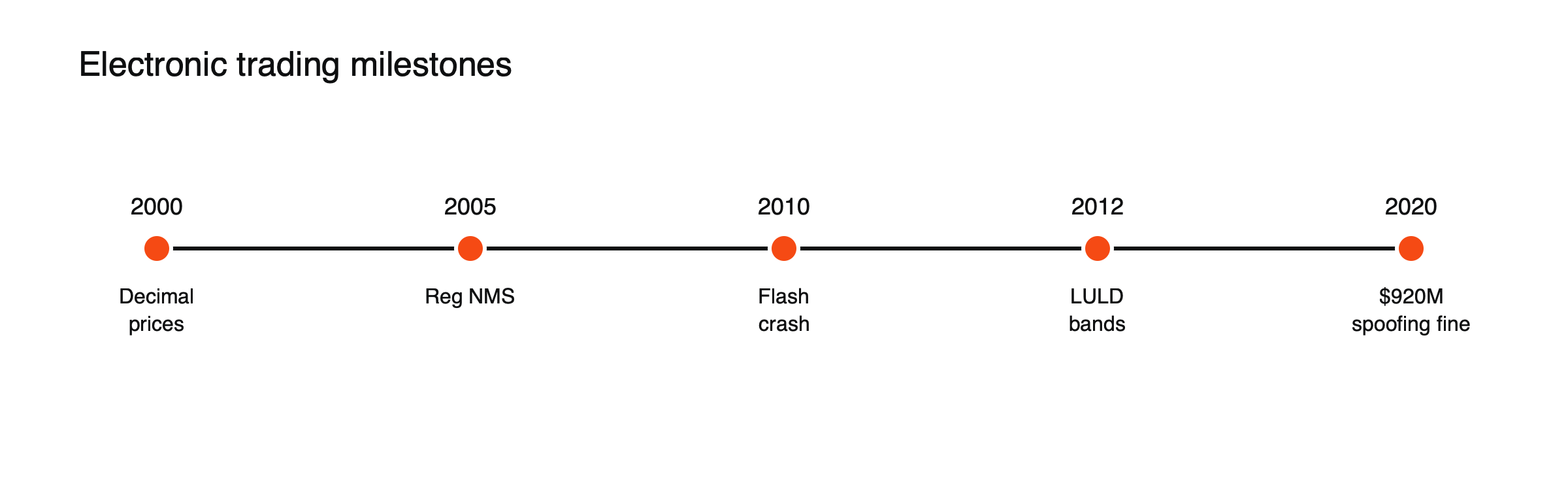
Figure: Milestones in electronic trading.
From fractions to pennies, illustrated
Before 2001, US shares were quoted in fractions such as sixteenths of a dollar, so the smallest possible spread was 6.25 cents. (Historical tick size.) On a 1,000-share trade, that minimum spread cost $62.50. After decimalization, spreads in liquid stocks fell to a cent or less, cutting the same trade’s spread cost to $10 or below. Multiplied across billions of shares a year, the savings for investors were enormous, and the narrower spreads also made market making a game of volume and speed rather than wide margins.
The race for speed
As spreads narrowed, profits depended on being first. Firms placed servers next to exchange computers, a practice known as co-location, to cut travel time to microseconds. In 2010, a new fiber-optic route between Chicago and New York shaved milliseconds off futures-to-shares trading, and microwave networks later cut times further because signals travel faster through air than glass. Each advance gave early adopters a temporary edge until rivals caught up.
What improved
Quoted spreads narrowed sharply, and trading costs for ordinary investors fell, especially for large, liquid stocks.
Knight Capital, 2012
On August 1, 2012, a software problem at Knight Capital, then one of the largest US market makers, sent a flood of erroneous orders into the market for about 45 minutes, affecting about 150 stocks. The firm realized a pre-tax loss of about $440 million, wiping out much of its capital and forcing a rescue. The episode showed how quickly an automated trading error could threaten a major firm and disrupt markets.
What got worse
- Fragility: liquidity can vanish in milliseconds when algorithms pull back.
- Manipulation: fake orders can mislead other algorithms. See how market surveillance catches manipulation.
- Arms race: firms spend heavily on speed, a cost some argue adds little social value.
What it means
Tight spreads are real, but depth can be fleeting. See how market makers make money, why payment for order flow is so controversial and how circuit breakers work.
Speed bumps and reforms
Critics argued that ultra-fast traders could profit by reacting to orders before slower investors. One response was a new exchange design with a tiny built-in delay, a “speed bump” of 350 microseconds, intended to blunt the advantage of the fastest traders; it won approval as a US exchange in 2016. Regulators also updated rules on order routing disclosures and execution quality reports, and adopted the limit up–limit down bands after the 2010 flash crash.
HFT beyond shares
High-frequency firms are major liquidity providers in futures, currencies, options and crypto. In currency markets, electronic market makers quote prices to banks and brokers around the clock. In crypto, many of the same firms provide liquidity on exchanges, though with fewer rules on conduct and surveillance than in regulated markets.
Who benefits, illustrated
Suppose a long-term investor buys 500 shares twice a year. (Illustrative scenario.) Narrower spreads save a few dollars per trade, a modest benefit. An active trader making 20 trades a day saves far more. But in a crisis, when HFT liquidity pulls back, both may face much wider spreads than the calm-day averages suggest. The benefits are real but uneven, and they shrink precisely when markets are most stressed. See why institutional traders care about market depth.
Latency arbitrage
One controversial HFT strategy, latency arbitrage, profits from seeing price changes on one venue a fraction of a second before others and trading on the slower venue before it updates. Critics argue it amounts to a tax on slower investors; defenders say it keeps prices aligned across venues. Speed bumps and other market design changes were partly aimed at reducing this advantage.
Algorithms and humans
Today, most trading in major markets is driven by algorithms, from HFT firms’ strategies to the execution algorithms that institutions use to slice large orders. Human traders still make strategic decisions, but the moment-to-moment interaction in order books is largely between machines. That shift explains why markets can move so quickly, and why surveillance and risk controls must also be automated. See how market surveillance catches manipulation.
Lessons for retail traders
For retail traders, HFT mostly means tighter spreads in normal conditions. It also means that liquidity can disappear in seconds, that stop orders may fill at worse prices in fast markets and that trying to compete on speed is futile. Using limit orders in volatile moments and avoiding trading in the first seconds after major news reduces exposure to the fastest market moves.
Common misreadings
- Blaming HFT for every crash.
- Assuming tighter spreads mean deeper markets.
The flash crash, step by step
On May 6, 2010, markets were already nervous about Europe’s debt crisis. In the afternoon, a fund began selling about $4.1 billion of stock index futures through an algorithm that sold based on volume, without regard to price or time. High-frequency traders initially bought, then sold to each other rapidly, and many withdrew as prices fell. For minutes, some shares traded at absurd prices. Prices recovered most of the fall within minutes, and nearly 21,000 trades were later canceled. See what happened in the 2010 flash crash.
Rules for algorithms
Regulators now require firms using algorithms to test them, set risk limits and maintain kill switches that can stop trading instantly. Europe’s rules since 2018 require algorithmic traders to be authorized and to keep records of their strategies.
Who provides liquidity now
In US shares, a handful of large electronic firms, including wholesalers such as Citadel Securities and Virtu, handle a large share of trading, especially retail orders. Similar firms are major market makers in futures, options, currencies and crypto. Their scale and technology give them advantages in speed and risk management, raising questions about concentration in a market function that was once spread across many human dealers.
The cost of speed
Firms spend heavily on data feeds, co-location, custom hardware and private networks to shave microseconds off trading times. Critics argue that much of this spending simply redistributes profits among fast traders without improving markets for others. Supporters say speed allows market makers to update quotes quickly and offer tighter spreads with less risk.
The 2020s
By the 2020s, competition among high-frequency firms had narrowed spreads so much that profits per trade were tiny, and the industry consolidated. Attention shifted toward new markets, such as crypto and extended-hours trading, and toward regulation of order routing and execution quality.
Lessons from the HFT era
The story of high-frequency trading shows that market structure changes, from tick sizes to venue rules, can transform who trades and how. Each change brought benefits, mainly lower costs, and new risks, mainly speed-driven instability. Regulators have responded with pauses, circuit breakers, surveillance and algorithm controls, aiming to keep the benefits while limiting the risks. For traders, the practical lessons are to respect liquidity, which can vanish quickly, to use order types that control prices in fast markets and to recognize that competing on speed with professional firms is not a realistic strategy. Understanding how modern markets work, including who provides liquidity and when it disappears, is one of the most practical forms of risk management available to any individual trader, whether trading shares, currencies, futures or crypto.
Frequently asked questions
Is high-frequency trading legal?
Yes. Using speed to trade is legal; manipulative practices such as spoofing are not.
Does HFT make markets more volatile?
It narrows spreads in normal times, but it can withdraw liquidity quickly in stress, contributing to sharp short-term moves.
This article is educational content and does not constitute financial, investment, legal or tax advice. Digital assets are volatile and you may lose the amount you invest.
Sources
- SEC Chair Gensler speaks on modernizing equity markets (decimalization in 2000; rules from 2005; 74% of volume quoted under 1.5 cents) — CLS Blue Sky Blog, October 2024
- Spoofing: QuickTake (Sarao guilty plea in 2016; May 2010 flash crash wiped almost $1 trillion temporarily; JPMorgan $920 million) — Bloomberg
- What are circuit breakers? (LULD approved by the SEC in 2012) — Moomoo
- Knight Capital Group provides update regarding August 1st disruption (erroneous orders in NYSE-listed securities; realized pre-tax loss of approximately $440 million) — Knight Capital Form 8-K, SEC, August 2, 2012
- When speed kills (Knight lost $440 million in about 45 minutes; incorrect bids for about 150 stocks) — The Japan Times, August 2012
- Regulators release flash crash probe report ($4.1 billion sell program; nearly 21,000 trades canceled) — PlanAdviser / AP
- Robinhood gets boost as Congress declines ban (Citadel Securities and Virtu as market makers) — Fox Business