
What Zero-Commission Trading Really Changed
In October 2019, Schwab, TD Ameritrade and E*Trade cut stock commissions to zero within days. How brokers replaced the revenue and what it changed.
Zero-commission trading became the US standard in October 2019, when Charles Schwab cut online stock commissions from $4.95 to zero and TD Ameritrade and E*Trade matched within days. Trading did not become free: brokers earned instead from payment for order flow, interest on cash and other services, and drew in many new traders.
Timeline
- 2015 onward: app-based brokers such as Robinhood offer commission-free trading funded largely by payment for order flow.
- Late September 2019: Interactive Brokers launches a commission-free service.
- October 1, 2019: Schwab announces zero commissions; its shares fall about 10%, TD Ameritrade’s nearly 26% and E*Trade’s about 16%.
- October 2019: TD Ameritrade and ETrade follow; ETrade estimates a cost of about $75 million a quarter.
- Late 2019–2020: consolidation follows, including Schwab’s deal for TD Ameritrade.
- January 2021: the meme-stock surge shows how many new retail traders the model had attracted.
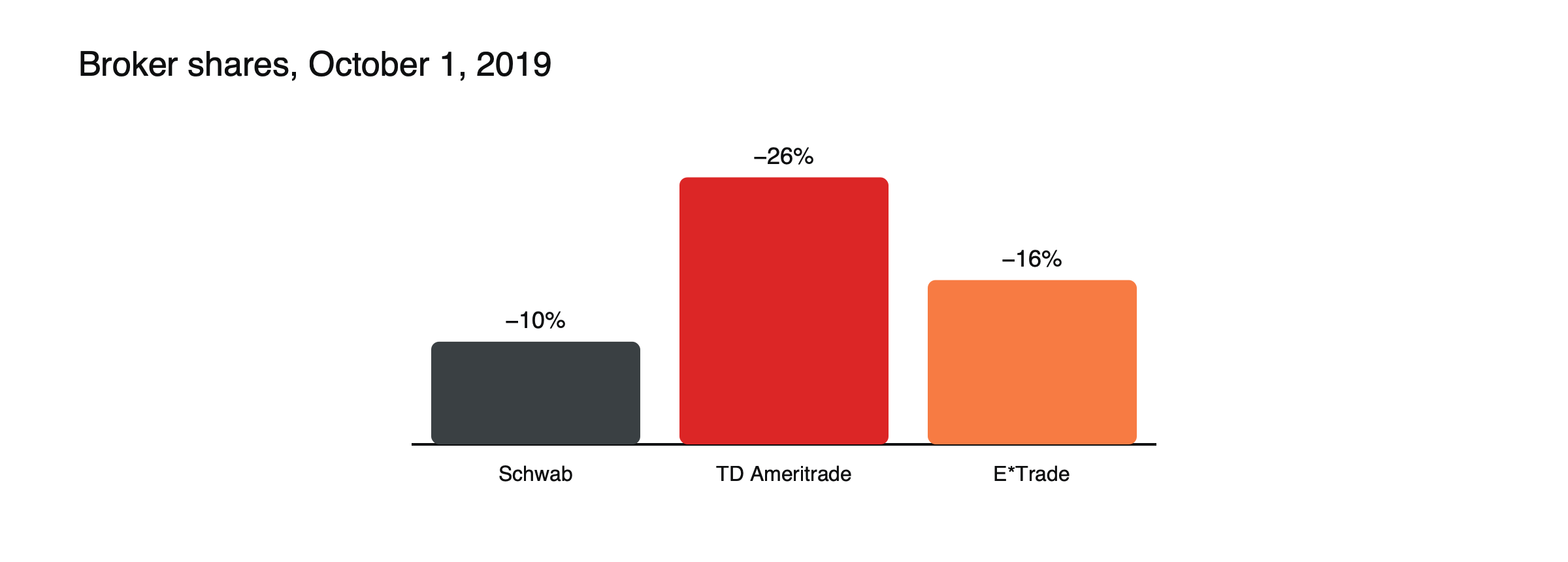
Figure: Brokers’ share prices on the day zero commissions arrived. Source: NPR.
How a free trade is paid for, illustrated
Suppose a customer buys 100 shares through a zero-commission broker. (Illustrative scenario.) The broker routes the order to a wholesale market maker, which pays the broker a fraction of a cent per share, say $0.20 for the order. The market maker fills the order at or slightly better than the best quoted price and earns part of the spread. Meanwhile, the customer’s uninvested cash earns interest for the broker, which may pass on only part of it. No commission appears, but the broker earns from routing and from cash, and the customer’s true cost depends on execution quality and cash interest.
Revenue source 1: payment for order flow
Market makers pay brokers for retail orders. See why payment for order flow is so controversial.
Revenue source 2: interest on client cash
For large brokers such as Schwab, net interest income was already the majority of revenue.
Revenue source 3: other products
Options, margin lending, subscriptions and other services.
Robinhood and the meme-stock moment
In January 2021, a surge of retail buying in GameStop and other heavily shorted shares showed the power of the new generation of commission-free traders. On January 28, Robinhood restricted purchases of several of these stocks, citing clearing deposit requirements, sparking public anger and congressional hearings. Weeks earlier, in December 2020, the SEC had charged Robinhood over misleading customers about its revenue from payment for order flow and execution quality, with the firm agreeing to pay $65 million. See what happened in the GameStop short squeeze.
Europe and the UK
Zero-commission models spread to Europe too, but rules differed. The UK has effectively banned payment for order flow since 2012, and the EU adopted a ban with a transition period ending June 30, 2026. Brokers there have relied more on other revenue, such as currency conversion fees, subscriptions and interest. See why payment for order flow is so controversial.
What it changed for traders
Small trades became economical, and fractional shares spread. But costs moved to less visible places, such as execution quality and spreads, and some research links free trading to more frequent, less profitable trading.
Lessons
Zero commission is not zero cost. Compare execution quality, spreads, cash interest and fees. See why best execution matters for traders and why trading platforms are going multi-asset.
Consolidation in the industry
Cutting commissions squeezed smaller brokers, accelerating mergers. Schwab agreed to buy TD Ameritrade in late 2019, and Morgan Stanley agreed to buy E*Trade in 2020. Scale became essential, because interest income on large client cash balances and a broad product range could support free trading in a way that commissions alone no longer did.
The cost of cash
Interest on client cash became a central revenue source, especially when rates rose after 2022. Some brokers paid clients little on uninvested balances while earning far more themselves, drawing criticism and, in some cases, legal challenges. Comparing the rate paid on cash has become as important as comparing trading costs.
The behavioral effect
Free trading, mobile apps and features such as notifications and fractional shares made trading easier and more frequent. Research suggests that more frequent trading tends to reduce returns for most individual investors, because costs, timing errors and emotion add up. Removing the commission removed one natural brake on overtrading.
Price improvement claims
Brokers using payment for order flow often point to price improvement: fills slightly better than the best public quote. Execution quality reports published under US rules allow comparison, though the figures depend on how they are measured and which orders are included. Investors comparing brokers can look at average price improvement per order and the share of orders improved, alongside other costs. See why best execution matters for traders.
Fractional shares
Zero commissions made fractional shares practical: buying $10 of a share priced at $500 makes sense only if there is no fixed fee. Fractional investing opened expensive shares to small accounts and enabled regular small investments, though fractional positions may not be transferable between brokers.
Options and margin
Options trading and margin lending became important profit centers for zero-commission brokers. Options orders generate higher payments for order flow than share orders, and margin loans earn interest. Critics argue that app features promoting options can encourage risky trading by inexperienced investors.
Common misreadings
- Equating zero commission with zero cost.
- Assuming every broker offers the same execution quality.
How brokers compete now
With commissions gone, brokers compete on other features: the interest paid on cash, the range of products, research and tools, user experience, fractional shares, access to extended-hours trading and the quality of execution. Some charge subscription fees for premium features or data. For investors, the right broker depends on which of these matter most for their own activity.
A broker checklist
- What interest is paid on uninvested cash?
- How does the broker earn money from my orders?
- What do execution quality reports show?
- What fees apply to currency conversion, transfers or inactivity?
- Which protections, such as segregation and compensation schemes, apply?
The legacy of 2019
The October 2019 cuts, which sent the share prices of several large brokers sharply lower on the day, turned commission-free trading from a start-up feature into the industry standard almost overnight. They reshaped how brokers earn money and drew millions of new investors into markets.
Free trading beyond shares
The zero-commission model spread to other assets. Many crypto apps advertise no commission but charge through spreads or conversion fees. CFD providers have long charged mainly through spreads rather than commissions on many products, with overnight financing for positions held longer. In each case, the absence of a commission tells little about the total cost. See CFD trading costs.
Did free trading help investors?
For long-term investors making occasional purchases, zero commissions clearly cut costs and made regular investing easier. For active traders, the picture is mixed: lower explicit costs encouraged more frequent trading, and research links frequent trading with lower returns. Free trading also opened markets to people who previously found them too expensive, broadening participation.
Effects on market structure
The growth of commission-free retail trading increased the share of orders handled by wholesale market makers rather than exchanges, and raised questions about competition in order execution. Regulators examined proposals to change how retail orders are handled, though a major US proposal was withdrawn in 2025.
The rise of the retail investor
Commission-free trading coincided with a surge in retail participation. Retail trading’s share of US share volume rose sharply during 2020 and 2021, and retail investors became a visible force in popular stocks and options. Platforms began publishing data on what their customers were buying, and analysts started tracking retail flows as a market indicator. See the retail trading boom.
Lessons for traders
The main lesson of zero commissions is to look beyond the headline. Execution quality, spreads, cash interest, financing costs and product features all determine what trading really costs, and the cheapest-looking option is not always the cheapest in practice. Comparing these costs for your own actual pattern of trading, rather than a typical customer’s, gives the clearest and most useful answer.
Frequently asked questions
Is zero-commission trading really free?
No. Costs are shifted to spreads, execution quality, cash interest and other fees.
Does payment for order flow hurt investors?
Opinions differ: supporters point to price improvement, while critics cite conflicts of interest; some markets have banned it.
This article is educational content and does not constitute financial, investment, legal or tax advice. Digital assets are volatile and you may lose the amount you invest.
Sources
- 3 online brokers cut commissions to zero (Schwab from $4.95; share reactions; E*Trade about $75 million a quarter) — NPR, October 1, 2019
- E*Trade ends commissions (follows Interactive Brokers’ commission-free launch a week earlier) — WealthManagement.com, October 2019
- Charles Schwab triggers online broker bloodbath (majority of Schwab revenue from net interest income) — BNN Bloomberg, October 2019
- Payment for Order Flow (Robinhood popularized the model from 2015) — Fin Still
- Payment for Order Flow Explained (UK banned since 2012; EU ban under MiFIR with transition to June 30, 2026) — LearnSignal
- Payment for Order Flow (Robinhood $65 million SEC settlement) — University of Miami International and Comparative Law Review
- What were the biggest short squeezes in history? (GameStop at $17.25 before the surge; Robinhood halted purchases on January 28, 2021) — IG
- Payment for order flow (SEC proposal withdrawn in 2025) — Wikipedia