
Why Central Bank Independence Matters to Markets
Markets trust independent central banks to fight inflation even when it hurts. What the 1970s showed about political pressure and why credibility matters.
Central bank independence matters because markets need to believe that policymakers will raise rates to fight inflation even when it is politically painful. When that belief weakens, investors demand higher long-term yields and the currency can fall. The 1970s are the classic warning: political pressure to keep rates low helped let US inflation climb to 14.8% by 1980.
The 1970s lesson
President Nixon pressed Fed Chair Arthur Burns to keep monetary policy easy ahead of the 1972 election, and the Fed did. Inflation rose from about 3% at the end of 1972 to over 11% by 1975 and over 14% by 1979. Burns later said it was “illusory” to expect central banks to curb inflation under such pressure. Paul Volcker, appointed in 1979, raised the federal funds rate to 20% by June 1981 and caused a deep recession, but restored credibility. See what 1970s inflation teaches today’s markets.
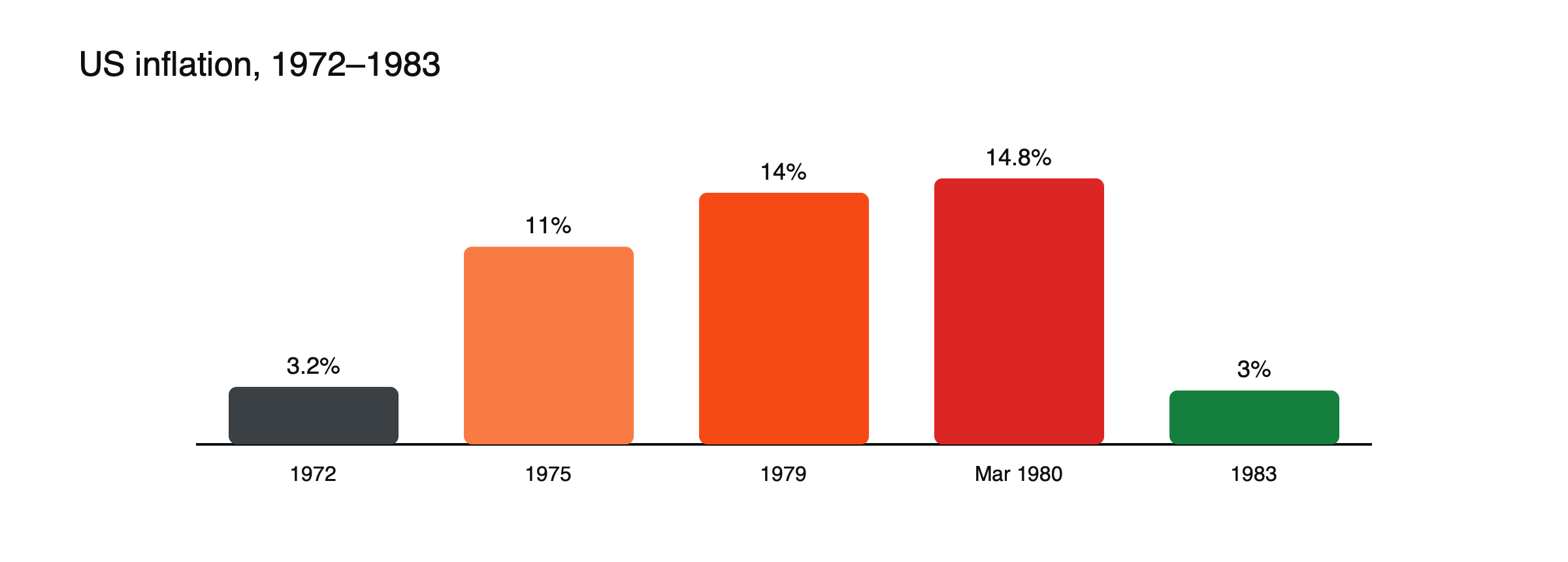
Figure: US inflation before and after the Volcker shock.
The Volcker turn
Inflation peaked at about 14.8% in March 1980. Under Chair Paul Volcker, the Fed raised its policy rate to about 20% by June 1981, accepting deep recessions to break inflation. The policy was politically painful but restored the Fed’s credibility, and inflation fell sharply during the 1980s. The episode became the model for independent central banks: willing to impose short-term pain to secure long-term price stability.
How markets price independence
- Inflation expectations: credible central banks keep long-term expectations anchored, so short-term shocks fade.
- Long-term yields: doubts about independence add a risk premium to long bonds.
- Currencies: perceived political control of rates tends to weaken a currency.
A credibility premium, illustrated
Suppose two countries have the same current inflation of 4%, but investors trust one central bank to bring inflation back to 2% and doubt the other. (Illustrative scenario.) Long-term inflation expectations might be 2.2% in the first and 3.5% in the second. Investors demand higher long-term yields to compensate, perhaps 1.5 points more, and the second country’s currency tends to weaken over time. The difference reflects credibility, not current inflation.
A modern case: Turkey
From 2021, Turkey’s central bank cut interest rates despite rising inflation, an easing cycle long sought by the president. The lira lost about 44% against the dollar in 2021 and another 30% in 2022, and annual inflation reached 85.5% in October 2022, its highest since 1998, while the central bank continued cutting its policy rate to 9% by late 2022. The episode showed how quickly a currency and inflation can move when markets doubt a central bank’s commitment to price stability.
Where the line is
Governments set central banks’ mandates, and coordination in a crisis is normal. The concern is when elected officials push for rate decisions that serve short-term political goals over price stability.
What to watch
Appointments, public pressure on officials, changes to mandates and moves in long-term yields and inflation expectations after political statements. See how fiscal deficits affect rates, currencies and stocks and how the ECB and the Fed differ in moving markets.
Fiscal dominance
Economists use the term fiscal dominance for situations where a government’s borrowing needs constrain the central bank, for example by pressuring it to keep rates low so that debt stays affordable. Investors worry about fiscal dominance when debt levels are high and deficits large, because it raises the risk that inflation will be tolerated to ease the debt burden. The 2022 UK gilt crisis showed how quickly bond markets can react to doubts about fiscal policy. See what happened in the UK gilt crisis.
How independence is protected
Most advanced economies give central banks independence through law: fixed terms for governors, rules limiting their dismissal, bans on direct financing of governments and clear mandates. Transparency, through published decisions, minutes and forecasts, also helps, because it shows that decisions follow the mandate rather than political calendars.
Market signals of doubt
When investors start to doubt independence, several signals tend to appear together: long-term yields rise more than short-term yields, inflation breakevens climb, gold strengthens and the currency weakens. A bear steepening of the yield curve driven by inflation fears is one of the clearest warning signs. See why yield curve steepening can mean very different things.
Independence and inflation targets
Most independent central banks now target inflation of about 2%, publish forecasts and explain their decisions in detail. The target gives markets a yardstick: if policymakers appear willing to tolerate inflation well above it for political reasons, investors demand more compensation. Clear targets and transparent reasoning make it harder for political pressure to change policy unnoticed. See what markets listen for in a central bank meeting.
The 1970s in markets
The loss of inflation control in the 1970s hurt bondholders badly, as rising inflation eroded fixed payments and pushed yields higher. Shares struggled in real terms, while gold and commodities soared. When credibility was restored in the early 1980s, the pattern reversed, launching a long bull market in bonds and shares. See what 1970s inflation teaches today’s markets.
Cooperation in crises
Independence does not mean central banks never work with governments. In 2008 and 2020, central banks and governments coordinated closely to stabilize markets, and few investors saw this as a threat to independence, because the actions were temporary and aimed at financial stability. The concern arises when cooperation becomes a lasting commitment to keep rates low regardless of inflation.
Emerging markets
Independence matters even more in emerging markets, where currencies are more fragile and inflation expectations less anchored. Changes in central bank leadership or sudden policy shifts can move their currencies sharply within days.
Common misreadings
- Treating any government comment on rates as a threat to independence.
- Assuming independence guarantees low inflation.
How appointments move markets, illustrated
Suppose markets learn that a new central bank head is expected to favor faster rate cuts despite inflation above target. (Illustrative scenario.) Short-term yields may fall on expectations of easier policy, but long-term yields can rise as investors demand more compensation for inflation risk, steepening the curve. The currency weakens and gold strengthens. If the appointee later signals a firm commitment to the inflation target, much of the move can reverse. Markets judge actions over time, not just announcements.
Independence and the currency
Currencies are especially sensitive to doubts about independence, because foreign investors can move money elsewhere quickly. A central bank seen as committed to low inflation supports demand for its currency; one seen as politically constrained can face persistent outflows.
Independence around the world
Most advanced economies, including the euro area, the UK, Japan and Canada, grant their central banks operational independence. Many emerging markets have also moved toward independent central banks with inflation targets since the 1990s, with generally lower and more stable inflation as a result. Where independence has been weakened, inflation and currency volatility have often risen. See how the ECB and the Fed differ in moving markets.
What investors can do
Investors worried about threats to independence often reduce exposure to long-dated bonds, add inflation-linked bonds or gold and diversify currency exposure. Watching long-term breakeven inflation, the slope of the yield curve and the currency after political statements gives an early read on whether markets are taking the threat seriously. Overreacting to every headline can be costly, because many concerns fade without lasting effects on policy.
Independence and the bond market, illustrated
Suppose long-term inflation expectations rise from 2.3% to 3.0% after doubts emerge about a central bank’s independence, while expected real rates stay unchanged. (Illustrative scenario.) A 10-year government bond yield could rise by about 0.7 points as a result, cutting the price of a bond with a duration of about 8 by roughly 5.6%. Mortgage rates and corporate borrowing costs would follow. The cost of lost credibility falls on borrowers and bondholders across the economy, not just on the government. Restoring credibility, once lost, usually takes years of consistent policy and higher rates in the meantime.
Frequently asked questions
Is the Fed fully independent?
It sets rates without government approval, but its leaders are appointed by the president and confirmed by the Senate, and Congress sets its mandate.
Why do markets care about appointments?
Because new leaders can shift the direction of policy, and markets look for signs of whether they will prioritize price stability.
This article is educational content and does not constitute financial, investment, legal or tax advice. Digital assets are volatile and you may lose the amount you invest.
Sources
- Yes, This is Stagflation (Nixon’s pressure on Burns; Burns called central bank inflation control “illusory”) — Luckbox Magazine
- An Unlikely Hero in the US’s Last Battle with Inflation (inflation from 3.2% in 1972 to over 11% by 1975 and over 14% in 1979) — Propmodo
- The Volcker Mistake (inflation peaked at 14.8% in March 1980; funds rate to 20% in June 1981) — Motley Fool discussion citing Federal Reserve history
- Three lessons from the 1970s’ Great Inflation (credibility and independence) — Livewire Markets
- Turkey’s inflation hits 24-year high of 85.5% after rate cuts (October 2022; policy rate cut 350 bp in three months to 10.5%) — Reuters via Investing.com, November 2022
- Turkey’s inflation falls to 64.27% in December (lira lost 44% in 2021 and another 30% in 2022; policy rate cut to 9%) — Reuters via AGBI, January 2023
- Putting out the NBFIre (30-year gilt yield up about 140 bp in three days) — SUERF