
Why Global Markets Watch Japan’s Bond Market
Japanese investors hold over $3 trillion abroad and are the top foreign owners of US Treasuries. Why rising Japanese yields can move global bonds and the yen.

Global markets watch Japan’s bond market because Japanese investors are among the world’s biggest lenders, with more than $3 trillion abroad in 2022. Japan is the largest foreign holder of US Treasuries, about $1.1 trillion at the end of 2023. When Japanese yields rise, some of that money can come home, pushing yields up elsewhere.
Why Japanese money went abroad
For years, the Bank of Japan held short-term rates negative and capped 10-year government bond yields near zero. Japanese banks, pension funds and insurers looked abroad for higher returns, becoming major buyers of US and European bonds.
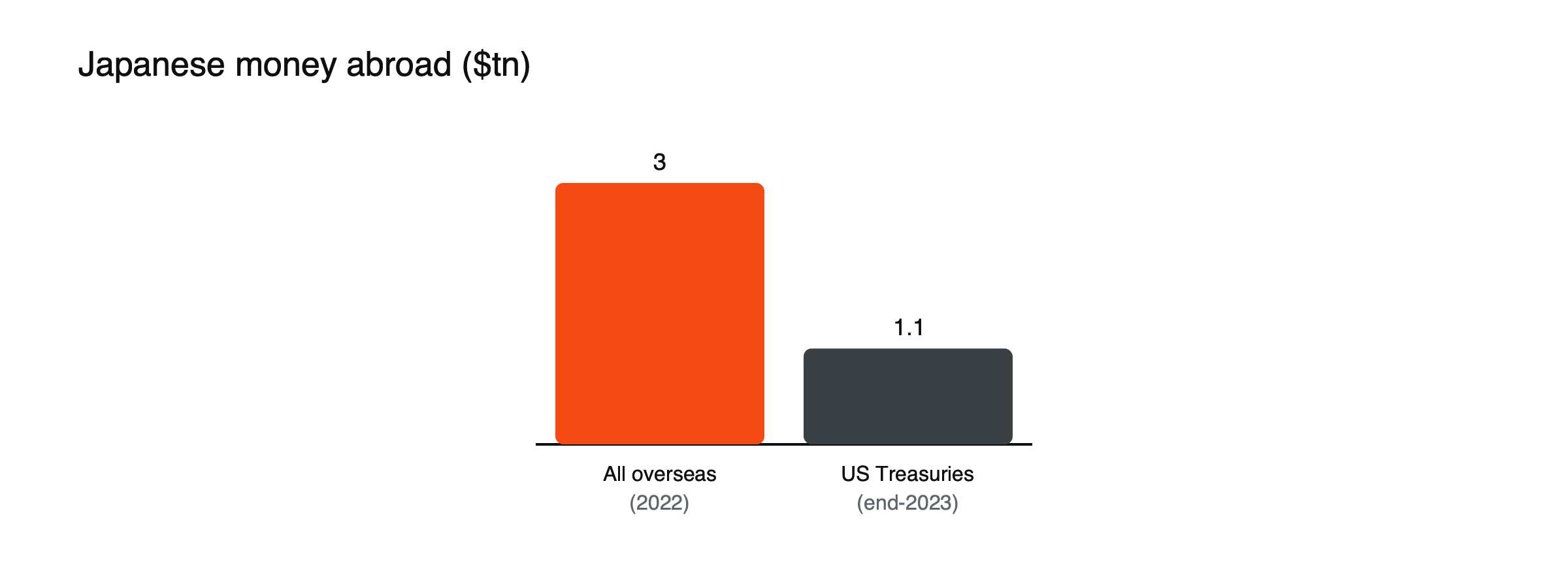
Figure: Japan’s overseas investments ($ trillions). Sources: MUFG; Bursa.
Currency-hedged returns, illustrated
Suppose a Japanese insurer can buy a 10-year US Treasury yielding 4.5% or a 10-year Japanese government bond yielding 1.5%. (Illustrative figures.) Unhedged, the US bond pays 3 points more, but exposes the insurer to swings in the yen. If it hedges the currency risk, the cost of hedging roughly equals the gap between US and Japanese short-term rates, say 4 points, leaving a hedged US yield of about 0.5%, below the Japanese bond. That is why rising US short-term rates in 2022 made hedged foreign bonds unattractive for many Japanese investors, even as US yields rose.
What changes when JGB yields rise
- Repatriation: higher domestic yields make Japanese bonds more attractive, reducing demand for foreign bonds.
- Global yields: less Japanese buying can push up yields in the US and Europe.
- The yen: money flowing home tends to strengthen the yen.
- Carry trades: a stronger yen can force investors who borrowed in yen to sell other assets. See why the yen rallies when global markets sell off.
A huge domestic market
Japan’s government debt is more than twice the size of its economy, one of the highest ratios in the world, and most of it is held at home, by the Bank of Japan, banks, insurers and pension funds. That domestic ownership has helped keep Japanese yields low and stable. But it also means changes in Japanese policy or investor behavior can shift huge sums, both within Japan and abroad.
Treasury holdings fell in 2022
Japanese holdings of Treasuries fell 18.5% in the year to November 2022, to about $1.08 trillion, as US rate hikes raised hedging costs and Japanese yields began to rise.
The December 2022 jump
When the Bank of Japan loosened its yield cap in December 2022, Japanese yields jumped and the yen had its biggest one-day surge since 1998.
August 2024
On July 31, 2024, the Bank of Japan raised rates to 0.25% and signaled reduced bond buying. Combined with weaker US data, the move helped send the yen up about 14% against the dollar between July 10 and August 5, triggering a rapid unwind of yen-funded trades. The Nikkei 225 fell 12.4% on August 5, and losses spread to Europe, the United States and crypto. See why volatility in one market spills into others.
Limits
US yields remain well above Japanese yields, so a sudden mass repatriation is unlikely; the effect is usually gradual. See why the Bank of Japan ended yield curve control , what happens to currencies when a central bank pivots and what markets listen for in a central bank meeting.
Japan’s net foreign assets
Decades of current account surpluses have left Japan with a net foreign investment position of about $3.3 trillion, one of the largest in the world. Pension funds, insurers and individuals hold large amounts of foreign shares and bonds. Even a small shift in where that money goes, for example a decision by a large pension fund to raise its domestic bond allocation, can affect global yields and the yen.
What to watch
- Bank of Japan meetings and comments on rates and bond buying
- The 10-year and 30-year Japanese government bond yields
- The gap between US and Japanese yields, hedged and unhedged
- Japanese investors’ monthly foreign bond purchases or sales
- Ministry of Finance comments on the yen
How traders use it
Rising Japanese yields can signal pressure on global bond markets and a stronger yen, both important for traders in USD/JPY, Japanese shares and global bonds. Sudden moves in Japanese yields have often coincided with volatility elsewhere. See why the Bank of Japan ended yield curve control.
Japanese yields and global yields, illustrated
Suppose Japanese 10-year yields rise from 1.0% to 2.0% over a year. (Illustrative scenario.) A Japanese life insurer that had been buying foreign bonds now earns a reasonable return at home without currency risk, so it shifts new money into domestic bonds. Multiplied across many institutions, that reduces demand for US and European bonds, adding a little upward pressure to their yields, and supports the yen as less money flows abroad. The effect is gradual, but over time it can matter for global borrowing costs.
Life insurers and pension funds
Japanese life insurers and the country’s large public pension fund are among the biggest investors in the world. Their decisions on how much to hold in foreign bonds, and whether to hedge currency risk, are watched closely by global markets. Changes in their annual investment plans can shift large amounts of money across borders.
The long end
Long-dated Japanese bonds, such as 30-year bonds, have at times seen sharp moves as the Bank of Japan reduced its purchases and demand from traditional buyers shifted. Weak demand at long-bond auctions can push yields higher, with effects that ripple into global long-term bond markets.
Common misreadings
- Expecting a sudden mass sale of US Treasuries by Japan.
- Treating every rise in Japanese yields as a global shock.
The carry trade link
For years, near-zero Japanese rates made the yen a cheap currency to borrow in order to buy higher-yielding assets abroad. Rising Japanese yields and expectations of further Bank of Japan hikes make those trades less attractive and more fragile. When Japanese yields jump unexpectedly, carry trades can unwind quickly, strengthening the yen and causing sell-offs in assets bought with borrowed yen. See what a carry trade is.
A brief history of Japanese money abroad
Japanese investors began buying foreign assets heavily in the 1980s, when trade surpluses generated large savings. The flows continued through decades of low domestic yields, making Japan one of the world’s biggest creditors. Each phase of Bank of Japan easing, especially after 2013 and 2016, pushed more money abroad. The gradual normalization of Japanese policy since 2022 raises the question of whether some of that money will come home over time.
Japan’s own inflation
After decades of near-zero inflation, Japan saw prices and wages rise from 2022, with wages growing about 3.6% in 2023, the fastest in three decades. Sustained inflation is what allowed the Bank of Japan to end negative rates and yield curve control, and what makes further rises in Japanese yields possible. If inflation stays near or above 2%, Japanese investors may increasingly find adequate returns at home, gradually changing global capital flows.
Trading around Japanese bond moves
Traders watch Japanese bond yields for signals about the yen and global bonds. A sharp rise in Japanese 10-year or 30-year yields can strengthen the yen, weigh on Japanese shares, especially exporters, and add pressure to global long-term yields. Because Bank of Japan decisions can surprise, positions in USD/JPY and Japanese index CFDs often carry elevated risk around its meetings, and sizing for gaps is prudent.
Japan, the dollar and US yields
USD/JPY is closely linked to the gap between US and Japanese yields. When US yields rise relative to Japanese yields, the dollar tends to strengthen against the yen; when the gap narrows, the yen tends to recover. Moves in Japanese yields therefore matter for the pair as much as moves in US yields, and traders watch both closely. See how USD/JPY tracks Treasury yields.
The yen and repatriation
If Japanese investors bring money home, they must sell foreign currencies and buy yen, which can add to yen strength over time. The process is usually very gradual, spread across several years rather than months.
Frequently asked questions
Could Japanese investors sell US Treasuries quickly?
They could sell some, but holdings are huge and mostly long-term; shifts have usually been gradual.
Why does the yen matter for global markets?
Because the yen has been a major funding currency for carry trades, and Japan is a major lender to the world.
This article is educational content and does not constitute financial, investment, legal or tax advice. Digital assets are volatile and you may lose the amount you invest.
Sources
- Unexpected BoJ policy pivot (Japanese investors had more than $3 trillion overseas, more than half in the US) — MUFG, December 2022
- Japan, the largest foreign holder of US Treasuries ($1.138 trillion at end-2023) — Bursa, April 2024
- Japanese investors poised to back further away from US Treasury market (holdings −18.5% to $1.082 trillion) — S&P Global Market Intelligence, February 2023
- Bank of Japan: Yield curve surprise (yen’s biggest one-day surge since 1998) — Principal Asset Management
- The Bank of Japan says goodbye to negative rates (US yields well above Japanese yields) — investingLive, March 2024
- What is the yen carry trade? (BoJ raised rates to 0.25% and announced less bond buying; Nikkei −12.40%) — GKToday
- Carry Trade Unwind: Is It Really Over? (yen +14% against the dollar July 10 to August 5, 2024; Japan’s $3.3 trillion net foreign investment position) — Schwab via Advisor Perspectives
- Bank of Japan raised rates for the first time in 17 years (wages +3.6% in 2023) — The Conference Board, March 2024