
Why Yield Curve Steepening Can Mean Very Different Things
A steeper yield curve can signal coming rate cuts and recession risk, or rising inflation and deficit worries. Bull vs bear steepeners and what each means.
Yield curve steepening means the gap between long-term and short-term interest rates widens. How it happens matters. In a “bull steepener,” short-term yields fall faster as markets expect rate cuts, often near a slowdown. In a “bear steepener,” long-term yields rise faster, often on inflation or deficit worries. Same shape change, very different messages.
Two kinds of steepening
Bull steepener: short rates drop because the central bank is expected to cut. After the 2022–2024 inversion, the US curve re-steepened as the Fed began cutting in 2024, a classic bull steepener.
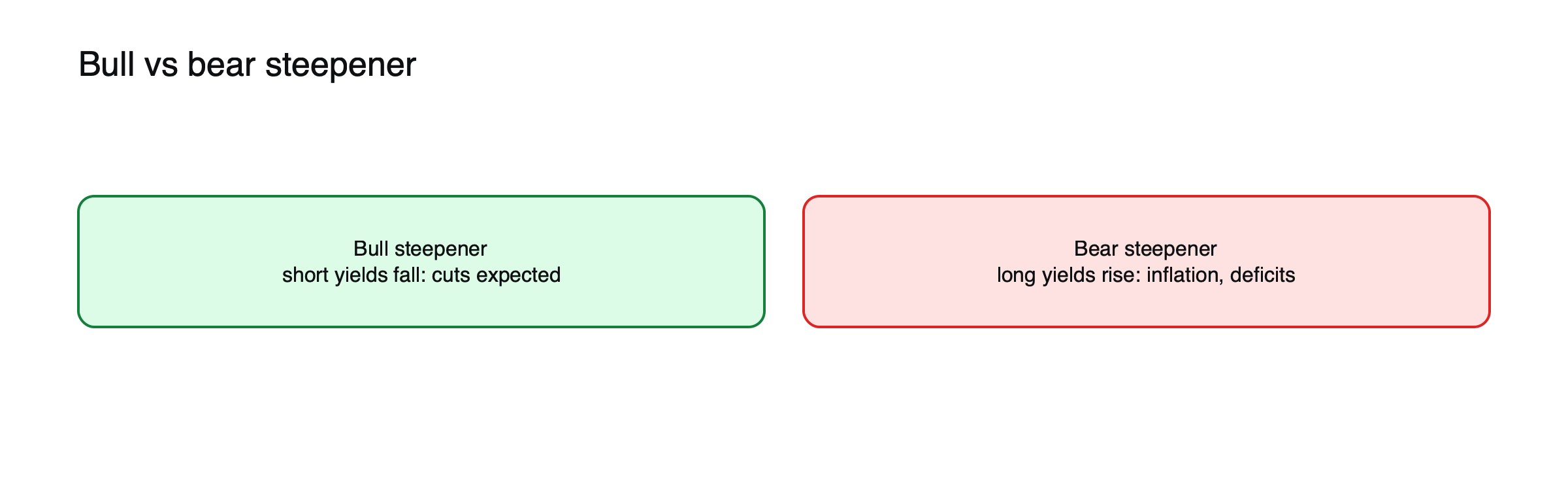
Figure: Same shape change, different messages.
Bear steepener: long rates rise because investors demand more to hold long-term debt, due to inflation risk, heavy government borrowing or reduced central bank buying. See how fiscal deficits affect rates, currencies and stocks.
Two steepeners, illustrated
Suppose the 2-year yield is 4.5% and the 10-year 4.0%, an inverted curve. (Illustrative figures.) In a bull steepener, the 2-year falls to 3.5% as markets price cuts, while the 10-year slips to 3.8%: the curve moves from −0.5 to +0.3 points, with all yields lower. In a bear steepener, the 2-year stays at 4.5% while the 10-year jumps to 5.0%: the curve again moves to +0.5 points, but long-term borrowing costs have risen sharply. Both are steepening, with opposite consequences for borrowers and long bonds.
Flatteners, too
The same logic applies to flattening. A bear flattener, with short yields rising faster, is typical when the central bank hikes; a bull flattener, with long yields falling faster, often reflects fading growth or inflation expectations. Naming the move precisely tells you far more than saying the curve flattened or steepened.
Why it matters for stocks
A bull steepener after an inversion has historically come close to recessions, because it reflects cuts in response to weakness. A bear steepener raises borrowing costs across the economy and can weigh on stock valuations, especially for long-duration growth companies.
How to tell them apart
Check which end of the curve is moving, and why: falling 2-year yields point to expected cuts; rising 10- or 30-year yields point to term premium, inflation or supply worries. Look at inflation expectations and Treasury auction demand too.
The 2024 re-steepening
The US 2-year/10-year curve inverted in July 2022 and stayed inverted for 26 months, before turning positive in September 2024 as the Fed began cutting rates. The move was a bull steepener, led by falling short-term yields. Historically, such re-steepening has often come close to the start of recessions, but as of 2026 none had followed, another sign that the curve is a clue rather than a timetable. See what an inverted yield curve means.
Bear steepening and the term premium
Long-term yields include a term premium, extra compensation for lending over many years. It tends to rise when investors worry about inflation uncertainty, heavy government borrowing or central banks reducing their bond holdings. A rising term premium steepens the curve from the long end, even if expected policy rates are unchanged, and can lift mortgage and corporate borrowing costs. See what moves the 10-year Treasury yield.
Limits. Central bank bond buying, foreign demand and regulation all distort the curve, so its shape is a clue rather than a forecast. See what happens to markets when the yield curve un-inverts and how recession signals have performed.
What steepening means for different assets
| Asset | Bull steepener | Bear steepener |
|---|---|---|
| Short-term bonds | Gain | Little change |
| Long-term bonds | Gain modestly | Fall |
| Bank shares | Mixed; margins improve but growth worries | Often benefit from wider margins |
| Growth shares | Supported by lower rates if no recession | Pressured by higher long yields |
| Currency | Often weakens as cuts are priced | Can weaken if fiscal fears drive the move |
(General tendencies; context matters.)
Steepening in other markets
The same patterns appear in other government bond markets. In 2022, UK long-dated gilt yields surged after the mini-budget, a sharp bear steepening driven by fiscal worries. Japanese curves have steepened as the Bank of Japan ended its yield caps. Comparing curves across countries helps separate global trends from local stories. See what happened in the UK gilt crisis.
Trading the steepener
Traders express views on the curve by buying short-dated bond futures and selling long-dated ones, or the reverse, sized so each leg has similar sensitivity to yields. CFDs on bond futures allow similar positions with leverage. Curve trades profit from changes in the slope, not the overall level of rates, but still carry significant risk when markets move abruptly.
Re-steepening and past recessions
In past cycles, the curve un-inverted shortly before the 2001 and 2007 recessions, as the Federal Reserve cut rates in response to weakening growth. That pattern led many analysts to treat a bull steepener after an inversion as a warning that a downturn was close. The 2024 episode, without a recession as of 2026, showed that the pattern is not guaranteed.
Banks and the curve
Banks borrow short and lend long, so a steeper curve tends to widen their lending margins. Bank shares often rally in bear steepeners and early in bull steepeners, provided credit quality holds up. If steepening comes with rising defaults, the benefit to margins can be outweighed by losses.
Steepening and the dollar
A bull steepener driven by expected Fed cuts tends to weaken the dollar, because US short-term rates are expected to fall relative to others. A bear steepener driven by fiscal worries can also weaken the dollar if investors lose confidence in US government finances, unlike a typical rise in yields, which supports the currency.
Common misreadings
- Treating every steepener as a recession signal.
- Ignoring which end of the curve is moving.
Watching steepening in real time
To read a steepening move, compare the daily change in the 2-year and 10-year yields. If the 2-year falls more, the move is a bull steepener driven by rate expectations; if the 10-year rises more, it is a bear steepener driven by the long end. Checking breakeven inflation and auction results then shows whether inflation or supply is behind a bear steepener. Many charting platforms let traders plot the spread directly.
What steepening means for long-term investors
For bond investors, a bear steepener can be painful for long-dated holdings but creates opportunities to buy long bonds at higher yields. A bull steepener rewards those who held shorter bonds and positioned for cuts. Matching bond maturities to one’s time horizon reduces the risk of being forced to sell long bonds after a sharp rise in yields.
Steepening and mortgages
US mortgage rates are linked to longer-term yields, especially the 10-year Treasury. In a bull steepener, mortgage rates may fall only slightly even as short-term rates drop sharply, because long yields move less. In a bear steepener, mortgage rates can rise even while the central bank is cutting, frustrating borrowers who expected relief. The shape of the curve, not just the policy rate, determines what households pay.
A steepening checklist
- Is the 2-year falling or the 10-year rising?
- What are inflation expectations doing?
- How was demand at recent long bond auctions?
- Is the central bank cutting, holding or shrinking its balance sheet?
Steepening and gold
Gold tends to benefit from a bull steepener, because falling short-term rates and expected cuts reduce the opportunity cost of holding it. In a bear steepener driven by inflation fears, gold can also do well; in one driven by rising real yields, it may struggle. As with other assets, the cause of the steepening matters more than the label.
Steepening and policy
Central banks influence the short end directly but the long end only indirectly, through expectations and bond holdings. When they shrink their balance sheets, they add to the supply of long bonds that investors must absorb, which can contribute to bear steepening.
Frequently asked questions
Is a steepening curve good or bad for the economy?
It depends on the cause: a bull steepener can signal coming cuts and weaker growth; a bear steepener can signal inflation or fiscal worries.
Which part of the curve should I watch?
The 2-year and 10-year yields are the most common pair, with the 30-year adding information about long-term inflation and fiscal risk.
This article is educational content and does not constitute financial, investment, legal or tax advice. Digital assets are volatile and you may lose the amount you invest.
Sources
- What is an inverted yield curve? (2022–2024 inversion followed by a bull steepener as cuts began; recessions historically began after re-steepening) — Tapeboard
- The Yield Curve Manual (un-inversion before the 2001 and 2007 recessions) — TheTrading.Tools
- 2s10s yield curve inversion history (inverted July 2022; 26 months; no recession as of 2026) — Eco3min