
How to Check Trading Hours for Every Market on OTCN
Open the instrument's specification, convert session times to your time zone, note breaks and holidays and check weekends: trading hours for each OTCN market.
To check trading hours on OTCN, open the instrument’s specification, note the session times and their time zone, convert them to your own, look for daily breaks and early closes, and check the holiday calendar. Hours follow the underlying markets: currencies trade around the clock on weekdays and stocks follow their exchanges.
[PRODUCT FACTS SHEET — Open decision 3: every OTCN-specific step, screen name, fee, limit and time in this article is a placeholder marked PFS and must be confirmed before publishing.]
Before you start
Know your own time zone and whether daylight saving time applies. [PFS: the server time zone used on the OTCN platform.]
Typical sessions by market
| Market | Typical schedule |
|---|---|
| Major currency pairs | Around the clock from Sunday evening to Friday evening, New York time |
| US shares | Regular exchange session 9:30 a.m. to 4 p.m. New York time |
| Major index CFDs | Often nearly 24 hours on weekdays, following futures, with short daily breaks |
| Commodities | Long sessions with daily breaks, following futures exchanges |
| Crypto CFDs | Often seven days a week, depending on the provider |
(General patterns; each provider sets its own schedule.) [PFS: OTCN hours by instrument.]
Reading the schedule
Open the specification
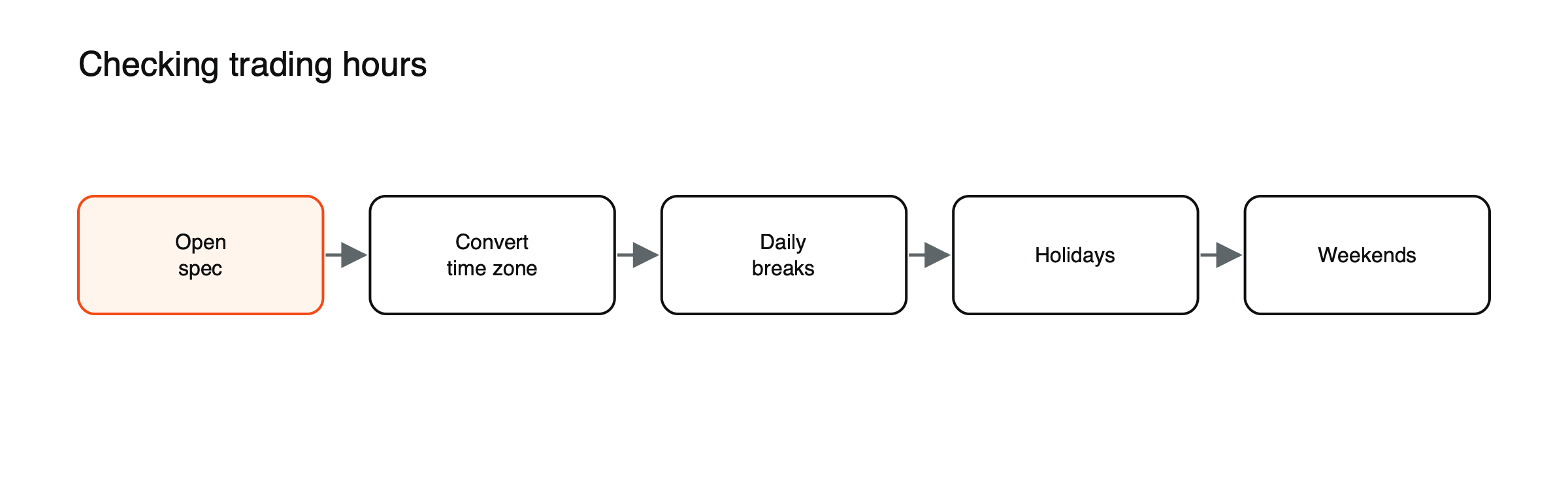
Figure: Checking trading hours.
[PFS: where hours appear on the platform.]
Convert the times
Platform times may differ from your local time and shift with daylight saving.
Note breaks
Many index and commodity CFDs pause daily. See why index CFDs move at the market open.
Check holidays
Exchange holidays close or shorten sessions. [PFS: holiday notices.]
Check weekends
Currency markets close from Friday evening to Sunday evening; crypto CFDs may continue. See what changes when you trade crypto CFDs on weekends.
Daylight saving time, illustrated
Suppose a trader in Istanbul, where clocks do not change, follows a US share market that opens at 9:30 a.m. New York time. (Illustrative scenario.) During US summer time, the open is 4:30 p.m. in Istanbul; in US winter time, it moves to 5:30 p.m. A trader who sets alarms by local time without accounting for the change can miss the open by an hour. Europe and the US also change clocks on different dates, so their market openings shift relative to each other for a few weeks each spring and autumn.
Liquidity across the day
Being open does not mean being equally liquid. Currency pairs are most active when European and US sessions overlap, while Asian hours are quieter for most pairs except those involving the yen and Australian dollar. Index CFDs that trade outside the underlying exchange’s hours usually have wider spreads. Trading during the most active hours generally means tighter spreads and smoother fills. See how 24/7 trading is changing market structure.
Common mistakes
Assuming hours never change, placing orders that cannot fill during breaks and holding through weekend gaps without a plan. See why prices gap over weekends and how to open an OTCN account.
The daily rollover
Many providers apply overnight financing at a set time each day, often around 5 p.m. New York time for currencies. Positions open at that moment are charged or credited, and some providers apply a triple charge on one weekday to cover the weekend. Knowing the rollover time helps traders decide whether to hold a position overnight. [PFS: OTCN rollover time and weekend charge day.] See how OTCN calculates margin and overnight financing.
Holidays and early closes
Exchange holidays close or shorten sessions for shares, indices and some commodities, while currency markets may stay open with thin liquidity. Holiday schedules differ between countries, so a US holiday can affect US index CFDs while European markets trade normally. [PFS: where OTCN publishes holiday schedules.]
Pending orders outside hours
Orders placed while a market is closed usually wait until the next session, when they may fill at the opening price, which can be far from the last price if the market gapped. Stops can fill beyond their levels for the same reason. See why prices gap over weekends.
Session overlaps, illustrated
Suppose a trader focuses on EUR/USD. (Illustrative scenario.) Between about 8 a.m. and noon New York time, when London and New York are both open, the pair is usually most active, spreads are typically at their tightest and important US data are released. In the late New York afternoon and Asian morning, activity drops and spreads often widen. A trader who can only trade in the evening in Europe may find the pair quiet and choose a different market or approach. See currency trading sessions.
The opening minutes
Markets often move sharply in the first minutes after an open, as overnight news and orders are absorbed. Spreads can be wider and prices can jump. Many traders wait for the opening volatility to settle before entering. See why index CFDs move at the market open.
Crypto on weekends
Crypto markets trade on weekends, but liquidity is often thinner and sharp moves can happen while other markets are closed. Positions in crypto CFDs can be affected at any hour.
Common misreadings
- Believing a market is equally liquid whenever it is open.
- Forgetting that orders can fill at the next session’s opening price.
Time zones explained
Trading platforms often display times in a single server time zone, which may differ from both your local time and the exchange’s time. Converting carefully, and checking again when clocks change in spring and autumn, prevents missed opens and unexpected closures. Writing down the key times for the markets you trade, in your own local time, is a simple safeguard.
Data release times
Major economic data are released at fixed local times, such as 8:30 a.m. New York time for many US reports. These moments often bring the biggest moves of the day, so it helps to know when they fall in your own time zone. See how to read an economic calendar.
A schedule checklist
- When does this market open and close in my time zone?
- Are there daily breaks?
- When is the rollover?
- Are holidays or clock changes coming up?
- When are the key data releases?
Hours and stop orders
Stop and limit orders on CFDs usually work only while the market is open. If a market closes with your position open and reopens at a very different price, a stop may be filled at the opening price rather than its level. Guaranteed stops, where offered, protect against this gap for a fee. [PFS: whether OTCN offers guaranteed stops.] See how stop-loss orders work.
Futures rolls
CFDs based on futures, such as many commodity and some index products, follow contracts that expire periodically. Providers roll positions to the next contract or close them before expiry, and the price can change at the roll because the new contract trades at a different level. Checking the roll dates in the specification avoids surprises. [PFS: OTCN rollover policy and dates.]
Shares listed abroad
Share CFDs follow the hours of the exchange where the share is listed, so a US share trades in New York hours and a German share in Frankfurt hours, whatever your own time zone. Shares listed on several exchanges may follow the main listing.
Building a routine around hours
Many traders choose markets that are most active when they are available. Someone working office hours in Europe might trade US indices in the evening, when they are active, while someone in Asia might focus on yen pairs during the Tokyo session. Matching markets to your own schedule, rather than trading whatever happens to be open, usually leads to better attention and fewer impulsive trades. It also makes it easier to plan around key data releases and avoid holding positions you cannot monitor.
Weekend gaps
When markets close for the weekend, news can still happen. Positions held over the weekend can open on Monday at prices very different from Friday’s close, skipping stop levels.
Holiday weeks
Around major holidays, such as the end-of-year period, many markets have shortened sessions and thin trading, and spreads can widen. Planning trades and positions around these weeks avoids being caught in illiquid conditions. Year-end is also when many funds rebalance.
Frequently asked questions
Why are trading hours shown in a different time zone?
Platforms often use a fixed server time zone; convert it to your local time and note daylight saving changes.
Can I trade shares when the exchange is closed?
Some providers offer extended hours on popular shares, usually with wider spreads; otherwise orders wait for the next session.
[RISK WARNING — Open decision 2: approved CFD and leverage risk warning to be inserted here before publishing.]
This article is educational content and does not constitute financial, investment, legal or tax advice. Digital assets are volatile and you may lose the amount you invest.