
How Short-Selling Rules Work Across Markets
Short sellers face price tests, locate rules and emergency bans that vary by market. How the US alternative uptick rule works and what the 2008 ban showed.
Short-selling rules limit how and when traders can bet on falling prices. In the US, the alternative uptick rule restricts short sales in a stock that falls 10% or more in a day, and shares must be located to borrow first. Regulators have also imposed crisis bans, as the SEC did for nearly 1,000 financial stocks in 2008.
Side by side
| Rule type | What it does | Example |
|---|---|---|
| Price test | Limits short selling after sharp falls | US Rule 201: after a 10% drop, short sales only above the best bid, for that day and the next |
| Locate requirement | Shares must be available to borrow before shorting | US Regulation SHO |
| Close-out rules | Failed deliveries must be closed out | US Rule 204 |
| Emergency bans | Temporary prohibitions in crises | US, September 19 to October 3, 2008 |
| Disclosure | Large net short positions reported | Required in several markets, with thresholds varying |
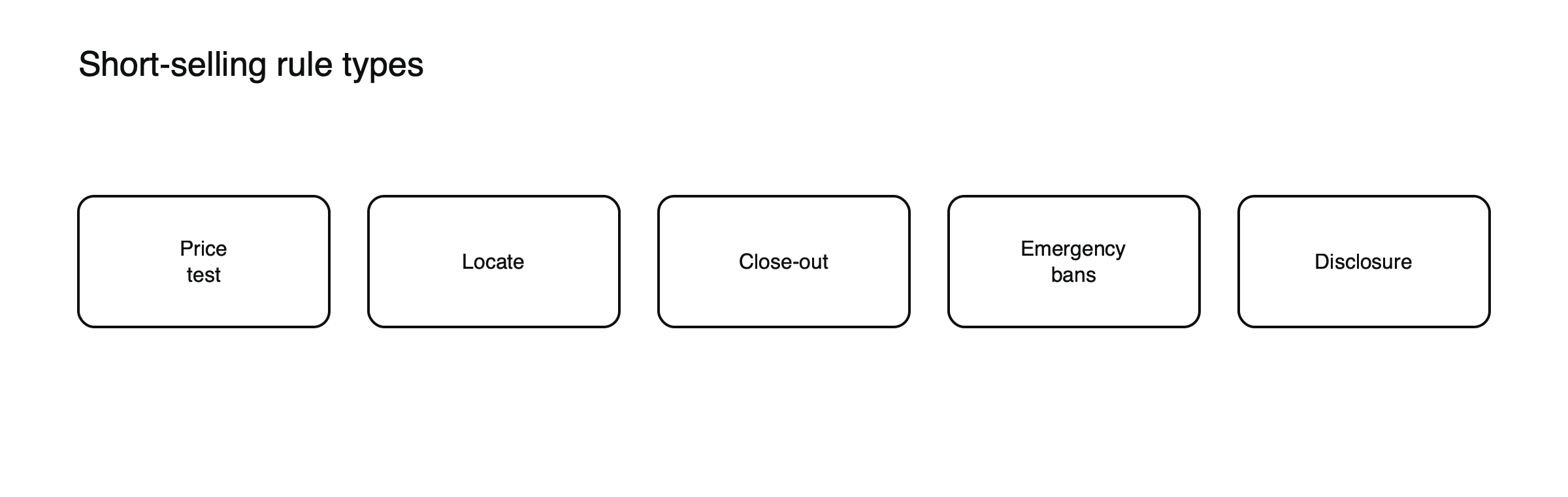
Figure: The main tools regulators use on short selling.
How short selling works, illustrated
Suppose a trader borrows 100 shares of a company trading at $50 and sells them for $5,000. (Illustrative scenario.) If the price falls to $40, the trader buys 100 shares for $4,000, returns them to the lender and keeps $1,000, minus borrowing fees. If the price rises to $70, buying back costs $7,000, a loss of $2,000. Because a share price can rise without limit, short sellers face potentially unlimited losses, which is why brokers require margin and can force positions closed.
What the 2008 ban showed
Financial stocks kept falling during the ban, and an SEC staff study found selling pressure that month came mainly from long investors, not short sellers. The SEC chair at the time later said he regretted the ban.
Disclosure in Europe
The European Union requires investors to report significant net short positions in shares to regulators, and to disclose larger positions publicly, under its short selling regulation in force since 2012. Public disclosure lets other investors see who is betting against a company, which can affect sentiment. Similar regimes exist in the UK and other markets, while the US has moved toward more aggregated reporting of short positions.
Bans beyond 2008
Short-selling bans have been used repeatedly. In March 2020, several European countries, including France, Italy and Spain, temporarily banned new short positions as markets crashed. In 2019, Germany’s regulator banned new short positions in Wirecard for two months after its shares fell sharply, a decision that drew criticism when the company later collapsed amid accounting fraud. The episode showed the risk of protecting a company that short sellers had correctly targeted.
Why rules exist
Short selling helps price discovery and can expose fraud, but regulators worry about abusive tactics, such as “naked” shorting without borrowed shares, and about short selling amplifying panics.
Where the usual answer flips
Bans are often popular in a crisis but can reduce liquidity and widen spreads, making prices less reliable.
CFDs and short exposure
CFDs let traders take short positions without borrowing shares, but they carry financing costs and leverage. See how market surveillance catches manipulation, why exchanges halt trading in a stock and how stocks behave in a 10% correction.
Short squeezes
When many traders are short a stock and the price starts rising, they may rush to buy shares to close positions, pushing the price higher still. In 2008, Volkswagen briefly became the world’s most valuable company when short sellers scrambled for scarce shares, with the free float about 6% against short interest of about 12%. In January 2021, GameStop’s short interest exceeded its available shares, and a rush of buying sent the price soaring. See what a short squeeze is.
Borrowing costs and availability
Shares that are hard to borrow carry higher borrowing fees, sometimes very high for heavily shorted stocks. Lenders can also recall shares, forcing short sellers to close positions at inconvenient times. These costs and risks are part of why short selling is more complex than buying.
Short selling in crypto
Crypto markets offer short exposure mainly through derivatives such as perpetual futures, and through CFDs where permitted. There is no equivalent of the uptick rule, and leverage can be high, so short squeezes and liquidation cascades can be violent. See what causes liquidation cascades.
Shorting with CFDs, illustrated
Suppose a trader sells a CFD on 100 shares of a company at $50, putting up 20% margin of $1,000 under a 5:1 leverage cap. (Illustrative scenario.) No shares are borrowed; the trader simply profits if the price falls and loses if it rises. A fall to $45 gains $500, while a rise to $60 loses $1,000, the full margin, and the provider may close the position before that point. Holding the position overnight incurs financing charges, and a short CFD position may also be debited an amount equal to any dividend paid. See short selling with CFDs.
Naked short selling
Naked short selling means selling shares without first borrowing them or arranging to borrow them. It can lead to failed deliveries and, critics argue, artificial selling pressure. Most major markets restrict it: in the US, locate and close-out rules aim to prevent persistent failures, and the EU requires short sellers to have arrangements to borrow shares before selling.
Short sellers and fraud
Short sellers have often been among the first to question companies later exposed for fraud or accounting problems. Their research, published openly, can bring scrutiny that regulators and auditors missed. The Wirecard case, where short sellers and journalists raised concerns years before the collapse, is a prominent example.
Short interest as a signal
Short interest, the number of shares sold short relative to shares available, shows how many investors are betting against a stock. High short interest can signal doubts about a company, but it also raises the risk of a squeeze if the price rises.
Common misreadings
- Assuming short selling is illegal or unethical by nature.
- Believing a ban will stop a falling market.
The uptick rule’s history
The original US uptick rule, introduced in 1938, allowed short sales only at a price above the previous trade. Regulators removed it in 2007 after studies suggested it had little effect in modern markets. After the 2008 crisis, they introduced a narrower version in 2010, the alternative uptick rule, which applies only after a stock has fallen 10% in a day. The history shows how rules on short selling tend to tighten after crises and loosen in calmer times.
Short selling and liquidity
Short sellers add liquidity by providing a source of selling when prices rise and buying when they cover. Bans remove that liquidity, which can widen spreads and make prices more volatile. Studies of the 2008 ban found that spreads in banned stocks widened noticeably, raising trading costs for all investors, not just short sellers.
Shorting around earnings
Short positions held through earnings face the risk of a sharp rise if results beat expectations, especially in heavily shorted stocks where covering can amplify the move. Many short sellers reduce positions before announcements or use options to limit risk. CFD traders face the same gap risk, with stops that may fill well beyond their levels.
A checklist for short positions
- How heavily shorted is the stock?
- Are borrowing costs or financing charges rising?
- Is any earnings or news event due?
- Where will the position be closed if the price rises?
Short selling in falling markets
In sharp sell-offs, regulators sometimes face pressure to restrict short selling, but evidence from past bans suggests prices often keep falling as long-term investors sell. Short sellers who correctly anticipated the decline are often buyers when they close positions, which can actually help markets find a price floor. Understanding this role helps explain why many regulators now prefer disclosure and targeted rules over blunt, outright bans in a crisis.
Frequently asked questions
Is short selling legal?
Yes, in most markets, subject to rules on borrowing, disclosure and temporary restrictions.
Do short sellers cause crashes?
Evidence from 2008 suggests bans did not stop falls, and short sellers often help reveal problems, though abusive practices are prohibited.
This article is educational content and does not constitute financial, investment, legal or tax advice. Digital assets are volatile and you may lose the amount you invest.
Sources
- The Uptick Rule: SEC limit on short selling reconsidered (2008 ban on nearly 1,000 financial stocks, September 19 to October 3; Cox regretted it; alternative uptick rule February 24, 2010) — Congressional Research Service
- SEC restricts short sales (Rule 201: after a 10% drop, short sales only above the national best bid for that day and the next) — CIO, February 2010
- Statement on the alternative uptick rule (SEC staff study: September 2008 selling pressure mainly from long sellers; financial stocks fell during the ban; Rule 204) — SEC Commissioner Paredes, February 2010
- Anatomy of a short squeeze (VW: free float 6% vs short interest 12%, ~€200 to over €900; GameStop short interest ~140% of float) — Janus Henderson