
CFD Trading vs Owning the Underlying Asset
Owning an asset gives you the asset and its rights; a CFD gives price exposure, easy shorting and leverage, with financing costs. A side-by-side comparison.
The key difference in CFD vs owning shares is what you hold. Owning means you have the asset: shareholder rights and no leverage unless you borrow. A CFD is a contract with a provider that tracks the price, makes going short easy and uses leverage, but charges financing for positions held overnight.
Side by side
| Owning the asset | CFD | |
|---|---|---|
| What you hold | The asset itself | A contract with a provider |
| Shareholder rights | Yes, including votes | No |
| Dividends | Paid | Cash adjustment instead |
| Going short | Requires borrowing | Built in |
| Leverage | Not by default | Standard, within regulatory limits |
| Holding costs | Custody or account fees | Daily overnight financing |
| Maximum loss | What you invested | Can exceed margin; limited by negative balance protection where it applies |
| Best suited to | Long-term holding | Shorter-term or hedging positions |
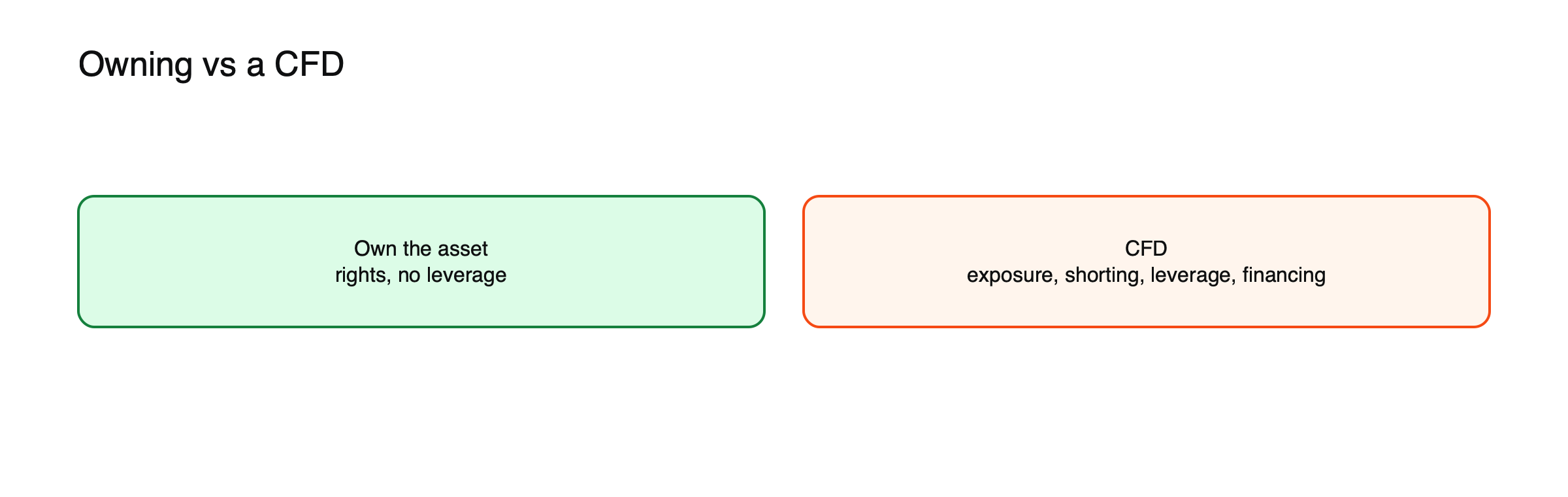
Figure: What you hold in each case.
When owning makes sense
For long-term investing, ownership avoids daily financing costs that add up over months and gives you the rights of an owner. See how overnight financing works.
When CFDs are used
Short-term trades, short positions and hedges of existing holdings, where leverage and ease of shorting matter more than ownership.
Is the CFD really cheaper?
“CFDs are cheaper because you only put up margin” ignores financing: on a long position held for months, financing can exceed what owning would have cost. And leverage means a smaller price move can force a close-out.
One year, compared
Suppose you want $10,000 of exposure to a share for a full year. (Example values.)
- Owning the shares: you pay a commission to buy and later to sell, possibly a small custody or account fee, and you receive any dividends in full, less local tax.
- Holding a long CFD: you pay the spread and any commission, plus overnight financing every night. At an illustrative 6.5% a year, financing costs about $650. Dividends arrive as cash adjustments, often net of a tax-related deduction.
Over a year, the CFD costs several hundred dollars more for the same exposure, which is why long-term investors usually own the asset.
One week, compared
Hold the same exposure for seven days, and the picture changes. Financing on the CFD is about $12.50, and you only need to put up margin rather than the full $10,000. Some countries also charge transaction taxes on share purchases that CFDs may not attract. For short holding periods, the CFD can be the cheaper and more flexible route, provided leverage is kept under control.
Rights you give up with a CFD
CFD holders do not own shares, so they cannot vote at shareholder meetings, take part in rights issues directly or hold the shares in an account protected as a shareholding. Corporate actions are handled by the provider through adjustments, and the outcome follows its terms rather than shareholder law.
Who you depend on
When you own a share through a regulated broker, the share is usually held in your name or in a segregated account. With a CFD, your position is a contract with the provider, so its financial strength and the client money rules that apply to it matter. This counterparty exposure is a real difference, even with reputable providers.
Tax treatment can differ
Tax rules for CFDs and directly owned assets can differ, for example in how gains are taxed or whether transaction taxes apply. They vary widely by country and change over time, so checking local rules, or asking a tax adviser, is worthwhile before choosing one route for tax reasons.
Using both together
Many investors combine the two: they own long-term holdings outright and use CFDs occasionally for short-term trades or to hedge temporarily, for example by shorting an index CFD ahead of an event they expect to cause a fall, rather than selling shares they want to keep. See how short selling works with CFDs.
Choosing by goal
| Goal | Usually better suited |
|---|---|
| Holding for years | Owning the asset |
| Trading a view over days or weeks | CFD, with modest leverage |
| Profiting from a fall | CFD |
| Temporarily protecting a portfolio | CFD hedge |
| Voting and shareholder rights | Owning the asset |
What to check
Your time horizon, total costs including financing, and whether the protections in your country apply. See what a CFD is and what negative balance protection is.
Leverage changes the comparison
Owning $10,000 of shares ties up $10,000. Holding the same exposure through a CFD at 5:1 needs about $2,000 of margin, leaving the rest of the money free. That capital efficiency is the main attraction of CFDs, but it does not reduce the exposure: a 20% fall still costs $2,000 either way. The danger comes when the freed-up money is used to open more positions, multiplying the exposure while the account balance stays the same.
Trading hours and access
Some providers quote CFDs on major shares and indices outside the underlying exchange’s hours, which lets traders react to overnight news. Owners of the shares can only trade when the exchange is open, or in limited extended sessions. Out-of-hours CFD quotes often have wider spreads and can differ from where the market eventually opens.
Smaller positions
CFDs often allow very small or fractional positions in expensive shares or indices, which can make it easier to build exposure in small amounts. Many brokers now offer fractional shares as well, so this advantage has narrowed for long-term investors.
Dividends and ex-dates
Owners receive dividends on the payment date after holding through the ex-dividend date. CFD holders receive or pay an adjustment on the ex-date itself, which means a short CFD pays the dividend equivalent, and a long CFD’s adjustment may be reduced by a tax-related deduction that differs from what an owner would pay. Around large dividends, these differences can matter.
Which costs to compare
- Commission and spread on entry and exit.
- Overnight financing for every night the CFD is held.
- Custody, account or platform fees for owning.
- Transaction taxes on share purchases where they apply.
- Dividend treatment, including any deductions.
- Currency conversion for foreign shares.
Comparing honestly means adding all of these over the period you actually expect to hold, not just the first day’s costs. The answer often changes with the holding period: what is cheaper for a week can be far more expensive over a year, and a route chosen for one trade may suit the next one badly. A quick spreadsheet with these lines, filled in once for your typical holding period, settles the question for most typical cases and takes only minutes.
Frequently asked questions
Can I convert a CFD into shares?
No. A CFD is a separate contract. To own the shares, you would close the CFD and buy the shares through a brokerage account.
Are CFD profits taxed like share profits?
Not necessarily. Treatment depends on the country and your circumstances. Some jurisdictions tax them differently or exempt one from certain taxes, so local rules decide.
Leverage, margin and cost figures in this article are example values for illustration. Actual terms depend on the provider, the instrument and the rules in your country.
This article is educational content and does not constitute financial, investment, legal or tax advice. Digital assets are volatile and you may lose the amount you invest.