
What Caused the 1973 Oil Crisis?
In October 1973, Arab producers imposed an oil embargo and prices quadrupled within months, triggering inflation and recession. Causes, timeline and lessons.
The 1973 oil crisis began in October 1973, when Arab producers imposed an embargo on nations backing Israel in the Yom Kippur War and cut output. Oil prices roughly quadrupled within months. Because energy feeds into nearly everything, inflation jumped and recessions followed, a mix later called stagflation.
Timeline
- Early 1970s: oil demand grows quickly; US production peaks; the dollar weakens after the end of gold convertibility in 1971. See what happened when Nixon ended dollar-gold convertibility.
- October 1973: war breaks out; Arab producers announce an embargo and output cuts.
- Late 1973–early 1974: oil prices quadruple; fuel shortages and rationing in several countries.
- March 1974: the embargo is lifted, but prices stay far higher.
- 1974–1975: inflation peaks and economies contract.
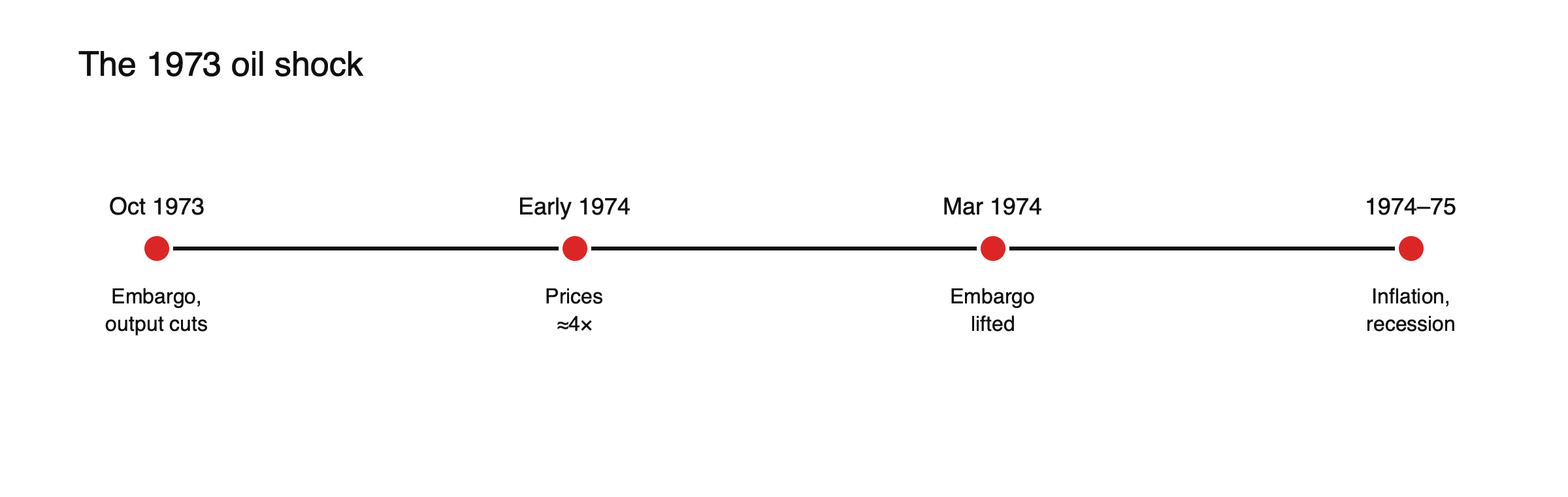
Figure: The 1973 oil shock.
The embargo in detail
The war began on October 6, 1973, when Egypt and Syria attacked Israeli positions. Within weeks, Arab oil producers announced monthly cuts in output and an embargo on countries seen as supporting Israel, including the United States and the Netherlands. At the same time, producers raised the posted price of oil unilaterally. The price of a benchmark Arabian crude rose from about $3 a barrel before the war to nearly $12 by January 1974, roughly a fourfold increase. The embargo itself lasted only about five months, but the higher prices did not reverse.
Life during the crisis
In importing countries, the effects were felt directly. Long lines formed at gasoline stations in the United States, and some states rationed purchases by license plate number. Several European countries introduced car-free Sundays and lower speed limits to save fuel. Governments urged households to turn down heating and switch off lights. The images of empty highways and queues for fuel became lasting symbols of how dependent modern economies had become on oil.
Why it hit so hard
- Heavy dependence on imported oil in Western economies.
- Few alternatives in the short run.
- Pricing power shifting from oil companies to producing countries.
Stagflation
The oil shock arrived when inflation was already rising after the end of the Bretton Woods system and years of loose policy. Higher energy costs fed directly into prices for transport, heating, food and manufactured goods, and inflation reached double digits in many economies by 1974. At the same time, consumers had less to spend on other things and businesses faced higher costs, so output fell. Rising prices combined with a shrinking economy, a combination that standard policy tools struggled to handle, gave rise to the term stagflation.
Central banks’ dilemma
Central banks faced an impossible choice: raise interest rates to fight inflation and deepen the recession, or keep rates low to support growth and let inflation run. Many chose the second path, which helped inflation become entrenched through the rest of the decade. It took the much tighter policy of the late 1970s and early 1980s, at the cost of a deep recession, to bring inflation down. Policymakers still draw on this experience when deciding how to respond to energy shocks.
Markets during the crisis
Stock markets in major economies fell steeply in 1973 and 1974, among the worst declines since the 1930s, as profits were squeezed by higher costs and interest rates rose. Gold, freed from its fixed price two years earlier, climbed sharply. Currencies of oil importers came under pressure, while the new floating exchange rate system absorbed shocks that would have broken fixed pegs. See what happened when Nixon ended dollar-gold convertibility.
What changed afterward
Countries built strategic petroleum reserves, improved energy efficiency and sought new supply, such as the North Sea and Alaska. The International Energy Agency was created in 1974.
A second shock in 1979
Only six years later, the Iranian revolution disrupted supply again, and oil prices more than doubled. The second shock reinforced the lessons of the first and pushed central banks toward the aggressive tightening that finally broke the inflation of the 1970s. Together, the two shocks transformed energy policy, accelerating the search for supply outside the Middle East and investment in efficiency, nuclear power and later renewables.
Lessons for today
Supply shocks raise inflation first and hurt growth later; central banks face a hard choice between the two. Today’s economies use less oil per unit of output, but remain vulnerable, as early 2026 showed. See how energy shocks travel through inflation, rates and currencies and how commodity CFDs work.
Comparing 1973 and 2026
| 1973–1974 | 2026 | |
|---|---|---|
| Trigger | War and embargo by Arab producers | Military action and closure of the Strait of Hormuz |
| Supply effect | Output cuts and embargo on selected countries | Gulf exports curtailed by blocked shipping |
| Price move | Roughly fourfold within months | Brent from about $72 to near $120, then back by July |
| Duration of high prices | Years | Months |
| Policy tools | Few; reserves built afterward | Strategic reserves released; spare capacity elsewhere |
The 2026 shock reversed far faster, partly because tools created after 1973, such as strategic reserves, were available and partly because supply routes reopened. See how geopolitical events move oil and gold.
Who the producers were
The Organization of the Petroleum Exporting Countries, OPEC, had been founded in 1960 by Iran, Iraq, Kuwait, Saudi Arabia and Venezuela to give producing countries more say over oil. In 1973, the cuts and the embargo were announced by Arab producers working together, while OPEC as a whole raised official prices. Before the crisis, international oil companies had largely set prices and output; after it, producing governments did.
The shift in pricing power
The crisis marked a lasting transfer of control over oil from Western companies to producing states, many of which nationalized their oil industries in the following years. Oil revenues flowed to producing countries on a huge scale, and much of that money was recycled into Western banks and loans to developing countries, shaping global finance for the rest of the decade. Oil had become a political as well as an economic asset.
Policy changes that followed
Importing countries responded with measures that still shape energy markets. The International Energy Agency was founded in 1974 to coordinate responses to supply emergencies, including shared oil stocks. The United States created its Strategic Petroleum Reserve and introduced fuel economy standards for cars. Many countries invested in nuclear power, coal and later natural gas to reduce dependence on oil, and in exploration outside the Middle East, which brought the North Sea and Alaska into production.
Lessons for traders
The crisis showed that supply shocks can change prices permanently, not just temporarily, when they shift who controls supply. It also showed that inflation from energy can outlast the shock itself. For traders, the key question in any supply crisis remains whether the change is temporary, like a blocked route, or structural, like the change in pricing power after 1973.
How much has changed
Developed economies use far less oil to produce each unit of output than they did in the early 1970s, thanks to more efficient engines and buildings, a shift toward services and the use of other fuels for power. Oil remains essential for transport and petrochemicals, but a given rise in its price does less damage to growth than it did in 1973. That is one reason the 2026 shock, though severe, did not produce a decade of stagflation.
Why the history still matters
The crisis remains the reference point whenever supply is threatened, because it shows the worst case: a lasting loss of supply, a political shift in control and an inflation problem that outlived the shock. For anyone trading energy, knowing what happened in 1973 helps judge how bad a new disruption could become and which signs separate a temporary spike from a lasting change. History rarely repeats itself exactly, but it often rhymes.
Frequently asked questions
Why did prices stay high after the embargo ended?
Because producing countries had taken control of pricing and kept official prices far above pre-war levels, and demand could not adjust quickly.
Could a 1973-style crisis happen again?
Large supply shocks still happen, as 2026 showed, but economies now use less oil per unit of output and hold strategic reserves, which tends to soften and shorten the impact.
This article is educational content and does not constitute financial, investment, legal or tax advice. Digital assets are volatile and you may lose the amount you invest.
Sources
- The stagflation beast is stirring (1973 embargo quadrupled oil prices in a few months; European growth fell sharply in 1973–1975) — Bank of Finland Bulletin, April 2022
- Does the private sector expect stagflation in the euro area? (inflation rose first, then output fell after 1973) — European Central Bank, 2022
- Crude oil and petroleum product prices increased sharply in 1Q26 (Strait of Hormuz) — US EIA, April 2026