
Gold vs Gold Mining Stocks
Gold miners tend to move more than gold because profits are leveraged to its price, but they add costs, debt and operating risks. A side-by-side comparison.
Gold vs gold mining stocks differ in what you own. Gold carries only price risk; a miner’s shares depend on the gold price and on the company’s costs, debt, output, management and countries. Because costs are largely fixed, a rise in gold can lift profits by more in percentage terms, so miners often swing more than gold.
Side by side
| Gold | Gold mining stocks | |
|---|---|---|
| What drives it | Gold price | Gold price plus company factors |
| Volatility | Lower | Usually higher |
| Income | None | Dividends possible |
| Specific risks | None beyond price | Costs, debt, mine problems, politics |
| Stock market link | Low | Moves with equities in sell-offs |
Operating leverage, worked example
A miner produces gold at an all-in cost of $2,000 an ounce (example value). At a gold price of $3,000, its margin is $1,000. If gold rises 20% to $3,600, the margin rises to $1,600, up 60%. A 20% fall to $2,400 cuts the margin by 60%.
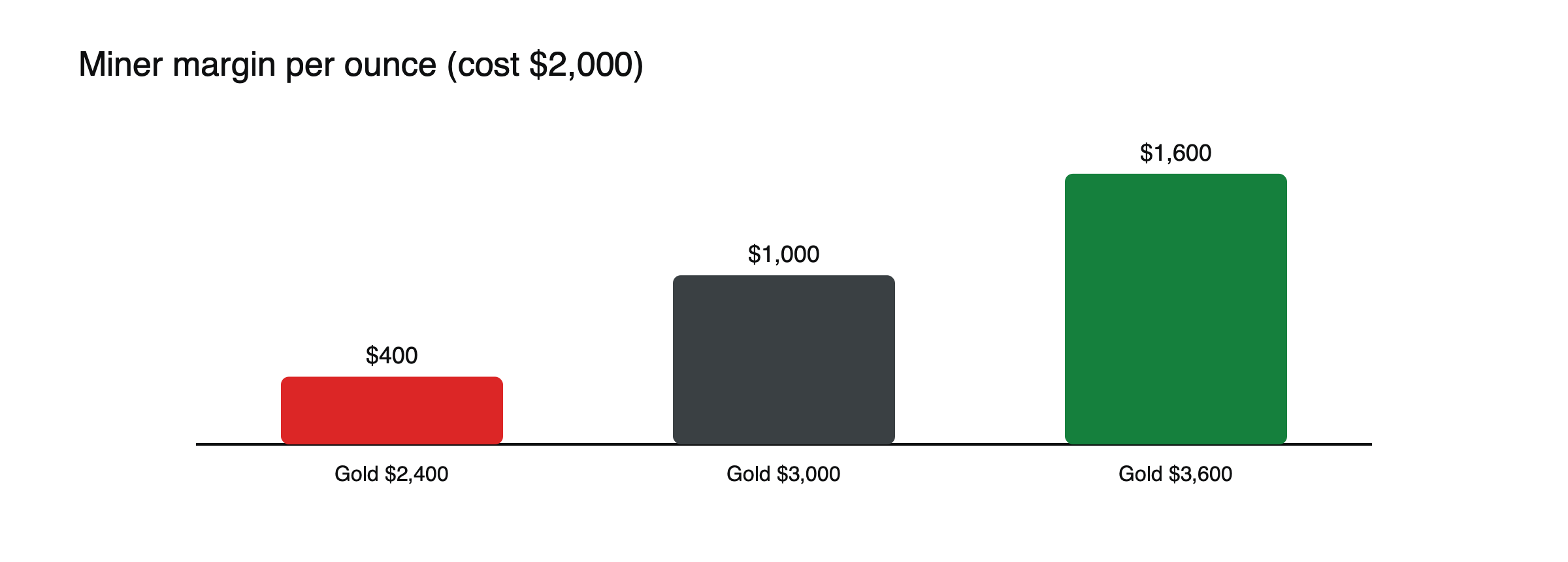
Figure: A 20% gold move changes the margin by 60% (example values).
All-in sustaining costs
Miners usually report a measure called all-in sustaining cost, which adds up the cost of mining an ounce of gold, keeping mines running and some general expenses. It is the number most investors compare with the gold price to judge margins. A company whose costs are rising as fast as the gold price gains little from a rally, while one that keeps costs steady can see profits jump. Reading how costs have moved over recent quarters is as important as following the gold price.
When miners lag gold
- Rising costs: energy, labor and equipment inflation squeeze margins.
- Stock market sell-offs: miners can fall with shares even when gold rises.
- Company problems: strikes, accidents, write-downs or political risk.
Large producers and juniors
Large, established producers operate several mines, pay dividends in good years and tend to move more steadily. Smaller exploration and development companies, often called juniors, may have no production yet and depend on discovering or building a mine. Their shares can rise many times over on success or collapse on a failed drill program or financing problem. Their link to the gold price is weaker than their link to company-specific news.
Royalty and streaming companies
Some companies finance mines in exchange for a share of future revenue or the right to buy part of the output at a fixed low price. These royalty and streaming companies gain when gold rises but carry fewer operating risks, because they do not run the mines themselves. Their shares often sit between physical gold and producers in terms of volatility.
Hedging by miners
Some miners sell part of their future output in advance to lock in prices, protecting cash flow if gold falls but limiting gains if it rises. Others leave production unhedged to give shareholders full exposure. Checking a company’s hedging policy explains why two miners can react differently to the same move in gold.
Country and political risk
Mines are often located in countries where taxes, royalties, permits and ownership rules can change. A new mining tax, a dispute with a government or local unrest can hit a company’s shares regardless of the gold price. Diversified producers spread this risk across several countries; single-mine companies are fully exposed to one.
When the leverage argument fails
“Miners are a leveraged bet on gold” holds only if costs stay under control; in some years, miners have underperformed gold despite rising prices.
See what moves gold prices, how stock CFDs work and how commodity CFDs work.
Trading miners through CFDs
Shares of gold miners can be traded as stock CFDs, which under EU retail rules carry a maximum leverage of 5:1, compared with 20:1 for gold. That means more margin per unit of exposure, alongside the higher volatility of the shares. Earnings reports, production updates and cost guidance become key dates, adding company events to the gold calendar. See how stock CFDs work.
Combining gold and miners
Some investors hold both: physical gold or gold CFDs for direct exposure, and a smaller allocation to miners for potential extra gains when gold rises and costs are controlled. Others compare the two to judge sentiment: miners outperforming gold can signal confidence in a lasting rally, while miners lagging can warn of cost pressures or wider stock market weakness.
Operating leverage in reverse
Using the earlier example, a miner with costs of $2,000 an ounce makes $1,000 of margin when gold is at $3,000. If gold falls to $2,200, the margin shrinks to $200, an 80% drop, even though gold fell only about 27%. Near the cost line, small further falls can wipe out profits entirely, forcing companies to cut output, delay projects or raise money. This is why miners often fall much harder than gold in downturns.
Reading a miner’s results
Quarterly reports show how much gold a company produced, at what cost and at what price it sold. Investors also watch guidance for future output and costs, capital spending on new projects and changes in debt. A miner beating its production targets while holding costs steady usually outperforms; one that misses targets or raises cost guidance can fall even when gold is rising.
Reserves and mine life
A miner’s value depends on how much gold it can extract in the future. Reserves, the gold judged economic to mine at assumed prices, and the expected life of each mine shape long-term prospects. Companies with short mine lives must keep finding or buying new deposits, which adds cost and risk.
Mergers and acquisitions
Higher gold prices often bring a wave of takeovers, as larger producers buy smaller companies to replace reserves. Takeover offers can lift the shares of target companies sharply, independent of the gold price.
Common misreadings
- Assuming miners always outperform gold in a rally.
- Ignoring costs and debt.
- Treating all miners as similar investments.
Mining funds
Exchange-traded funds holding baskets of mining shares spread company-specific risk across many producers, so a strike or cost overrun at one company matters less. They still carry stock market risk and the cost pressures of the industry as a whole, so they do not track gold closely. Some funds focus on large producers, others on juniors, with very different volatility.
How miners are valued
Analysts often value mining companies by comparing their share price with the estimated value of their mines, known as net asset value, or with the cash flow they generate. When miners trade at a large discount to the value of their assets, it can signal pessimism about costs, politics or management, or simply that investors prefer owning gold directly. Changes in these valuations help explain why miners sometimes lag gold for long periods and then catch up quickly.
Dividends
Unlike gold, many established miners pay dividends, which can make their shares attractive to income investors when margins are strong. Dividends usually rise when gold prices and profits are high and are often cut when margins shrink, so they add to returns in good years but offer little protection in bad ones. A dividend’s safety at lower gold prices matters more than its yield.
Frequently asked questions
Do gold miners always rise when gold rises?
No. Rising costs, company problems or a falling stock market can hold them back even in a strong gold rally.
Are miners a safer way to own gold?
Usually not. They add company, cost and stock market risks to the gold price risk, and their shares are typically more volatile than gold itself.
Leverage, margin and cost figures in this article are example values for illustration. Actual terms depend on the provider, the instrument and the rules in your country.
This article is educational content and does not constitute financial, investment, legal or tax advice. Digital assets are volatile and you may lose the amount you invest.