
What Moves Crude Oil Prices?
Oil moves on OPEC+ supply, global demand, inventories, geopolitics, the dollar and the futures curve. How each driver works, with 2020, 2022 and 2026 cases.
Oil prices move on supply, demand and expectations: OPEC+ decisions, global growth, inventories, geopolitics, the dollar and the futures curve. Shocks can be extreme: US futures fell below zero in April 2020, and prices jumped in early 2026 after military action in the Middle East and the de facto closure of the Strait of Hormuz.
Supply: OPEC+ and others
OPEC+ coordinates output among major producers; in October 2022, it cut production targets by 2 million barrels a day. US shale and other producers respond to prices with a lag. See what OPEC+ is.
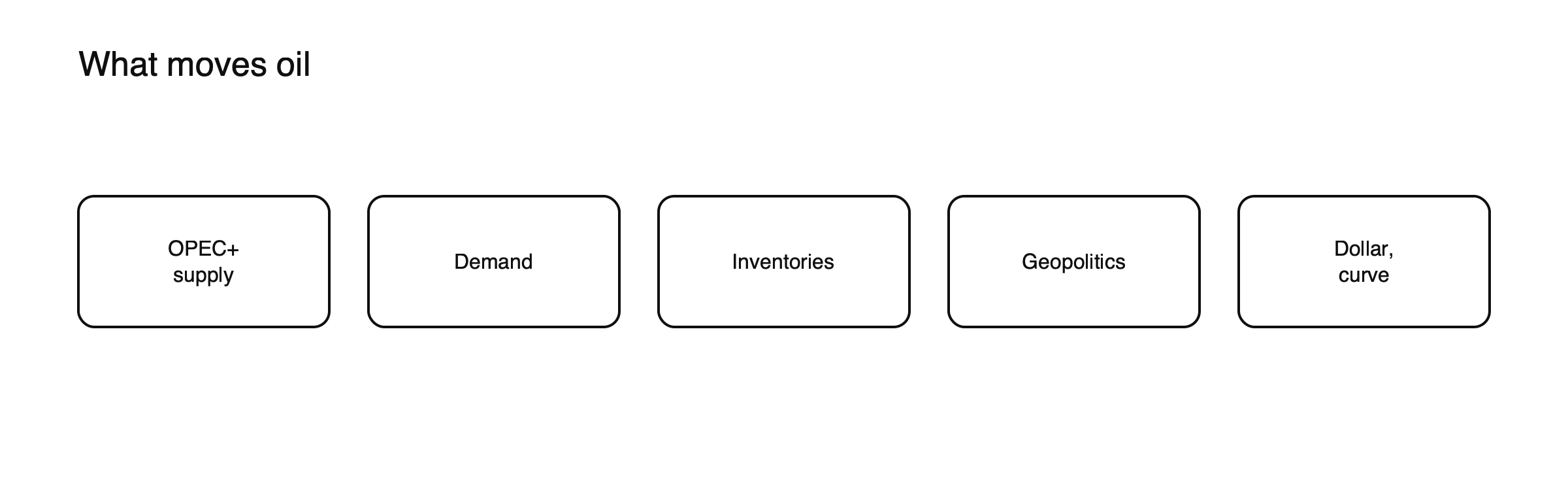
Figure: The main oil drivers.
Spare capacity
Spare capacity, oil that producers could add quickly if needed, is a key cushion. Before the 2026 conflict, the International Energy Agency estimated that Saudi Arabia and the United Arab Emirates held most of OPEC+’s spare capacity, roughly 2.5 million barrels a day between them. When spare capacity is large, supply shocks can be offset; when it is small, or sits behind a blocked shipping route, prices react far more.
Demand: growth and seasons
Economic growth, especially in China and the US, drives demand; summer driving and winter heating add seasonality.
Inventories
Weekly US inventory data show whether supply is outrunning demand. See how to read the weekly EIA oil inventory report.
Geopolitics
Wars, sanctions and shipping disruptions can remove supply or raise risk premiums quickly.
The 2026 Hormuz shock
The events of 2026 showed several drivers at once. After military action in the Middle East on February 28, shipping through the Strait of Hormuz, a route for roughly a fifth of global crude and product flows, was effectively closed. Brent, which had traded around $72 to $73 before the conflict, climbed toward $120. OPEC+ kept raising its production targets, but the increases were largely on paper: the group’s actual output fell from about 42.8 million barrels a day in February to around 33.2 million in April, because Gulf producers could not ship their oil. As traffic through the strait gradually resumed and strategic reserves were released, prices fell back, and Brent was again near $72 by early July. See what OPEC+ is.
What the episode showed
Supply policy matters only if the oil can reach buyers. Geography, through chokepoints such as Hormuz, can override production decisions entirely. And prices can reverse as quickly as they rise once supply routes reopen and reserves are released, which made the period difficult for traders who bought late in the spike.
The dollar and the curve
Oil is priced in dollars, and the futures curve’s shape affects returns on rolling positions. See what contango and backwardation are.
Weather
Hurricanes can shut production and refineries. See how hurricanes and weather move energy prices.
See WTI vs Brent and how commodity CFDs work.
Drivers by time horizon
| Horizon | Main drivers |
|---|---|
| Minutes to hours | Inventory reports, OPEC+ headlines, geopolitical news |
| Days to weeks | Supply disruptions, weather, risk premiums, positioning |
| Months | OPEC+ policy, economic growth, inventories, refinery demand |
| Years | Investment in new supply, energy transition, demographics |
The risk premium
When supply is threatened but not yet lost, prices often include a risk premium: an extra amount reflecting the chance of disruption. The premium can build quickly on headlines and disappear just as fast when tensions ease, even if physical supply never changed. Separating the premium from changes in actual supply and demand helps explain sharp reversals after geopolitical events.
Refining and products
Crude oil is valuable for the products refined from it, such as gasoline, diesel and jet fuel. Strong product demand and high refining margins support crude prices, while refinery outages can weaken crude demand and lift product prices at the same time. See what the crack spread is.
A quick oil checklist
- What are OPEC+ and other major producers doing, and can they deliver?
- Are inventories building or drawing compared with normal?
- Are key shipping routes open?
- Is a risk premium building or fading?
- What is the dollar doing, and is the curve in contango or backwardation?
Supply outside OPEC+
Producers outside the alliance, including the United States, Canada, Brazil and Guyana, have added large amounts of oil over the past decade. Before the 2026 conflict, analysts expected rising output from the Americas to outpace slowing demand growth, pointing toward a surplus. That background matters: when non-OPEC+ supply is growing quickly, OPEC+ decisions have less power to lift prices, and any disruption that is resolved tends to be followed by renewed pressure from ample supply.
Common misreadings
- Assuming a production target is the same as actual output.
- Treating every geopolitical headline as a lasting loss of supply.
- Reading one weekly inventory report as a trend.
- Forgetting that a strong dollar can weigh on oil even when supply is tight.
A risk premium fading, illustrated
Suppose threats to a major shipping route push Brent up $8 in a week, although no oil has yet been lost. (Illustrative scenario.) Over the next two weeks, diplomacy eases tensions, tankers keep moving and inventories stay steady. Brent gives back about $6. The remaining $2 may reflect a small lasting premium for future risk. Traders who bought at the peak, expecting the threat to become a real shortage, lost most of the move. Asking whether supply has actually been lost, or only threatened, is the key question during geopolitical spikes.
Frequently asked questions
Why do oil prices sometimes fall after OPEC+ raises output targets less than expected?
Because markets react to the full picture: weaker demand, rising inventories or the reopening of supply routes can outweigh a production decision.
Is oil always pushed up by geopolitical tension?
Usually at first, through a risk premium. But if actual supply is not lost, or reserves are released, prices can fall back quickly.
This article is educational content and does not constitute financial, investment, legal or tax advice. Digital assets are volatile and you may lose the amount you invest.
Sources
- Crude oil and petroleum product prices increased sharply in 1Q26 (after military action in the Middle East on February 28 and the de facto closure of the Strait of Hormuz) — US EIA, April 2026
- OPEC+ agrees to cut output by 2m bpd (from November 2022; Brent above $93) — The Cable, October 2022
- CFTC staff interim report (WTI −$37.63 on April 20, 2020) — CFTC
- OPEC+ lifts quotas for fourth month running despite Gulf production collapse (output 42.77 million b/d in February vs 33.19 million in April 2026; Brent $96.63 on June 8; reversal of 2023 cut of 1.65 million b/d; 21 members) — Kotak Neo, June 2026
- OPEC+ decides on additional output increase as transit through the Strait of Hormuz resumes (Brent about $72 on July 3, down from about $120 after the conflict began; +188,000 b/d from August) — FN News, July 2026
- OPEC+ to boost oil production 206,000 b/d as Iran conflict threatens supply (Hormuz carries about 20% of global crude and product flows; Saudi and UAE spare capacity about 2.5 million b/d per the IEA) — World Oil / Bloomberg, March 2026
- OPEC+ to raise oil output again as Hormuz traffic normalizes (OPEC+ output 42.77 million b/d in February vs 33.13 million in May; record releases of strategic reserves; Brent $72) — Reuters via Standard, July 2026