
Why Crypto CFD Spreads Widen at Certain Times
Crypto CFD spreads widen when liquidity thins: weekends, quiet hours, major news, crashes and smaller coins. Why it happens and how to plan your trades for it.
Crypto CFD spreads widen when liquidity thins or uncertainty jumps: at weekends and quiet hours, around major announcements, in sharp sell-offs and in smaller altcoins. Providers quote around prices from exchanges and liquidity providers, so when those markets turn thin or chaotic, the cost of trading a CFD rises.
Spreads in money, illustrated
| Coin | Example price | Example spread | Spread as % | Cost on a $6,000 position |
|---|---|---|---|---|
| Bitcoin | $60,000 | $60 | 0.1% | $6 |
| Ether | $3,000 | $3 | 0.1% | $6 |
| A smaller coin | $2.00 | $0.01 | 0.5% | $30 |
(Illustrative spreads.) Expressing spreads as a percentage of price makes them comparable across coins; converting them into money at your usual size shows what each trade really costs.
Weekends and quiet hours
Crypto trades around the clock, but traditional market participants and many liquidity providers are less active at weekends and overnight, and providers may widen spreads then. See what changes when you trade crypto CFDs on weekends.
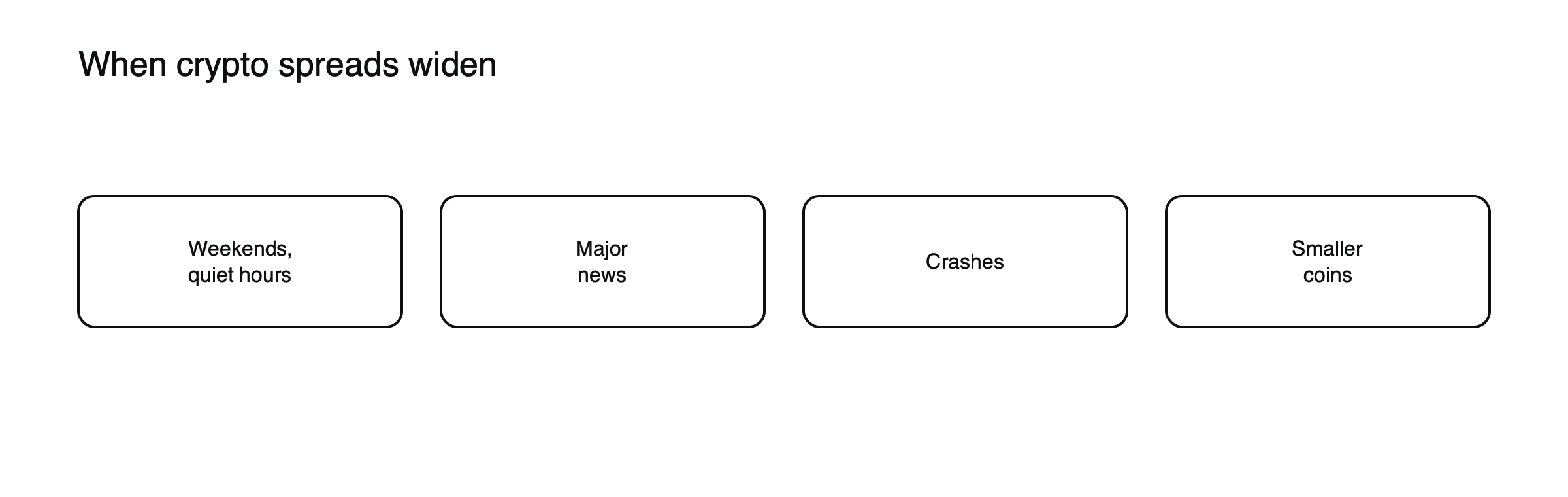
Figure: When spreads widen.
News and data
Regulatory announcements, exchange problems, major hacks and US economic data can widen spreads for minutes.
Crashes
In fast falls, exchanges may lag, liquidations cascade and prices diverge between venues. During the October 2025 crash, more than $19 billion of leveraged positions were wiped out. See what a liquidation cascade is.
The October 2025 crash
On October 10, 2025, more than $19 billion of leveraged crypto positions were wiped out, and prices on different venues diverged sharply. In such conditions, providers widen spreads to reflect the uncertainty about the true price and the difficulty of hedging, sometimes many times their normal level. Orders placed at those moments carry a much higher cost than usual.
Smaller coins
Altcoins have thinner order books, so their spreads are wider and widen more. See why altcoin CFDs move more than bitcoin CFDs.
Fixed and variable spreads
Most crypto CFDs use variable spreads that change with market conditions. Some providers advertise fixed or minimum spreads, but may still widen them in extreme conditions or adjust the price in other ways. Reading how a provider defines its spreads, and what happens in fast markets, avoids surprises.
Spreads add up, illustrated
A trader who makes 100 round-trip trades a year in a $6,000 bitcoin position at a $60 spread pays about $600 in spreads, 10% of the position’s value, before financing. (Illustrative figures.) For frequent traders, a difference of a few dollars per trade in spreads matters more than almost any other cost.
How to plan for it
Avoid opening positions in the widest periods, leave room between stops and normal price swings, and check typical spreads by time of day. See what spread widening is and what a crypto CFD is.
Spread compared with the expected move
A useful check is to compare the spread with the move a trade aims to capture. Paying a 0.1% spread to target a 5% move is reasonable; paying 0.5% to target a 1% move gives away half the expected gain before the trade starts. Short-term strategies in smaller coins often fail on this test.
Comparing providers fairly
Advertised minimum spreads are usually achieved only in the best conditions. Comparing typical spreads at the times you actually trade, including weekends and around major news, gives a more realistic picture, as does checking whether costs are hidden elsewhere, such as in financing rates.
A spread-check routine
- Note the spread on each coin at your usual trading times.
- Check again at weekends and after major announcements.
- Convert spreads into money at your usual size.
- Compare with the move each trade targets.
Why providers widen spreads
A provider’s spread covers the cost and risk of offering a price. When exchanges’ order books thin out or prices diverge between venues, the provider faces more uncertainty about the true price and higher costs to hedge client positions. Widening the spread protects it against those risks. In calm, liquid conditions, competition between providers keeps spreads tight; in stressed conditions, spreads reflect the real difficulty of trading.
Spreads and stop orders
Stop orders on long positions are usually triggered by the bid price, and on short positions by the ask. When a spread widens sharply, the bid can fall to a stop level even if the mid price has barely moved, closing a position that a calmer market would have left open. Placing stops further from the price, and sizing positions accordingly, reduces the chance of being stopped out by a temporary spread spike.
Spread-only and commission pricing
Most crypto CFD providers charge through the spread alone. Some offer accounts with tighter spreads plus a separate commission per trade. For frequent traders, comparing the total cost of a round trip, spread plus commission, across account types shows which is cheaper.
Spreads through the day, illustrated
A trader recording bitcoin CFD spreads at different times might find about $50 to $60 when US and European markets are both active, $70 to $90 during quiet Asian hours and $100 or more late on weekend nights. (Illustrative figures.) Timing entries for active hours can halve spread costs without changing anything else about a strategy.
Around major announcements
US inflation and employment data, central bank decisions and major regulatory news often move crypto prices sharply. Providers commonly widen spreads in the minutes before and after such releases. Opening positions just before a scheduled announcement adds both price risk and spread cost.
Common misreadings
- Comparing advertised minimum spreads instead of typical ones.
- Ignoring spread costs on frequent small trades.
Spread and slippage
The spread is the visible gap between bid and ask; slippage is the difference between the expected price and the actual fill. In fast markets, both rise at once: a wider spread plus slippage on a market order can make the true cost of a trade several times the normal spread. Limit orders avoid slippage but may not be filled.
Spreads on index and altcoin CFDs
Crypto index CFDs usually have spreads between those of bitcoin and of smaller coins, reflecting their mix. Smaller altcoins can have spreads several times wider than bitcoin in percentage terms, and these widen most in stressed markets. See what a crypto index CFD is.
Keeping a spread log
Recording the spread at entry and exit for each trade, alongside the time of day, quickly shows when spreads are tightest and how much they cost over a month. The log often changes when traders choose to enter positions.
Spreads during rallies
Sharp rallies can widen spreads too, as buyers rush in and sellers step back. Chasing a fast move upward often means paying a wide spread at the worst moment.
Estimating monthly spread costs, worked through
A trader expects to make about 20 round-trip trades a month in bitcoin CFDs, each around $6,000 in size, with a typical spread of $60 per coin. Each trade pays about $6, so the month costs about $120 in spreads. If half the trades are placed during quiet hours at double the spread, the cost rises to about $180. (Illustrative figures.) Writing down this estimate at the start of each month, and comparing it with actual costs, keeps trading costs visible and shows whether timing changes are paying off. Over a year, the difference between trading mainly in quiet hours and mainly in active hours can amount to several hundred dollars on a single position size, before counting any other costs.
Frequently asked questions
Why is my position immediately negative after opening?
Because it is valued at the price you could close at, so the spread appears as an instant small loss.
Do spreads widen for every coin at the same time?
Often, during market-wide events, but smaller coins usually widen more.
This article is educational content and does not constitute financial, investment, legal or tax advice. Digital assets are volatile and you may lose the amount you invest.