
How Cross Rates Are Calculated From Two Dollar Pairs
A cross rate is the price of two currencies derived from their US dollar prices. Formulas and worked examples for EUR/JPY and EUR/GBP, and why spreads widen.
A cross rate calculation prices two currencies against each other from their prices against the US dollar. EUR/JPY can be derived from EUR/USD and USD/JPY: at 1.1000 and 150.00, EUR/JPY = 1.10 × 150 = 165.00. When the dollar is on opposite sides, multiply; when it is on the same side, divide.
The two rules
Dollar on opposite sides → multiply. EUR/USD × USD/JPY = EUR/JPY (the dollars cancel).
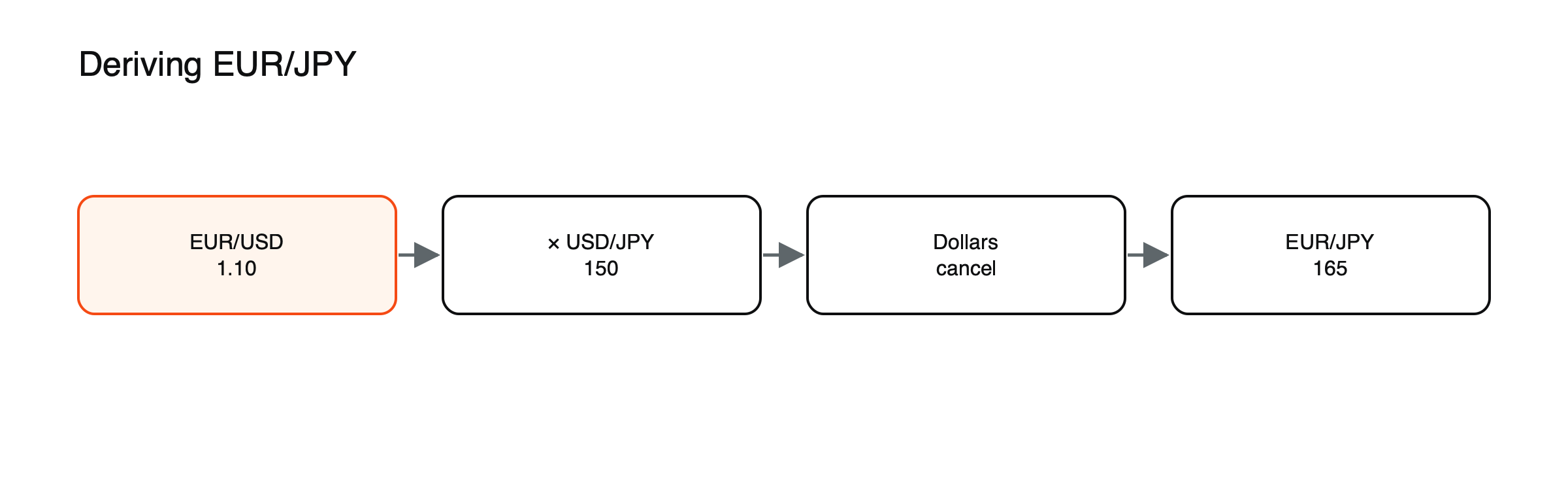
Figure: The dollars cancel when multiplying (example rates).
Dollar on the same side → divide. EUR/USD ÷ GBP/USD = EUR/GBP.
Worked example 1: EUR/JPY
- EUR/USD = 1.1000
- USD/JPY = 150.00
EUR/JPY = 1.1000 × 150.00 = 165.00.
Worked example 2: EUR/GBP
- EUR/USD = 1.1000
- GBP/USD = 1.2700
EUR/GBP = 1.1000 ÷ 1.2700 = 0.8661.
(Rates above are example values.)
Worked example 3: AUD/JPY
- AUD/USD = 0.6600; USD/JPY = 150.00
- Dollar on opposite sides, so multiply: AUD/JPY = 0.6600 × 150.00 = 99.00
Worked example 4: GBP/CHF
- GBP/USD = 1.2700; USD/CHF = 0.8800
- Multiply: GBP/CHF = 1.2700 × 0.8800 ≈ 1.1176
Worked example 5: EUR/CAD
- EUR/USD = 1.1000; USD/CAD = 1.3600
- Multiply: EUR/CAD = 1.1000 × 1.3600 = 1.4960
Why it matters
- Spreads: a cross inherits costs from two dollar pairs, so its spread is usually wider than either. See how much the spread costs on a forex trade.
- Hidden dollar exposure: a move in EUR/JPY can come from a change in either the euro or the yen against the dollar.
- Arbitrage: if a quoted cross drifts from the implied rate, dealers trade it back into line, which keeps crosses consistent.
Bid and ask
For exact executable prices, combine the right sides: to buy EUR/JPY, multiply the EUR/USD ask by the USD/JPY ask; to sell, multiply the bids.
Bid and ask, with numbers
Suppose EUR/USD is quoted 1.0999 / 1.1001 and USD/JPY 149.99 / 150.01. (Example quotes.)
- EUR/JPY bid = 1.0999 × 149.99 ≈ 164.97
- EUR/JPY ask = 1.1001 × 150.01 ≈ 165.03
The implied spread is about 6 yen pips, wider than either dollar pair’s 2 pips, because the costs of both legs combine.
Dividing pairs: which sides to use
When the dollar is on the same side, the bid of the cross uses the first pair’s bid divided by the second pair’s ask, and the ask uses the first pair’s ask divided by the second pair’s bid. With EUR/USD 1.0999 / 1.1001 and GBP/USD 1.2699 / 1.2701:
- EUR/GBP bid = 1.0999 ÷ 1.2701 ≈ 0.86599
- EUR/GBP ask = 1.1001 ÷ 1.2699 ≈ 0.86629
That is an implied spread of about 3 pips.
Why a cross moves
A cross moves when either of its dollar pairs moves. If EUR/USD rises 1% and USD/JPY rises 1% on the same day, EUR/JPY rises about 2%, because the euro gained against the dollar and the dollar gained against the yen. If EUR/USD rises 1% while USD/JPY falls 1%, EUR/JPY is roughly unchanged. Breaking a cross’s move into its two legs shows whether the euro, the yen or the dollar drove it.
See major, minor and exotic currency pairs and how the forex market works.
A cross trade, worked through
You buy 0.5 lots of EUR/JPY at 165.00. Over the next day, EUR/USD rises 0.5% and USD/JPY rises 0.3%. (Example moves.) EUR/JPY becomes about 165.00 × 1.005 × 1.003 ≈ 166.32, a gain of about 132 pips. On 0.5 lots, a pip is worth ¥500, so the profit is about ¥66,000, which converts to roughly $439 at the new USD/JPY rate of about 150.45. Both legs added to the result; had USD/JPY fallen instead, part of the euro’s gain would have been cancelled. Tracking the two dollar pairs alongside the cross shows which leg is doing the work and what news could reverse it.
Crosses also let traders isolate a view. Someone who expects the euro to outperform the yen can buy EUR/JPY directly instead of holding long EUR/USD and long USD/JPY separately. One position means one spread, one stop and a clearer link between the idea and the trade.
Triangular arbitrage, and why it rarely lasts
If a dealer quoted EUR/JPY at 165.20 while the dollar pairs implied 165.00, a trader could in theory sell euros for yen at the high quote, sell the yen for dollars and buy euros with the dollars, locking in about 20 yen pips for each euro. (Illustrative quotes.) In practice, banks’ automated systems spot such gaps within fractions of a second, and spreads on each leg usually exceed any difference. For retail traders, the main lesson is that cross quotes stay tied to the dollar pairs.
Exotic crosses
The same rules work for pairs that are rarely quoted directly. With USD/JPY at 150.00 and USD/MXN at 18.00, the dollar sits on the base side of both, so divide: MXN/JPY = 150.00 ÷ 18.00 ≈ 8.333, meaning one peso buys about 8.33 yen. Spreads on such crosses combine two exotic-sized costs and can be wide.
Cross rates for converting results
The same arithmetic converts profits and losses into your account currency. A profit in pounds on a EUR/GBP trade becomes dollars at the GBP/USD rate, and a profit in yen on EUR/JPY becomes euros by dividing by EUR/JPY or by combining USD/JPY and EUR/USD. Knowing the rule makes it easy to check the platform’s conversions. See how to calculate profit and loss on a forex trade.
Pip value on crosses
A cross’s pip value is set by its quote currency. On EUR/GBP it is £10 per standard lot, on EUR/JPY ¥1,000, converted into your account currency at the relevant dollar rate. See how to calculate pip value.
A spreadsheet version
A small spreadsheet with two input rates and a rule, multiply if the dollar sits on opposite sides and divide if it sits on the same side, reproduces any cross. Adding bid and ask columns shows the implied spread too, which is a quick way to judge whether a broker’s cross quote is competitive.
Common mistakes
- Multiplying when the dollar is on the same side of both pairs, or dividing when it is on opposite sides.
- Combining mid prices and expecting to trade at the result, when real trades happen at bid and ask.
- Forgetting that a pair may be quoted the other way round, such as USD/CHF rather than CHF/USD.
Frequently asked questions
Do brokers calculate crosses this way?
Brokers usually quote crosses directly, using prices from their liquidity providers, but those prices stay very close to the implied rate, because any gap would be traded away quickly.
Why is the cross spread wider?
Because two currency exchanges are combined, each with its own spread, and because crosses are generally less traded than the dollar pairs they are built from.
Leverage, margin and cost figures in this article are example values for illustration. Actual terms depend on the provider, the instrument and the rules in your country.
This article is educational content and does not constitute financial, investment, legal or tax advice. Digital assets are volatile and you may lose the amount you invest.