
How Leverage Changes the Math on a Forex Trade
Effective leverage = position value ÷ equity. On a $2,000 account, 0.5 lots of EUR/USD is 27.5:1 and a 100-pip move is 25% of the account. Worked examples.

Forex leverage determines how much of your account a given price move represents. Effective leverage = position value ÷ account equity. On a $2,000 account, 0.5 lots of EUR/USD at 1.1000 is a $55,000 position, or 27.5:1, so a 100-pip move against you costs $500, a quarter of the account. At 0.1 lots, the same move costs $100, or 5%.
Effective vs maximum leverage
The maximum leverage, such as 30:1 on major pairs under EU retail rules, is the most a provider allows. Effective leverage is what you actually use, and it decides your risk. See what leverage is in CFD trading.
Worked example ($2,000 account, EUR/USD at 1.1000)
| Size | Position value | Effective leverage | 100-pip move | Share of account |
|---|---|---|---|---|
| 0.1 lot | $11,000 | 5.5:1 | $100 | 5% |
| 0.5 lot | $55,000 | 27.5:1 | $500 | 25% |
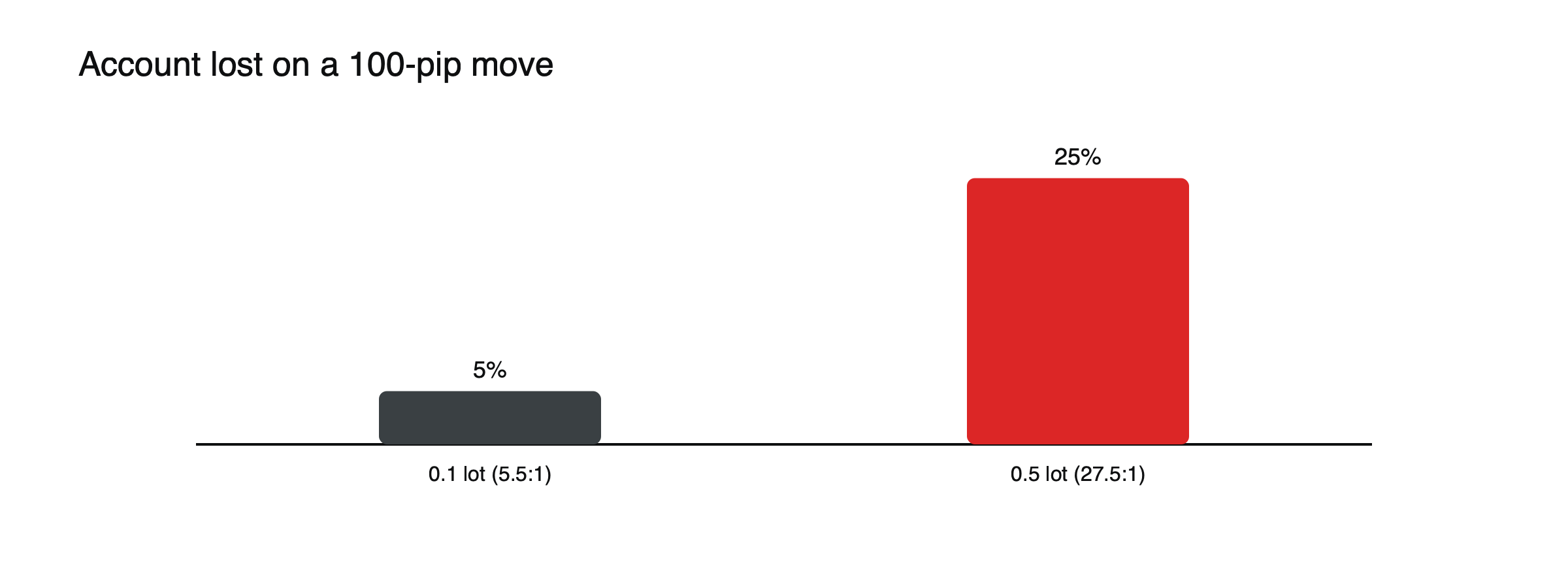
Figure: The same move, very different damage (example values).
A full lot ($110,000) would exceed what 30:1 allows on $2,000, since it needs about $3,667 in margin.
The same trade on three account sizes
| Account | 0.5 lot EUR/USD as effective leverage | 100-pip move as share of account |
|---|---|---|
| $2,000 | 27.5:1 | 25% |
| $5,000 | 11:1 | 10% |
| $20,000 | 2.75:1 | 2.5% |
The trade is identical; the account behind it decides whether a normal move is a minor event or a serious blow.
How many pips to a margin call?
On the $2,000 account, 0.5 lots of EUR/USD at 1.1000 needs about $1,833 of margin at 30:1, a starting margin level of about 109%. A loss of only about $167, roughly 33 pips, takes the margin level to 100% and a margin call. At a 50% stop-out level, positions start closing after a loss of about $1,083, roughly 217 pips. EUR/USD can move 33 pips in an hour on an ordinary day, so this position leaves almost no room for normal noise. See equity, free margin and margin level explained.
Why it matters
At 27.5:1, a 1% move in EUR/USD changes your account by about 27.5%. A few normal days can produce large swings, and a margin call can follow quickly. See what happens in a margin call and a stop-out.
Keeping leverage in check
Size positions by risk per trade, not by available margin, and track effective leverage across all open positions. See how to calculate position size in forex and how the forex market works.
Leverage across several positions
Effective leverage applies to the whole account. Suppose a $10,000 account holds 0.3 lots of EUR/USD (about $33,000), 0.3 lots of GBP/USD (about $38,100) and 0.2 lots of USD/JPY ($20,000). Total exposure is about $91,100, effective leverage about 9:1, even though no single position looks large. If the three positions all depend on the dollar moving the same way, they behave like one larger trade. See currency correlation.
The same target with less leverage
Lower leverage does not mean giving up on a trade idea; it means expressing it at a size the account can carry. A 100-pip target on 0.1 lots earns $100 on the $2,000 account, 5%, while a 50-pip stop risks $50, 2.5%. The higher-leverage version promises five times the gain but brings a margin call within about 33 pips. The smaller position lets the trade work as planned.
Leverage against normal daily moves
EUR/USD often moves around half a percent to just under one percent on an ordinary day. (Illustrative range.) At an effective leverage of 27.5 to 1, that is a swing of roughly 14% to 22% of the account in a single day, before any news. At 5.5 to 1, the same moves change the account by about 3% to 4%. Leverage turns a currency pair’s quiet daily rhythm into either a manageable fluctuation or a daily threat to the account.
Leverage and margin level are two views of the same thing
With a single position at a 30:1 margin rate, the starting margin level equals 30 divided by effective leverage, times 100%. At 27.5 to 1, that is about 109%, a whisker above a margin call. At 10 to 1 it is 300%, and at 5 to 1 600%. The formula makes the trade-off concrete: every step up in effective leverage removes room between the account and the first warning, before the market has moved at all. Checking margin level right after opening a position is therefore a quick and reliable way to see effective leverage without any calculation: a reading below about 300% means the whole account is already running at more than ten to one.
What lower leverage actually costs
Using less leverage does not change the percentage a currency moves; it only changes how much of the account rides on it. The real cost of low leverage is slower growth when trades go well. The benefit is that a string of ordinary losses, which every method experiences, stays survivable. For most traders, surviving long enough to learn is worth more than a faster start.
Leverage limits by client type
Retail clients in the EU, UK and Australia are capped at 30:1 on major currency pairs and 20:1 on others. Clients classed as professional can access more, giving up some protections, and providers regulated elsewhere may offer far higher ratios. The cap is a ceiling, and the examples above show that sensible effective leverage usually sits well below it. See leverage limits by country.
After a winning streak
Leverage tends to creep up after a run of wins, when confidence is high and position sizes grow faster than the account. A rule that ties size to current equity and risk per trade, rather than to recent results, keeps a good month from setting up a bad one.
A short leverage routine
Before opening a trade, add its value to the value of open positions, divide by equity and compare the result with a personal limit, for example about 5 to 1. If the new total exceeds the limit, reduce the size or wait.
Frequently asked questions
Is it safe to use the full 30:1?
Using the full amount means a move of about 3.3% against you wipes out the margin on that position, and much smaller moves trigger margin calls. Most traders use far less, sizing positions by risk rather than by the maximum allowed.
How do I see my effective leverage?
Add up the value of all open positions in your account currency and divide by your equity. Some platforms show it directly; otherwise a quick calculation from position sizes does the job.
Leverage, margin and cost figures in this article are example values for illustration. Actual terms depend on the provider, the instrument and the rules in your country.
This article is educational content and does not constitute financial, investment, legal or tax advice. Digital assets are volatile and you may lose the amount you invest.