
How to Read a Forex Quote
Identify base and quote, read the bid and ask, find the spread in pips and work out the cost of a trade: how to read a forex quote, step by step with EUR/USD.
To read a forex quote, identify the base and quote currencies, find the bid (where you sell) and ask (where you buy), work out the spread in pips and note the decimals. On EUR/USD at 1.10000/1.10010, you sell euros at 1.10000 dollars, buy at 1.10010, and the spread is 1 pip.
Before you start
Open a live quote for a major pair such as EUR/USD so you can follow along.
Reading it step by step
Identify base and quote
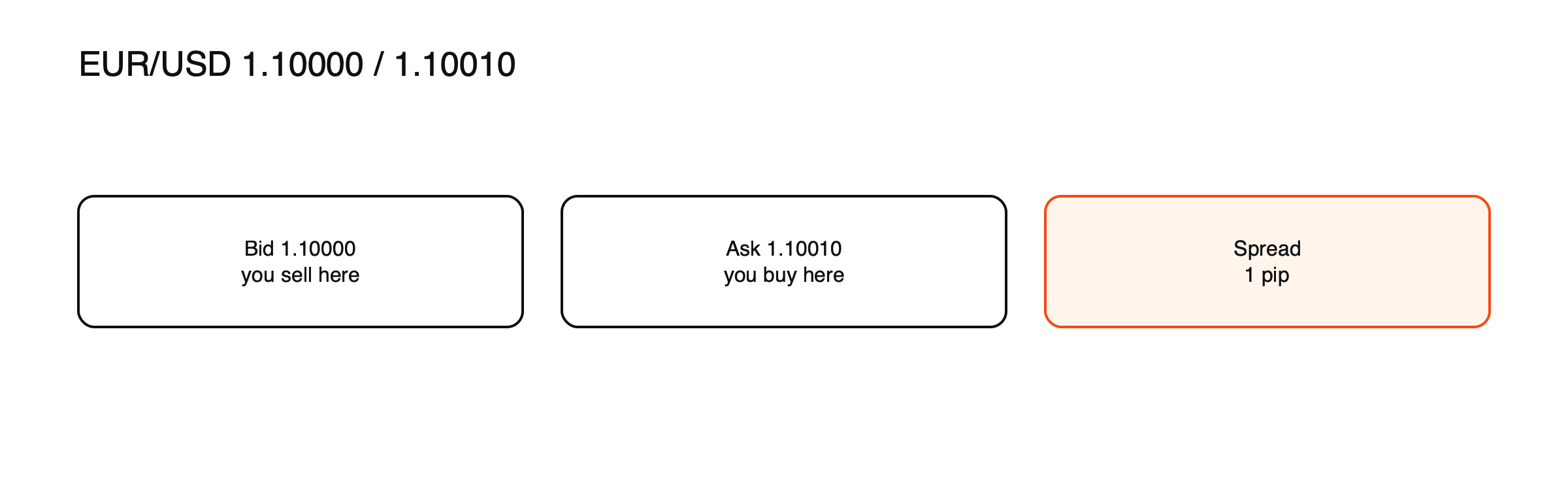
Figure: Reading a quote (example values).
In EUR/USD, the euro is the base (one unit) and the dollar is the quote (the price). See what a currency pair is.
Read the bid and ask
- Bid: the price you sell the base currency at, here 1.10000.
- Ask: the price you buy it at, here 1.10010.
You always buy at the higher price and sell at the lower one.
Work out the spread
Ask − bid = 0.00010 = 1 pip (with a fifth-decimal pipette). See what a pip is.
Check the decimals
Most pairs quote to five decimals; yen pairs to three, such as USD/JPY 150.123/150.135, a 1.2-pip spread.
Translate into cost
Multiply the spread by the pip value and your size: 1 pip on 1 lot of EUR/USD is $10. See how much the spread costs on a forex trade.
Three quotes, read through
| Quote | Base / quote | Spread | What buying means |
|---|---|---|---|
| EUR/USD 1.10000 / 1.10010 | Euro / dollar | 1.0 pip | Paying 1.10010 dollars per euro |
| USD/JPY 150.123 / 150.135 | Dollar / yen | 1.2 pips | Paying 150.135 yen per dollar |
| EUR/GBP 0.85000 / 0.85020 | Euro / pound | 2.0 pips | Paying 0.85020 pounds per euro |
(Example quotes.) The same steps work for every pair: find which currency is being priced, read both sides of the quote and measure the gap in pips.
What else a quote screen shows
Trading platforms usually show more than bid and ask. A daily high and low show the range so far, a change figure shows the move since the previous close, and some screens show the spread directly, often in points rather than pips. On platforms quoting five decimals, a spread shown as 10 points is 1 pip. Market depth, where available, lists the volumes offered at prices beyond the best bid and ask, which matters for larger orders.
Direct and indirect quotes
From the point of view of someone in the United States, EUR/USD is a direct quote: it shows how many dollars one euro costs. USD/JPY is an indirect quote from the same viewpoint: it shows how many yen one dollar buys. When the dollar strengthens, direct quotes such as EUR/USD fall and indirect quotes such as USD/JPY rise. Keeping that in mind avoids confusion when comparing moves across pairs.
Chart prices versus trading prices
Many charts plot the bid price only. When you buy, you pay the ask, which sits above the line by the spread, and when you sell a short position back, you also pay the ask. That is why a buy limit order can stay unfilled even though the chart seems to touch your price, and why short positions can be stopped out without the bid line reaching the stop.
Common mistakes
- Confusing which currency you are buying.
- Ignoring that the chart may show the bid while you buy at the ask.
- Missing that spreads change by time of day and around news. See what spread widening is.
For the bigger picture, read how the forex market works.
Quotes when spreads widen
The same pair can show very different spreads at different times. EUR/USD might be quoted with a 0.8-pip spread in the European afternoon and several pips in the quiet hour around the daily rollover or during a major data release. Reading the spread every time before placing an order, rather than assuming the usual figure, avoids paying several times the expected cost.
Three questions for any quote
Before acting on a quote, it helps to answer three questions. Which currency am I buying or selling, the base or the quote? What will it cost me to enter and exit right now, measured by the spread? And how does the current price compare with today’s range, shown by the high and low? Answering these takes seconds and catches most beginner errors, such as buying the wrong side of a pair or trading into an unusually wide spread.
Quotes on exotic pairs
Exotic pairs, such as USD/TRY or USD/ZAR, are read the same way but often show larger prices, more digits and much wider spreads. A spread of 50 pips or more is not unusual, and quotes can jump in thin markets. The reading steps are identical; the costs and risks behind them are not.
Practicing with a demo account
Watching live quotes on a demo account for a few days, noting how spreads change across sessions and around news, builds a feel for normal conditions before real money is involved.
Quotes and your account currency
A quote shows prices in the pair’s own currencies, not in your account currency. If your account is in euros and you trade USD/JPY, both profit and spread cost arise in yen and are converted into euros at the current exchange rate. The quote tells you the cost in pips; your platform converts it into money.
Frequently asked questions
Why are there two prices in a forex quote?
Because the dealer quotes a price to buy from you, the bid, and a price to sell to you, the ask. The difference is the dealer’s compensation and your cost of trading.
Why do some quotes have five decimals?
The fifth decimal, or third for yen pairs, is a pipette, one tenth of a pip. It allows prices and spreads to be quoted more precisely than whole pips.
Leverage, margin and cost figures in this article are example values for illustration. Actual terms depend on the provider, the instrument and the rules in your country.
This article is educational content and does not constitute financial, investment, legal or tax advice. Digital assets are volatile and you may lose the amount you invest.