
What Is a Currency Pair?
A currency pair shows how much of one currency buys one unit of another. How base and quote currencies work, how to read bid and ask and what buying means.
A currency pair is a price quote showing how much of one currency, the quote currency, it takes to buy one unit of another, the base currency. In EUR/USD at 1.1000, one euro costs 1.10 US dollars. Buying the pair means betting the base currency will strengthen against the quote currency; selling means the opposite.
Base and quote
- Base currency: the first one, always worth one unit (EUR in EUR/USD).
- Quote currency: the second one, the price of one base unit (USD in EUR/USD).
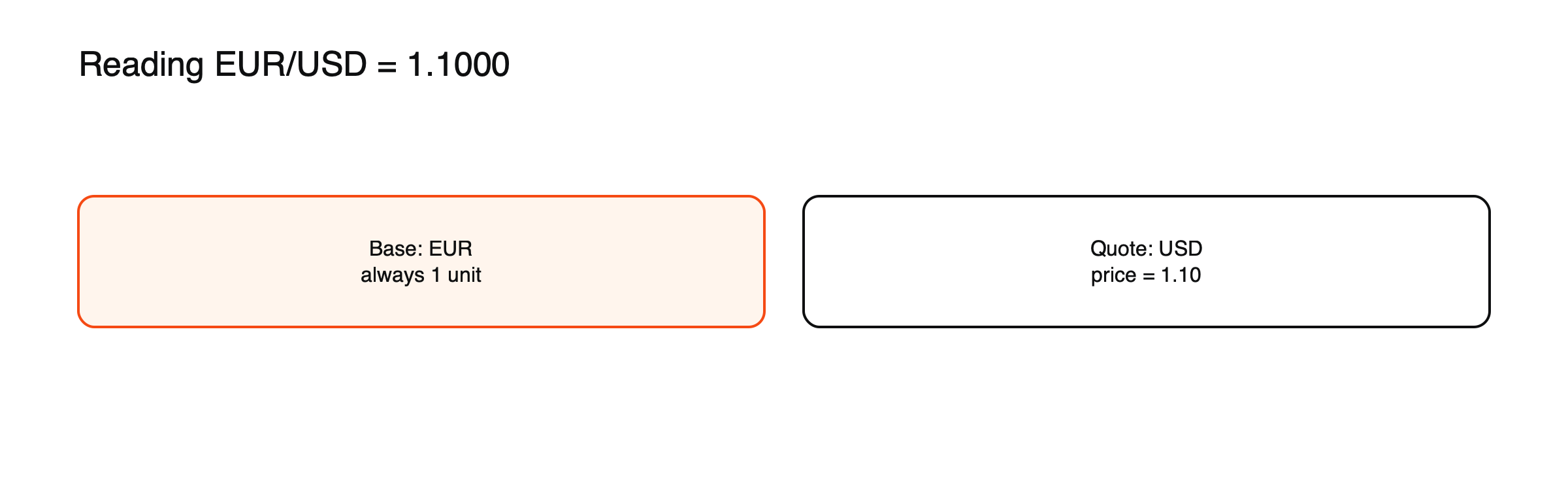
Figure: Reading a currency pair quote (example value).
If EUR/USD rises from 1.1000 to 1.1100, the euro has strengthened: one euro now buys more dollars.
How pairs are named
Each currency has a three-letter code: USD for the US dollar, EUR for the euro, JPY for the Japanese yen, GBP for the British pound, CHF for the Swiss franc and so on. The market follows long-standing conventions about which currency comes first. The euro usually leads, followed by sterling, the Australian and New Zealand dollars, then the US dollar, so the market quotes EUR/USD and GBP/USD rather than USD/EUR, but USD/JPY and USD/CAD with the dollar first. The convention matters because it decides which way the price moves when one currency strengthens.
Reading a move both ways
If EUR/USD rises from 1.1000 to 1.1100, the euro has gained against the dollar. The same move, seen from the dollar’s side, takes the price of one dollar in euros from about 0.9091 to about 0.9009: the dollar has weakened. Every currency pair tells the story of two currencies at once, and the quoted direction depends only on which is written first.
Bid and ask
Quotes have two prices: the bid, where you can sell the base currency, and the ask, where you can buy it. The gap is the spread, your entry cost. See how much the spread costs on a forex trade.
Buying and selling a pair
- Buy (long) EUR/USD: profit if the euro rises against the dollar.
- Sell (short) EUR/USD: profit if the euro falls against the dollar.
Every trade is a view on two currencies at once: a stronger dollar can push EUR/USD down even if nothing changes in Europe.
Naming conventions. Pairs follow market convention, so the same two currencies are always quoted the same way: EUR/USD, not USD/EUR; USD/JPY, not JPY/USD. Pairs are grouped into majors, minors and exotics. See major, minor and exotic currency pairs.
A trade in money terms
You buy 1 standard lot of EUR/USD, 100,000 euros, at 1.1000. The euro rises and you close at 1.1050, a move of 50 pips. Each pip on one lot of EUR/USD is worth about $10, so the profit is about $500, before the spread and any rollover. Had the pair fallen to 1.0950 instead, the loss would have been about $500. Selling the pair works the other way: you profit if it falls and lose if it rises. See what a pip is.
Two currencies, two stories
Because a pair has two sides, a move can come from either. Suppose EUR/USD falls from 1.1000 to 1.0900 on a day of strong US jobs data while nothing happens in Europe. The euro has not weakened in any general sense; the dollar has strengthened against almost everything. Checking how each currency moves against others, for example whether the dollar also rose against the yen and sterling, shows which side drove the move. That matters for planning: a trade based on a view about Europe can be overwhelmed by news from the United States.
Pairs and trading hours
Each pair is most active when the financial centers of its two currencies are open. EUR/USD and GBP/USD trade most heavily when London and New York overlap; USD/JPY and AUD/USD see more activity during Asian hours. Spreads tend to be tightest and moves smoother when a pair’s home markets are busy, and wider in the quiet hours between sessions. Choosing when to trade a pair can matter almost as much as choosing the pair itself. See forex trading sessions. Overlaps are when most of each day’s volume changes hands.
Majors, crosses and exotics
Pairs that include the US dollar and another leading currency are called majors and have the deepest markets and tightest spreads. Pairs of two major currencies without the dollar, such as EUR/GBP or EUR/JPY, are called crosses. Pairs that include the currency of a smaller or emerging economy are called exotics and usually have wider spreads and larger moves. See major, minor and exotic currency pairs.
Inverse quotes and cross rates
Any pair can be inverted by dividing one by its price, and the price of a cross can be derived from two dollar pairs. If EUR/USD is 1.1000 and USD/JPY is 150.00, EUR/JPY should trade near 1.1000 × 150.00 = 165.00. Brokers quote crosses directly, but knowing how they relate explains why crosses move when dollar pairs move. See how to calculate a cross rate.
For crypto pairs, see what a crypto trading pair is. For the bigger picture, read how the forex market works.
Frequently asked questions
Which currency do I own when I buy EUR/USD?
In effect, you are long euros and short dollars: you gain if the euro rises against the dollar. With a CFD, you do not hold either currency; the position tracks the price difference.
Why is USD/JPY quoted with the dollar first?
By market convention. The yen is usually the second currency in pairs with major currencies, so the quote shows how many yen one unit of the other currency buys.
This article is educational content and does not constitute financial, investment, legal or tax advice. Digital assets are volatile and you may lose the amount you invest.