
What Is Tracking Difference in an ETF?
Tracking difference is the gap between an ETF's return and its index's, driven by fees, trading costs, cash drag and lending income. How to measure it and why.
Tracking difference is the gap between an ETF’s return and its index’s return over a period. If the index returned 10.00% and the ETF 9.90%, it is −0.10%. It is usually close to the expense ratio, but trading costs, cash, dividend taxes and securities lending income can make it larger or smaller.
What causes it
- Fees: the expense ratio is taken from the fund.
- Trading costs when the index changes.
- Cash drag: small cash balances that don’t earn the index return.
- Withholding tax on dividends from foreign holdings.
- Securities lending income, which can offset costs.
- Sampling: holding only part of the index.
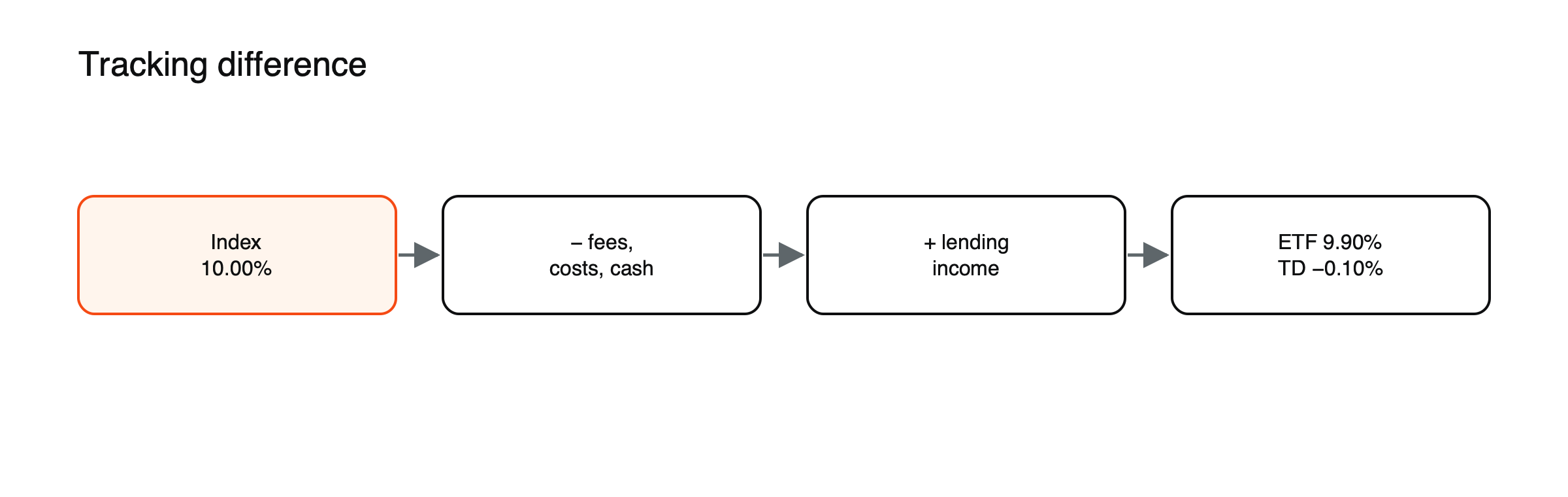
Figure: From index return to fund return (example values).
Withholding tax, illustrated
Suppose an ETF tracks a global index yielding 2% in dividends, and 40% of its holdings are in a country that withholds 15% of dividends paid to the fund. (Example values.) The fund loses about 0.12% a year, 2% × 40% × 15%, compared with an index that assumes no tax. Depending on the index’s own method and the fund’s domicile, that loss can make tracking difference noticeably larger than the expense ratio.
Securities lending, illustrated
Some ETFs lend shares they hold to other investors, usually short sellers, in exchange for fees, with collateral to cover the risk. If lending earns 0.05% a year, a fund charging 0.07% may show a tracking difference of only about −0.02%. Lending adds a small counterparty risk, which is why funds disclose their lending policies and collateral.
Tracking difference vs tracking error
Tracking difference is the size of the gap over a period. Tracking error measures how much that gap varies from day to day or month to month. A fund can have a small, steady tracking difference and low tracking error.
Tracking error, illustrated
Two funds each lag their index by 0.10% over a year. The first lags by about 0.008% every month, with little variation; the second beats the index by 0.30% in some months and lags by 0.40% in others, ending with the same annual gap. Both have the same tracking difference, but the second has much higher tracking error, meaning its returns are less predictable relative to the index. (Example values.)
Why it matters
It shows the real cost of owning the ETF better than the expense ratio alone. When comparing ETFs on the same index, look at tracking difference over several years. See how to compare ETFs that track the same index.
Where the usual answer flips. A fund can beat its index slightly, a positive tracking difference, thanks to lending income or tax treatment.
See how much an ETF’s expense ratio costs over 10 years and what an ETF is.
Reading tracking difference in practice
Factsheets and fund websites often show the fund’s return next to the index return for each calendar year. Subtracting one from the other gives the tracking difference for each year. Looking at several years, rather than one, smooths out one-off effects and shows whether a fund consistently lags by roughly its fee or by more.
Synthetic ETFs and tracking
Synthetic ETFs, which receive the index return through swap agreements, can track their index very closely because the swap counterparty promises the return, sometimes even adding to it in markets where they handle tax more efficiently. In exchange, investors take on the counterparty’s credit risk, usually limited by collateral. See physical vs synthetic ETFs.
Tracking in stressed markets
In turbulent markets, trading costs rise and index changes can be harder to replicate, so tracking difference can widen temporarily. Bond ETFs, which hold many less liquid securities, are especially prone to this.
Calculating it yourself, worked through
Suppose an index returned 8.50% in a year and an ETF tracking it returned 8.41%. The tracking difference is −0.09%. If the fund’s expense ratio is 0.07%, the fund lagged by 0.02% more than its fee, perhaps through trading costs or taxes. (Example values.) Repeating the calculation for each of the last five years shows whether that extra lag is consistent or a one-off.
Cash drag, illustrated
ETFs hold small amounts of cash for dividends received, flows and trading. If a fund keeps 1% of its assets in cash during a year when the index rises 10%, that cash earns much less than the index, costing roughly 0.1% of performance. In falling markets, the same cash slightly cushions losses. Well-run funds keep cash balances small to limit this effect.
Sampling
Some indices contain thousands of securities, many small or hard to trade, particularly in bond and emerging market indices. Funds may hold a representative sample rather than every security, which lowers trading costs but can cause the fund’s return to drift from the index. Sampling tends to increase tracking error more than tracking difference.
Index changes
When an index adds or removes members or changes weights, the fund must trade to match. These trades cost money through spreads and market impact, especially in less liquid markets, and contribute to tracking difference. See how index rebalancing works.
Common misreadings
- Treating the expense ratio as the full cost.
- Judging a fund on one year’s tracking difference.
Bond ETFs and tracking
Bond indices contain thousands of individual bonds, many of which trade rarely. Bond ETFs therefore rely heavily on sampling, and their trading costs are higher than those of equity funds, so tracking difference tends to be larger and more variable. In stressed markets, as in March 2020, the gap between bond ETF prices and index values can widen sharply for a time.
Currency-hedged ETFs
Currency-hedged ETFs aim to remove the effect of exchange rate moves on returns from foreign assets. The hedging itself has costs or benefits that depend on the difference in interest rates between the two currencies, which shows up as part of tracking difference against the unhedged index. Comparing a hedged fund with the hedged version of its index gives a fairer picture.
Where the gap comes from
| Factor | Usual effect on tracking difference |
|---|---|
| Expense ratio | Negative |
| Trading and rebalancing costs | Negative |
| Cash drag | Negative in rising markets |
| Withholding tax | Negative, depending on index method |
| Securities lending income | Positive |
| Sampling | Either direction |
ETF CFDs and tracking
A CFD on an ETF follows the ETF’s price, so the ETF’s tracking difference is built into the CFD as well. CFD traders also pay spreads and financing, which usually dwarf the tracking difference over any meaningful holding period.
Comparing several funds, illustrated
Three ETFs track the same index. Over five years, the first lagged by an average of 0.05% a year, the second by 0.12% and the third by 0.20%, while their fees were 0.07%, 0.07% and 0.15%. (Example values.) The first fund, with lending income offsetting part of its fee, delivered the best result despite having the same fee as the second. Several years of results, not just fees, reliably show which fund actually tracks its index best in practice.
Frequently asked questions
Is a small negative tracking difference normal?
Yes. Most index ETFs lag their index by roughly their fee, sometimes a little more or less.
Should I choose the ETF with the best tracking difference?
It is one of the best measures of total cost among funds tracking the same index, alongside spread, size and structure.
Leverage, margin and cost figures in this article are example values for illustration. Actual terms depend on the provider, the instrument and the rules in your country.
This article is educational content and does not constitute financial, investment, legal or tax advice. Digital assets are volatile and you may lose the amount you invest.