
Bond Market Myths That Confuse New Traders
Six bond market myths tested like lab hypotheses on the same $10,000: price risk, long Treasuries, high yield, stock-bond links, inversions and maturity.
Common bond market myths: bonds can’t lose money, government bonds don’t swing, high yield is a free extra return, bonds always rise when stocks fall, inverted curves time recessions and holding to maturity removes all risk. Treating each myth as a hypothesis and testing it on the same $10,000 shows where it breaks.
The laboratory setup
Each section below follows the same steps: a hypothesis taken from a common belief, an experiment using $10,000 and simple bond arithmetic, the result and the conclusion. Where history provides a real test, the experiment uses it. (Unless sourced, all figures are illustrative.)
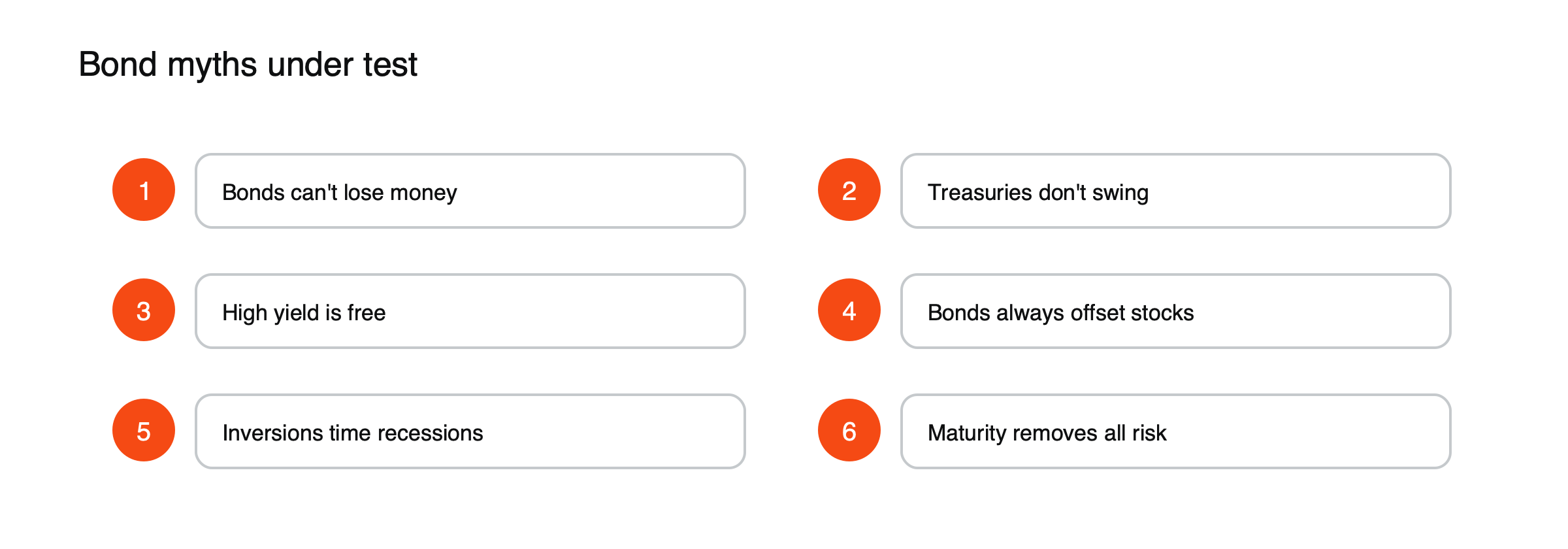
Figure: Six bond myths under test.
Experiment 1: “Bonds can’t lose money”
Hypothesis: a high-quality bond is a safe place for money, so its value cannot fall.
Experiment: put $10,000 into a 10-year bond paying 4% at par. Raise market yields by 1 percentage point and reprice the bond.
Result: the bond’s price falls about 7.7%, a paper loss of about $772. In 2022, when yields rose sharply, the main US bond index lost about 13%, its worst year since 1976.
Conclusion: rejected. Bonds lose value when yields rise; only holders who keep them to maturity, and whose issuers pay, avoid realizing the loss. See why bond prices fall when yields rise.
Experiment 2: “Treasuries don’t swing”
Hypothesis: US government bonds are risk-free, so their prices are stable.
Experiment: compare $10,000 in a 2-year, a 10-year and a 30-year Treasury, each paying 4%, after a 1-point rise in yields.
Result: the 2-year falls about 1.9%, the 10-year about 7.7% and the 30-year about 15%. In 2022, 10-year Treasuries lost about 16% while 2-year notes lost about 4%.
Conclusion: rejected for long maturities. Treasuries are nearly free of default risk, not of price risk. See how bond duration predicts price moves.
Experiment 3: “High yield is a free extra return”
Hypothesis: a high-yield bond paying 7.8% when Treasuries pay 4.2% earns an extra 3.6 points a year for little extra effort.
Experiment: apply two shocks to $10,000 in a high-yield fund with a duration of about 4. First, assume 4% of issuers default each year and bondholders recover 40%, a loss of about 2.4 points a year. Second, widen spreads by 5 points in a panic.
Result: defaults alone consume about two-thirds of the extra yield. The spread shock cuts the fund’s price by roughly 20%, about $2,000, before any recovery. In March 2020, US high-yield spreads reached about 1,087 basis points.
Conclusion: rejected. The extra yield pays for default and liquidity risk, which arrive unevenly and often all at once. See what a credit spread is.
Experiment 4: “Bonds always rise when stocks fall”
Hypothesis: holding bonds alongside shares guarantees protection in a sell-off.
Experiment: look at 2022, when inflation forced central banks to raise rates rapidly.
Result: US shares fell about 18% and the main US bond index about 13%. A $10,000 portfolio split evenly between them would have lost roughly $1,550 instead of being cushioned.
Conclusion: partly rejected. Government bonds have often risen in recessions, when rates are cut, but in inflation shocks, bonds and shares can fall together. See how the stock-bond correlation works.
Experiment 5: “An inverted curve times recessions”
Hypothesis: once the yield curve inverts, a recession follows on a predictable schedule.
Experiment: check the record. The 2-year/10-year curve inverted before each of five US recessions since 1976, with lags ranging from months to more than a year. Then check the most recent inversion, which began in July 2022.
Result: the curve stayed inverted for 26 months and un-inverted in September 2024, and as of 2026 no US recession had followed.
Conclusion: rejected as a timing tool. An inversion has been a meaningful warning, but not a clock. See what an inverted yield curve means.
Experiment 6: “Holding to maturity removes all risk”
Hypothesis: if a bond is held until it repays, nothing can go wrong.
Experiment: put $10,000 into a 10-year bond yielding 2%, held to maturity, while inflation averages 4% a year.
Result: the bond returns about $12,190 in money terms, but its purchasing power is only about $8,235 at today’s prices, a real loss of about 18%. Meanwhile, new bonds issued at higher yields would have earned far more.
Conclusion: rejected. Holding to maturity removes the need to sell at a loss, but not inflation risk, reinvestment risk or the cost of missing higher yields. See how to calculate a real yield.
The lab report
| Hypothesis | Verdict | What actually limits the risk |
|---|---|---|
| Bonds can’t lose money | Rejected | Shorter duration, holding to maturity |
| Treasuries don’t swing | Rejected for long maturities | Matching maturity to time horizon |
| High yield is free | Rejected | Diversification, spread awareness |
| Bonds always offset stocks | Partly rejected | Knowing whether growth or inflation is the threat |
| Inversions time recessions | Rejected as a timer | Using several indicators |
| Maturity removes all risk | Rejected | Inflation-linked bonds, laddering |
Bonds reduce some risks and add others. See how bonds work.
Why these myths persist
For four decades after the early 1980s, falling interest rates gave bond investors steady price gains on top of their income, and losses were brief. Investors who learned about bonds during that period came to see them as reliably safe. The experiments above show that the experience depended on falling rates, not on bonds being immune to losses, and 2022 made the point painfully clear.
Myths about bond funds
Bond funds add a twist: unlike individual bonds, most never mature, so there is no date when a fund’s price is sure to return to par. A fund with a duration of six that loses 10% in a rate shock recovers through higher income over time, not through repayment. Investors who believe they can wait for a fund to come back to its old price may wait a long time, though rising income does eventually help.
Running your own experiments
The same method works for any belief about bonds: state the belief precisely, choose a realistic amount, apply a plausible change in yields, spreads or inflation and calculate what happens. A spreadsheet with a bond pricing formula or a duration estimate is enough. Testing beliefs before they are tested by markets is far cheaper.
A bonus experiment: “Cash has no risk”
Hypothesis: keeping $10,000 in cash avoids all the risks shown above. Experiment: hold it for ten years at an average interest rate of 2% while inflation averages 3%. Result: the balance grows to about $12,190, but its purchasing power falls by roughly 9%. Conclusion: rejected. Cash avoids price swings but not inflation, and its income falls when rates are cut.
What the experiments share
In each case, the myth confuses one type of risk with risk in general. Default risk, price risk, inflation risk, liquidity risk and correlation risk are different, and safety from one does not mean safety from the others. Naming the specific risk in each holding is the first step to managing it.
Applying the lessons
The experiments point to practical steps: match bond maturities to when money will be needed, hold some inflation-linked bonds if inflation is a concern, diversify credit exposure rather than chasing the highest yields, and treat yield curve signals as warnings rather than timetables. None of these removes risk, but each targets a specific one.
A note on leverage
Bond CFDs and futures magnify the price moves shown in these experiments. A 1-point rise in yields that costs an unleveraged holder of 10-year notes about 8% could cost a leveraged position several times that relative to its margin.
Checking your own holdings
For each bond or fund you own, note its duration, credit quality, currency and whether it is inflation-linked. Then ask what a 1-point rise in yields, a sharp widening of credit spreads or a burst of inflation would do to it. That short exercise, repeated once a year, turns the lessons of these experiments into a practical review of your own exposure. Small adjustments made in calm markets cost far less.
Frequently asked questions
Are bonds still worth owning?
For many investors, yes, for income, stability and diversification, but with realistic expectations about price risk and inflation.
Which bonds are least affected by rising yields?
Short-term bonds and Treasury bills, which mature quickly and can be reinvested at higher rates.
This article is educational content and does not constitute financial, investment, legal or tax advice. Digital assets are volatile and you may lose the amount you invest.
Sources
- Why ordinary investors got hit so hard in 2022 (Agg −13.1%, worst since 1976; 10-year yield from about 1.5% to about 4.2%) — Yahoo Finance via AOL
- Bond credit spread (definition and example; US high-yield OAS 1,087 bp on March 23, 2020; about 270 bp on July 10, 2026) — BIT Knowledge Hub
- 2s10s yield curve inversion history (five inversions since 1976 followed by recession; 26-month 2022–2024 inversion without one as of 2026) — Eco3min
- Commodities are more than just an inflation hedge (US equities −18% in 2022) — WisdomTree
- Bonds: a H1 2023 report card (2022 Treasury returns from −4.1% for 2-year to −16.3% for 10-year) — WisdomTree