
How Bonds Work
A bond is a loan that pays a coupon and repays face value at maturity. How bonds work, how they are priced, why prices fall when rates rise and the main risks.
A bond is a loan from an investor to a government or company, which pays regular interest, the coupon, and repays the face value, often $1,000, at maturity. Bonds trade after issue, and prices move with interest rates and credit quality. When rates rise, prices fall: in 2022 the main US bond index lost 13%, its worst year since 1976.
The key terms
- Face value: the amount repaid at maturity.
- Coupon: the annual interest, as a percentage of face value.
- Maturity: when the loan is repaid.
- Price: what the bond trades for now, often quoted per 100 of face value.
- Yield: the return you earn if you buy at today’s price. See how to calculate yield to maturity.
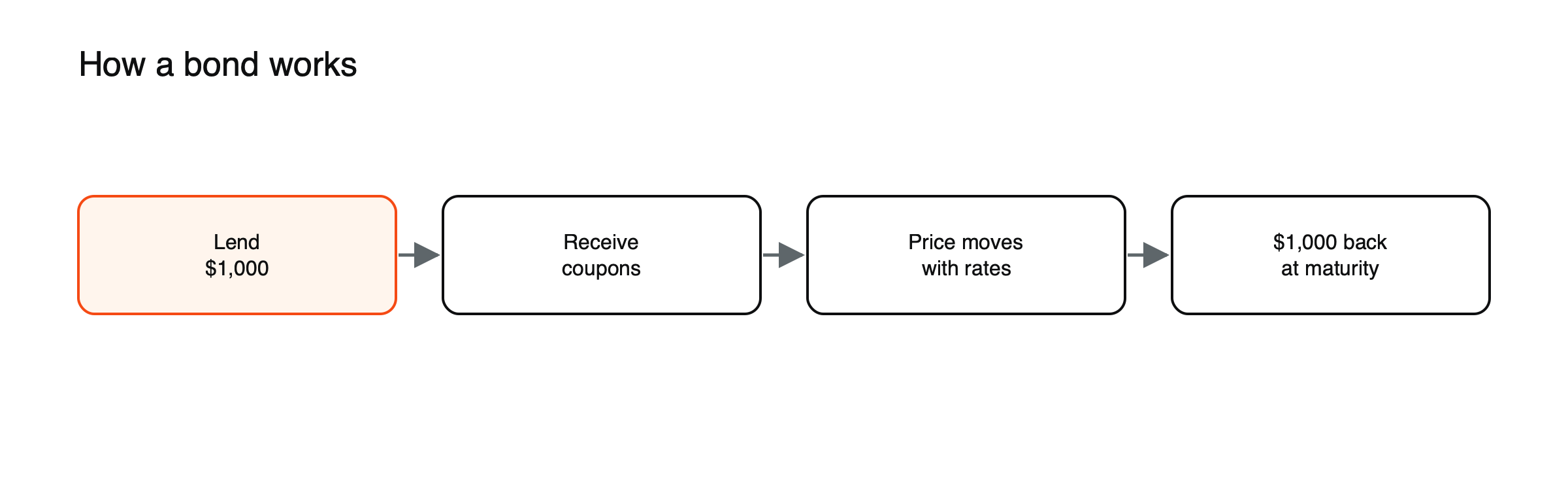
Figure: The life of a bond.
A bond’s cash flows, illustrated
Suppose a company issues a five-year bond with a face value of $1,000 and a 4% annual coupon. (Example values.) The holder receives $40 a year for five years and $1,000 at the end, a total of $1,200. If the bond is bought at issue for $1,000 and held to maturity, the return is 4% a year, provided the company pays. Most bonds pay coupons once or twice a year; US Treasuries pay twice, so this bond would pay $20 every six months.
Price and yield, worked through
Suppose a year later market interest rates for similar bonds have risen to 5%. A buyer can get a new bond paying 5%, so the old 4% bond must sell for less. Its price falls until its yield, combining the coupon and the gain to $1,000 at maturity, matches 5%: about $964.54 for the remaining four years. If rates had fallen to 3%, it would sell for about $1,037.17. The coupon never changes; the price adjusts. See why bond prices fall when yields rise.
Main types
Government bonds such as US Treasuries, corporate bonds, municipal bonds and inflation-linked bonds. See investment-grade vs high-yield bonds.
Who issues bonds
| Issuer | Examples | Typical features |
|---|---|---|
| National governments | US Treasuries, UK gilts, German Bunds | Lowest credit risk in their own currency; very liquid |
| Local governments | US municipal bonds | Often tax advantages in their home country |
| Companies | Corporate bonds | Higher yields to compensate for credit risk |
| Supranational bodies | Development banks | High credit quality |
| Governments, inflation-linked | US TIPS, UK index-linked gilts | Payments rise with inflation |
Credit ratings
Rating agencies grade issuers’ ability to repay. Bonds rated BBB− or higher by S&P or Fitch, or Baa3 or higher by Moody’s, are investment grade; lower ratings are high yield, sometimes called junk. Lower-rated bonds pay higher yields to compensate for a greater chance of default, and their prices are more sensitive to the economy. See investment-grade vs high-yield bonds.
Why prices move
- Interest rates: higher market rates make existing bonds less attractive. See why bond prices fall when yields rise.
- Credit risk: worries about the issuer lower prices.
- Inflation erodes fixed payments.
2022: when bonds fell hard
As the Federal Reserve raised rates rapidly in 2022, the 10-year Treasury yield rose from about 1.5% to about 4.2%. The main US bond index lost about 13%, its worst year since 1976, and 10-year Treasuries lost about 16%, while 2-year notes lost about 4%. The year showed that bonds, often seen as safe, can suffer large losses when rates rise quickly from low levels, and that longer bonds suffer most.
Main risks
Interest rate risk, credit and default risk, inflation risk and liquidity risk. Longer bonds are more sensitive to rates. See how bond duration predicts price moves.
Bonds and CFDs
Traders can take positions on government bond futures or bond ETFs through CFDs. See what a CFD is.
The yield curve
Plotting yields on government bonds of different maturities produces the yield curve. Normally, longer bonds yield more than shorter ones, compensating for tying up money longer. When short-term yields rise above long-term ones, the curve is inverted, which has often preceded recessions. See what the yield curve is.
Inflation and real yields
Inflation reduces the value of fixed payments. A bond yielding 4% when inflation is 3% delivers a real yield of about 1%. Inflation-linked bonds adjust their payments for inflation, protecting purchasing power, and their yields show the real return investors require. See what real yield is.
Bond funds and ETFs
Most individual investors own bonds through funds and ETFs, which hold many bonds, pay regular income and can be bought in small amounts. Unlike individual bonds, most bond funds never mature, because they keep replacing bonds as they mature, so their prices keep moving with rates. See what an ETF is.
Bonds in a portfolio
Investors use high-quality bonds for income and to balance shares, because government bonds have often risen when shares fell in recessions. That relationship is not guaranteed: in 2022, shares and bonds fell together as inflation pushed rates up. See how the stock-bond correlation works.
Trading bonds through CFDs, worked through
Retail traders usually access government bonds through CFDs on bond futures, such as those on 10-year US Treasury notes or German Bunds. Suppose a CFD on a bond future is priced at 110.00 and each full point is worth $10 per contract unit chosen by the trader. (Illustrative contract.) A trader who expects yields to fall buys; if yields fall about 0.25 percentage points and the price rises about 2 points to 112.00, the gain is about $20 per unit. Because bond futures move inversely to yields, a short position profits when yields rise. Bond CFDs carry financing costs, and some providers treat them as non-major instruments with their own margin rules.
A checklist before buying a bond
- Who is the issuer, and what is its credit rating?
- What is the yield to maturity, not just the coupon?
- How long is the maturity, and what is the duration?
- What would a 1-point rise in yields do to the price?
- Is it easy to sell before maturity?
Reading a bond quote
Bond prices are usually quoted as a percentage of face value. A quote of 98.50 means $985 per $1,000 of face value; a quote of 103.25 means $1,032.50. Quotes are often shown alongside the yield to maturity, which is the more useful figure for comparing bonds. Prices are typically quoted excluding accrued interest, the coupon earned since the last payment, which the buyer pays to the seller on top of the quoted price.
How bonds are traded
Most bonds trade over the counter, through dealers rather than on exchanges, and individual issues may trade rarely. Government bonds are highly liquid; many corporate bonds are not, especially smaller issues. Individual investors often find bond funds or ETFs easier to buy and sell than individual bonds, though some brokers offer direct access to government and corporate bonds.
Callable bonds
Some bonds allow the issuer to repay early, usually when interest rates have fallen and it can refinance more cheaply. That limits how much the bond’s price can rise and exposes holders to reinvesting at lower rates. Callable bonds pay higher yields to compensate, and their yields are often quoted to the earliest call date as well as to maturity.
Default and recovery
If an issuer cannot pay, bondholders usually rank ahead of shareholders in claims on its assets, and recover part of their money, though recovery rates vary widely. Government bonds in their own currency rarely default, while high-yield corporate bonds default more often, especially in recessions. Diversifying across many issuers limits the damage from any single default.
Bond ladders
Some investors build ladders of bonds maturing in successive years, for example one bond maturing in each of the next five years. As each bond matures, the money is reinvested at the long end of the ladder. Ladders provide predictable cash flows and spread the risk of reinvesting all at once when rates may be low.
Inflation-linked bonds, illustrated
Suppose an inflation-linked bond with a face value of $1,000 pays a real coupon of 1%. If inflation is 3% in the first year, the face value is adjusted to about $1,030, and the coupon becomes about $10.30. Over time, both the principal and the coupons rise with inflation, so the bond’s purchasing power is protected. (Example values.) In return, its yield is lower than that of an ordinary bond, by roughly the inflation rate the market expects.
Government bonds around the world
Each major economy has its own benchmark: US Treasuries, German Bunds for the euro area, UK gilts and Japanese government bonds. Their yields reflect each country’s interest rates, inflation and fiscal position. Differences between them help drive currency moves, and stress in one market, such as UK gilts in 2022, can spill into others. See what happened in the UK gilt crisis of 2022.
Bonds through the rate cycle
When central banks raise rates, bond prices tend to fall, especially for longer maturities; when they cut, prices tend to rise. Bonds therefore often perform best when growth slows and rate cuts become likely, and worst when inflation surprises upward.
Treasury bills and money market funds
At the shortest end, Treasury bills mature in a year or less and money market funds hold such short-term instruments. Their prices barely move with rates, and their yields follow the central bank’s policy rate closely, making them a near-cash holding.
Taxes on bond income
Interest from bonds is usually taxed as income, and tax treatment varies between government, municipal and corporate bonds and between countries. Some government bonds carry tax advantages for local investors. Comparing after-tax yields gives a fairer picture than headline yields.
Bonds and currency
Buying bonds in another currency adds currency risk, which can outweigh the yield. A dollar bond yielding 4% held by a euro investor loses money if the dollar falls more than 4% in a year. Hedged funds remove most of this risk.
Frequently asked questions
Can I lose money on a government bond?
If you sell before maturity after yields have risen, yes. If you hold to maturity and the government pays, you receive the face value and coupons as promised.
Why do bond prices and yields move in opposite directions?
Because the coupon is fixed. When market yields rise, an existing bond’s price must fall for its yield to match the new rate.
Are bonds safer than shares?
High-quality bonds are usually less volatile than shares, but they carry interest rate, inflation and credit risks, as 2022 showed.
This article is educational content and does not constitute financial, investment, legal or tax advice. Digital assets are volatile and you may lose the amount you invest.
Sources
- Why ordinary investors got hit so hard in 2022 (Bloomberg US Aggregate −13.1% through December 28, worst since 1976; 10-year yield from about 1.5% to about 4.2%) — Yahoo Finance Morning Brief, December 2022
- Largest bond discount in decades (Agg average bond price about $93.25; yield-to-worst 4%–5%; prices and yields move inversely) — Landmark Wealth Management
- Bonds: a H1 2023 report card (2022 Treasury returns from −4.1% for 2-year to −16.3% for 10-year) — WisdomTree