
What Is the Hang Seng Index?
The Hang Seng tracks the largest Hong Kong-listed companies by market value, with heavy exposure to Chinese firms. How it works, what moves it, how it trades.
The Hang Seng Index is Hong Kong’s main benchmark, tracking the largest and most traded Hong Kong-listed companies by market value. Created by Hang Seng Bank, it was first published in 1969. Many of its biggest members are mainland Chinese companies, so it reflects China’s economy and policy as much as Hong Kong’s.
How it is built
- Market-cap weighted, with caps on individual weights.
- Members reviewed quarterly by Hang Seng Indexes.
- Base: 100 points at July 31, 1964; published from 1969.
What it contains
Financials, internet and technology, property and consumer companies, with a large share of mainland Chinese firms listed in Hong Kong.
Mainland Chinese companies
Over the past two decades, large mainland Chinese companies, including technology platforms, banks, insurers and consumer groups, have listed in Hong Kong and grown to dominate the index. The Hang Seng therefore responds to Chinese growth, consumer spending and regulation as much as to conditions in Hong Kong itself. Index membership has also expanded in recent years to better represent the market.
The peg and interest rates
The Hong Kong dollar has been pegged to the US dollar since 1983, kept within a narrow band of 7.75 to 7.85 per US dollar. Hong Kong’s interest rates therefore follow US rates rather than local economic conditions. When the Federal Reserve raises rates, borrowing costs in Hong Kong rise too, weighing on property and other rate-sensitive companies, even if Hong Kong’s own economy is weak.
What moves it
- Chinese policy and growth data, including stimulus announcements. See how China’s policy moves ripple into commodities.
- US interest rates: the Hong Kong dollar is pegged to the US dollar, so local rates follow the Fed. See fixed vs floating exchange rates.
- US–China relations and regulation of Chinese tech companies.
- Global risk sentiment.
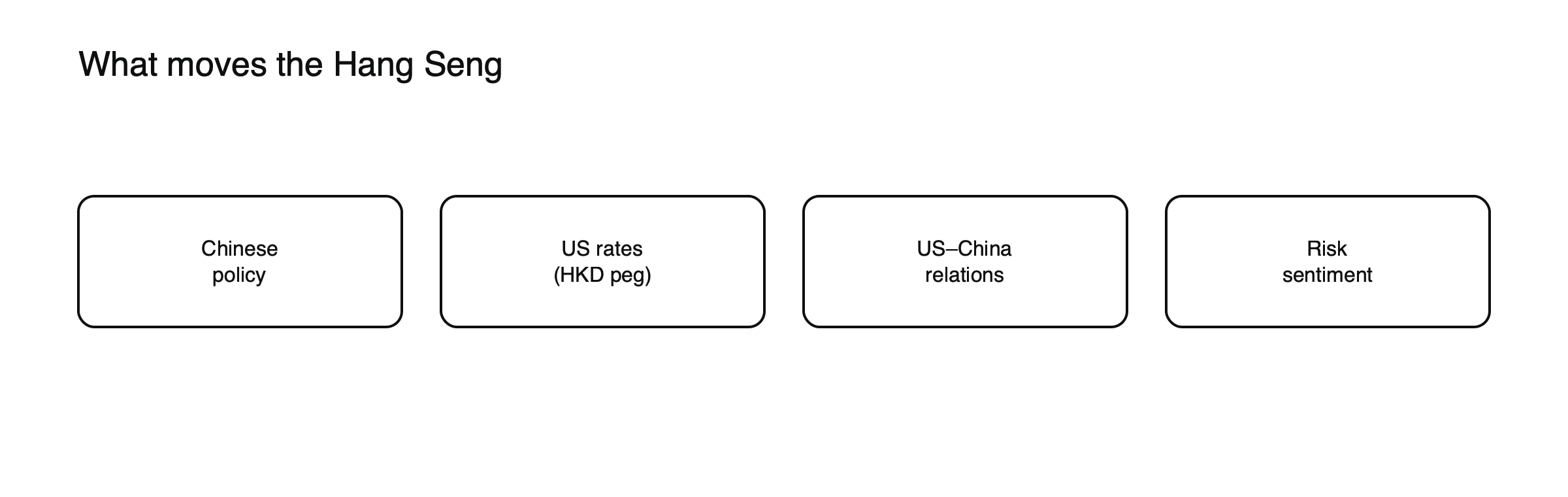
Figure: What moves the Hang Seng.
How it is traded
Through futures, ETFs and CFDs, often labeled “Hong Kong 50” or similar. Its trading hours include a midday break. See how stock index CFDs work.
Regulation of Chinese technology
From late 2020, Chinese authorities tightened rules on large technology platforms in areas such as competition, data and online services, and the shares of many of the Hang Seng’s biggest technology members fell sharply in 2021 and 2022. Later signals of support for the private sector produced strong rebounds. Policy statements from Beijing are therefore among the most important drivers of the index.
Flows from the mainland
Since 2014, connections between the Hong Kong and mainland exchanges have allowed mainland investors to buy Hong Kong-listed shares, and foreign investors to buy mainland shares through Hong Kong. Southbound flows from mainland investors have become a significant source of demand for Hong Kong shares, and data on these flows are watched as a sentiment indicator.
What makes it different
Its exposure to Chinese companies and the currency peg make it behave differently from US or European indices. See what moves stock market indices.
Leverage limits
The Hang Seng is not on the EU’s list of major indices used for retail CFD rules, so retail leverage is capped at 10:1, a 10% margin, rather than the 20:1 allowed on indices such as the S&P 500 or DAX. Positions therefore need twice as much margin for the same size, which, combined with the index’s volatility, makes careful sizing especially important. See leverage in CFD trading.
Trading a Hong Kong 50 CFD, worked through
With the Hang Seng at an illustrative 20,000, a CFD at HK$1 per point is a position worth about HK$20,000, needing about HK$2,000 of margin at 10:1. A 400-point move, about 2%, gains or loses HK$400. Daily moves of 2% or more are common in volatile periods. (Illustrative trade.)
Trading hours
The Hong Kong cash session runs in morning and afternoon sessions with a midday break, and futures trade into the evening. The index often reacts to overnight US moves at its open and to Chinese data and policy announcements during the day, which can arrive at short notice.
Valuations
Hong Kong shares have often traded at lower valuations than US or European ones, reflecting concerns about Chinese growth, regulation and geopolitical tensions. Low valuations can mean strong rallies when sentiment improves, as during stimulus announcements, but they can also persist for years when doubts remain. The index is known for sharp swings in both directions.
Property
Property developers and landlords, in Hong Kong and mainland China, have long been part of the index. The mainland property downturn that began in 2021, including the debt problems of several large developers, weighed on the sector and on Chinese banks. Measures to support property markets have been among the policy announcements that move the index most.
The Hang Seng TECH Index
Launched in 2020, the Hang Seng TECH Index tracks the largest technology-themed companies listed in Hong Kong. It is more volatile than the main index and more sensitive to regulation of Chinese technology platforms and to global technology sentiment. Some providers offer CFDs on it as well as on the main index.
US–China relations
Tensions over trade, technology and investment between the United States and China affect the Hang Seng directly, through tariffs, export controls on chips and restrictions on investment in Chinese companies. Signs of easing tensions tend to lift the index sharply, while new restrictions weigh on it.
Common misreadings
- Treating the Hang Seng as a measure of Hong Kong’s economy alone.
- Using the same leverage as on major US or European indices.
Shares listed in two places
Several large Chinese companies are listed both in Hong Kong and in New York, or have moved their main listing to Hong Kong. Their Hong Kong shares often react overnight to moves in their US-listed shares, and concerns about possible delisting from US exchanges in recent years encouraged more companies to list in Hong Kong. These dual listings link the Hang Seng more closely to US market sentiment.
Holidays and gaps
Hong Kong markets close for several days around the Lunar New Year and other holidays, and mainland markets have their own, sometimes different, closures. Positions held over these breaks can gap when trading resumes, especially if major Chinese data or policy news arrived in the meantime.
The Chinese data calendar
Monthly Chinese releases, including manufacturing surveys, industrial production, retail sales, credit growth and trade data, often move the Hang Seng more than Hong Kong’s own figures. Policy meetings in Beijing, especially those setting economic targets or announcing support measures, are among the most important events for the index. See how China’s policy moves ripple into commodities.
A Hang Seng checklist
- What signals is Beijing sending on growth and regulation?
- Are major Chinese data releases or policy meetings due?
- What are US interest rates and the dollar doing?
- Are US–China tensions easing or rising?
- Is a holiday closure coming up?
- Is the position sized for 10:1 leverage and large daily moves?
Working through these before a trade helps separate China-driven moves from global ones. Because the index can move several percent in a day on policy news, sizing positions conservatively matters more here than on most major indices.
Frequently asked questions
Why does the Hang Seng react to US interest rates?
Because the Hong Kong dollar’s peg to the US dollar ties local interest rates to US rates.
Is the Hang Seng a Chinese or a Hong Kong index?
It is a Hong Kong-listed index, but many of its largest members are mainland Chinese companies, so it reflects China’s economy and policy heavily.
This article is educational content and does not constitute financial, investment, legal or tax advice. Digital assets are volatile and you may lose the amount you invest.
Sources
- Hang Seng Index (established by Hang Seng Bank; base 100 on July 31, 1964; published from 1969; capitalization-weighted) — CMC Markets
- Share index SMI (Hang Seng launched 1969; cap-weighted) — SIX Group
- Can you make money from the Big Mac index? (Hong Kong defends its dollar peg) — The Economist via Breezy
- ESMA adopts CFD measures (20:1 for major indices; 10:1 for non-major equity indices) — Finadium