
What Is the Nikkei 225?
The Nikkei 225 tracks 225 major Japanese companies weighted by share price, so a few high-priced stocks dominate. How it works, its cap and what moves it.
The Nikkei 225 is Japan’s best-known stock index, tracking 225 major Tokyo-listed companies. Like the Dow, it is price-weighted, so high-priced stocks have more influence than larger, lower-priced ones. Fast Retailing, Uniqlo’s owner, has carried a weight above 10%, prompting a cap on single-stock influence from 2022.
How it is built
- 225 members chosen by Nikkei.
- Price-weighted, with price-adjustment factors.
- Weight cap: since 2022, a stock’s weight above 10% triggers a reduced adjustment factor at the next review.
Why price weighting matters
A company with a high share price can move the index more than a much larger company. Fast Retailing’s weight reached 11.4% in early 2025, while larger companies by market value counted for less. See price-weighted vs market-cap-weighted indices.
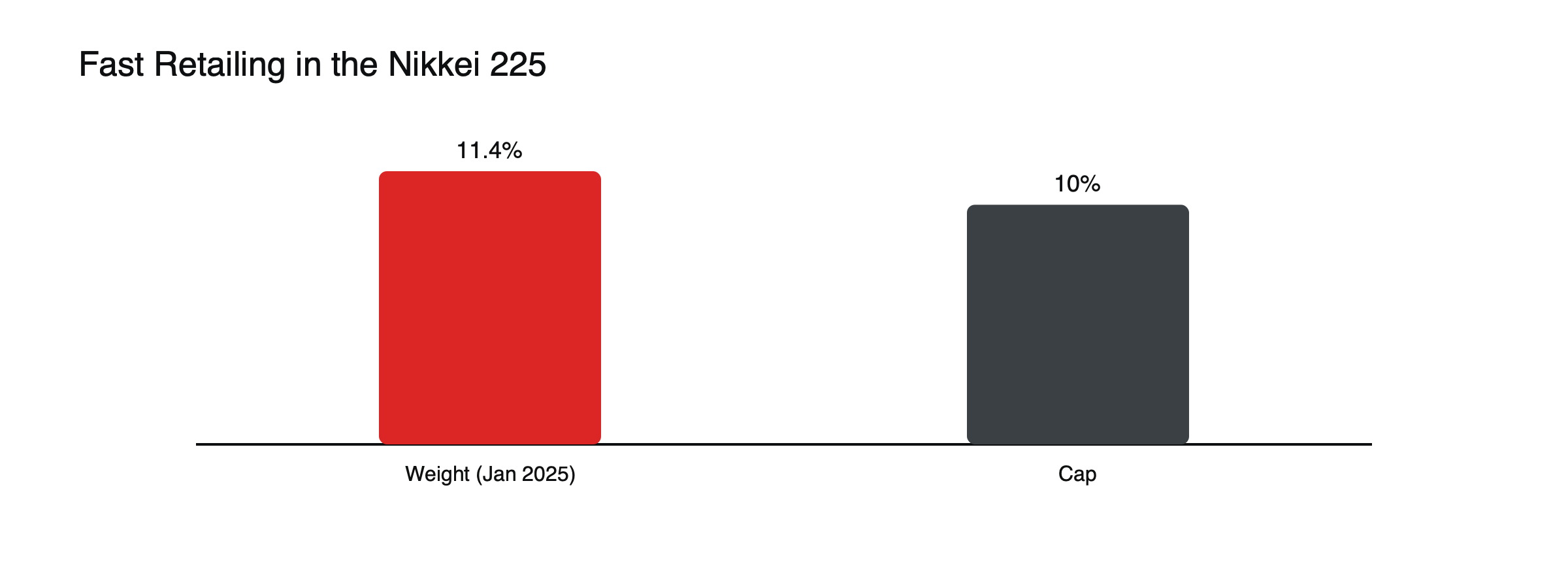
Figure: One stock above the cap. Source: Nikkei Asia.
Nikkei 225 and TOPIX
Japan has a second major index, the TOPIX, which covers a much wider range of companies and is weighted by market value. Because the Nikkei is price-weighted and narrower, the two can diverge: a strong day for high-priced technology and retail shares lifts the Nikkei more, while a rally in banks or other large, lower-priced companies lifts the TOPIX more. Many professional investors use the TOPIX as their benchmark, while the Nikkei remains the most quoted.
What moves it
The yen (a weaker yen helps exporters), Bank of Japan policy, global tech and chip stocks, and US markets. In August 2024, the Nikkei fell 12.4% in a day as the yen carry trade unwound. See what happened in the August 2024 yen carry trade unwind.
The yen effect, illustrated
Suppose a Japanese carmaker earns $10 billion a year abroad. At 140 yen to the dollar, that is ¥1.4 trillion; at 160 yen, it is ¥1.6 trillion, about 14% more, with no change in sales. (Illustrative figures.) Because many Nikkei members are large exporters, a weaker yen tends to lift the index, and a sharp rise in the yen, as in August 2024, tends to hit it hard.
The long road back
The Nikkei peaked at the end of 1989 at the height of Japan’s asset bubble, then spent more than three decades below that level, finally surpassing it in early 2024. Improvements in corporate governance, rising shareholder returns, a weak yen and strong interest from foreign investors all contributed to the recovery. See why it took the Nikkei 34 years to regain its 1989 peak.
How it is traded
Through ETFs, futures and CFDs, often called “Japan 225.” See how stock index CFDs work.
See why it took the Nikkei 34 years to regain its 1989 peak and what the Dow Jones Industrial Average is.
Trading a Japan 225 CFD, worked through
With the Nikkei at an illustrative 38,000, a Japan 225 CFD at ¥100 per point is a position worth about ¥3.8 million, needing about ¥190,000, roughly $1,267 at 150 yen, of margin at the 20:1 retail limit for major indices. A 500-point move, about 1.3%, gains or loses ¥50,000. Some providers price Japan 225 in dollars instead, which changes the currency exposure. (Illustrative trade.)
Trading hours
The Tokyo cash session runs in two parts with a lunch break, roughly from 9:00 a.m. to 3:30 p.m. Tokyo time. Nikkei futures trade in Osaka and Chicago for much longer hours, and Japan 225 CFDs are often quoted nearly around the clock. Because Tokyo opens long before Europe and the United States, the Nikkei is often the first major index to react to overnight US moves and to news from China.
Bank of Japan decisions
After years of very low or negative interest rates, the Bank of Japan began raising rates in 2024. Its decisions affect the Nikkei through the yen and through valuations: a surprise move toward tighter policy can lift the yen and hit exporters, as happened in the summer of 2024. Bank of Japan meeting days are among the most important dates for Japan 225 traders. See why USD/JPY tracks Treasury yields.
Corporate governance reforms
Japan has pushed listed companies to improve their returns to shareholders. In 2023, the Tokyo Stock Exchange asked companies trading below the value of their net assets to explain how they would improve profitability and capital efficiency. Many responded with higher dividends, larger buybacks and sales of cross-shareholdings in other companies. Foreign investors saw the reforms as a lasting change, which contributed to the rally that took the Nikkei past its 1989 peak.
Foreign investors
Foreign investors account for a large share of trading on the Tokyo exchange, so their buying and selling can drive the Nikkei’s direction. Their interest depends on the yen, global risk appetite and views on Japanese reforms. Weekly data on foreign purchases of Japanese shares are watched as a sentiment signal.
Chip and technology shares
Several high-priced members are semiconductor equipment and electronics makers, which carry large weights in the price-weighted index. Their shares react to global chip demand and to US technology results, so a strong report from a US chipmaker can lift the Nikkei the next morning. That link has made the index more sensitive to the global technology cycle.
The Nikkei and US markets
Because Tokyo trades while US markets are closed, the Nikkei often opens by reflecting the previous US session, especially moves in technology shares and the dollar-yen rate. Traders frequently use US index futures during Asian hours as a guide to the Nikkei’s direction.
Common misreadings
- Assuming the Nikkei reflects the largest Japanese companies by value.
- Ignoring the yen when explaining moves.
August 2024, in more detail
In early August 2024, after a Bank of Japan rate rise and a weak US jobs report, investors rushed to unwind trades funded in cheap yen. The yen surged, and the Nikkei fell about 2.5% and 5.8% on consecutive days before plunging about 12.4% on August 5, its worst day since 1987. The next day, it rebounded about 10.2%, its largest one-day gain on record. Within a week, the index had swung through ranges that normally take months. For Japan 225 CFD traders, gaps and spreads in those days were extreme.
Quirks of price weighting
Because the Nikkei is price-weighted, stock splits by high-priced members reduce their influence, and changes in a few expensive shares can move the index far more than their companies’ size would suggest. Some analysts therefore prefer the TOPIX for judging the Japanese market as a whole.
Costs of trading Japan 225
Spreads on Japan 225 CFDs are usually tightest during Tokyo hours and when US markets are open, and wider in between. Financing on cash CFDs reflects Japanese interest rates, which have been much lower than US rates, so long positions have often been cheaper to hold than on US indices.
A Japan 225 checklist
- What is the yen doing against the dollar?
- Is a Bank of Japan decision approaching?
- How did US technology shares close overnight?
- Are high-priced members reporting results soon?
- Is the CFD priced in yen or dollars, and what does that mean for your account currency?
These questions cover most of what moves the index on a typical day. Checking them each morning before trading takes only a few minutes and avoids many costly surprises at the Tokyo open.
Frequently asked questions
Why can one company move the Nikkei so much?
Because the index is price-weighted. A company with a high share price, such as Fast Retailing, has a large weight regardless of its market value, though a cap now limits its influence.
Is the Nikkei a good guide to the Japanese economy?
It reflects large exporters and technology companies more than domestic demand, so it follows global conditions and the yen closely.
This article is educational content and does not constitute financial, investment, legal or tax advice. Digital assets are volatile and you may lose the amount you invest.
Sources
- Nikkei 225 to cap Fast Retailing stock weight (11.4% as of January 31; 10% cap rule from 2022) — Nikkei Asia
- Nikkei 225 definition and characteristics (price-weighted; 225 companies; Fast Retailing largest influence) — Purple Trading
- The yen carry trade that crashed the markets (Nikkei −12.4% on August 5, 2024) — Money by CJ
- ESMA adopts CFD measures (20:1 for major indices; 10:1 for non-major equity indices) — Finadium
- Bank of Japan reassures markets (Nikkei −2.5% and −5.8% before −12.4% on August 5, +10.2% on August 6) — FinanzaOnline, August 7, 2024