
Price-Weighted vs Market-Cap-Weighted Indices
Price-weighted indices like the Dow give high-priced stocks more say; cap-weighted ones like the S&P 500 favor the largest firms. How each one works.
Price-weighted vs market-cap-weighted indices differ in what decides a stock’s influence. In price-weighted ones, such as the Dow or Nikkei 225, a higher share price counts for more, whatever the company’s size. In cap-weighted ones, such as the S&P 500 or FTSE 100, larger companies by market value count for more.
Side by side
| Price-weighted | Market-cap-weighted | |
|---|---|---|
| Influence based on | Share price | Company market value |
| Examples | Dow Jones, Nikkei 225 | S&P 500, DAX, FTSE 100, Hang Seng |
| Effect of a stock split | Cuts the stock’s weight | No effect |
| Concentration risk | High-priced stocks | Largest companies |
Worked example: price weighting
Three stocks priced at $300, $50 and $10 form an index averaging 120. If the $300 stock rises 10%, the index rises 10 points, or 8.3%. If the $10 stock rises 10%, the index rises 0.33 points, or 0.3%. (Example values.)
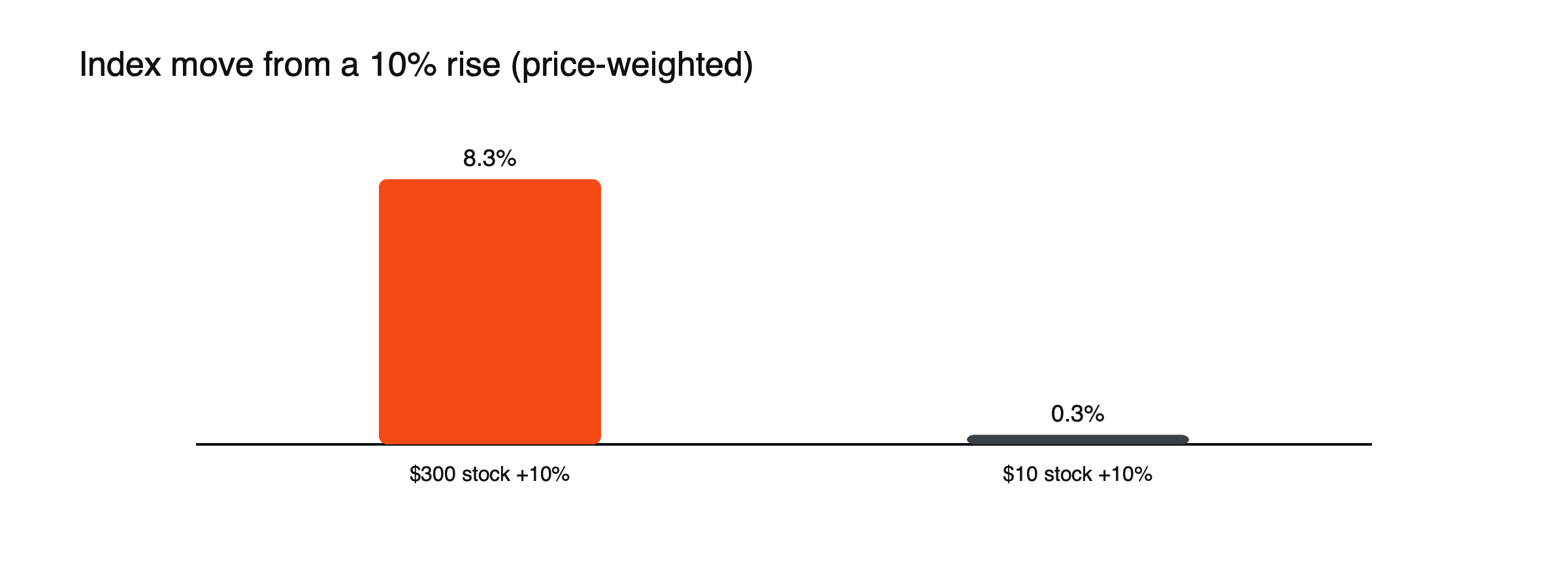
Figure: Price weighting favors high-priced stocks (example values).
Worked example: cap weighting
Now take three companies worth $2,000 billion, $500 billion and $100 billion, a total of $2,600 billion. In a cap-weighted index, their weights are about 76.9%, 19.2% and 3.8%. If the largest rises 10%, the index rises about 7.7%; if the smallest rises 10%, the index rises about 0.4%. Here, size rather than share price decides influence. (Example values.)
How a split changes a price-weighted index
Suppose the $300 stock in the first example splits 3-for-1, becoming a $100 stock. To keep the index level unchanged on the day, the provider adjusts the divisor. From then on, a 10% move in that company moves the price-weighted index only a third as much as before, even though the company itself is unchanged. That is why splits by large companies can noticeably reduce their influence on the Dow.
Why it matters
- Dow: a stock split can sharply reduce a company’s influence.
- Nikkei: Fast Retailing’s weight above 10% led to a cap in 2022. See what the Nikkei 225 is.
- S&P 500: cap weighting means the top 10 stocks reached a record 40.7% in 2025.
Free-float adjustment
Most cap-weighted indices count only shares freely available to trade, excluding large holdings by founders, governments or other companies. A company worth $100 billion but with half its shares held by a founder might count as $50 billion in the index. Free-float adjustment makes indices more investable for funds that must buy the shares, and it explains why some large companies carry less index weight than their total value suggests.
Other methods
Equal-weighted indices give every member the same weight, reducing concentration; modified cap weighting, as in the Nasdaq 100, caps the largest names.
When representative means concentrated
Cap weighting is called “market-representative,” but it can make an index a concentrated bet on a few companies. See why a handful of stocks can drive an entire index and what moves stock market indices.
Equal weighting, illustrated
Using the three companies above, an equal-weighted index gives each a third. A 10% rise in the smallest company now moves the index about 3.3%, as much as the same move in the largest. Equal-weighted indices give more influence to smaller companies, which tends to make them behave differently from cap-weighted versions, especially when the largest companies lead or lag the market. Comparing an equal-weighted index with its cap-weighted version shows whether a rally is broad or narrow. See what market breadth tells you.
What it means for index CFD traders
The weighting method decides which companies’ news moves an index CFD. On the Dow, a large move in a high-priced share can swing the index even if bigger companies are flat. On the S&P 500 or Nasdaq 100, the largest technology companies dominate. Before trading an index around a company’s results, checking its weight in that index shows how much the report might matter.
The divisor in a price-weighted index
A price-weighted index adds up its members’ share prices and divides by a divisor, which is adjusted after splits and member changes so that the index level is continuous. Over many decades of adjustments, the Dow’s divisor has fallen well below 1, so a one-dollar change in any member’s price moves the index by several points. With an illustrative divisor of 0.15, a $1 move in any member shifts the index by about 6.7 points, whatever the company’s size. That is why a large dollar move in a high-priced share can swing the Dow noticeably.
Japan’s Nikkei 225
The Nikkei 225 is also price-weighted, which gave a few high-priced shares very large influence. When Fast Retailing’s weight rose above 10%, the index provider introduced a cap from 2022 to limit any single member’s weight, applied at its regular reviews. The change reduced, but did not remove, the effect of high-priced shares on the index. See what the Nikkei 225 is.
Capped cap-weighting
Some cap-weighted indices limit the weight of their largest members to prevent extreme concentration. The Nasdaq 100 uses a modified method that can trim the largest companies’ weights when they become too dominant. These caps keep the index investable for funds subject to diversification rules, at the cost of slightly reducing its link to pure company size.
Common misreadings
- Assuming the Dow tracks the largest US companies by size.
- Treating a split as irrelevant to a price-weighted index.
- Calling a cap-weighted index fully diversified.
The same day on two indices, illustrated
Suppose a high-priced industrial company in the Dow jumps 6% on results, while the largest technology companies fall 1%. (Illustrative scenario.) The Dow, where the industrial company’s high share price gives it a large weight, may rise, while the S&P 500, dominated by the technology giants, falls. Traders who see the indices moving in different directions often find the explanation in weighting rather than in different views of the economy.
Other weighting schemes
Some indices weight members by fundamentals such as sales, earnings or dividends rather than market value; others favor less volatile shares or apply other rules. These alternative indices are mainly used for funds and research, and CFDs are usually offered on the traditional cap-weighted and price-weighted benchmarks.
Checking weights before trading
Index providers and financial websites publish current member weights. Looking them up before trading an index around a big company’s results shows how much that report could move the index, and whether a price-weighted or cap-weighted index is the better way to express the view. Weights change over time, so recent figures matter most.
Frequently asked questions
Why are some indices still price-weighted?
Mainly for historical reasons: the Dow dates back to the 1890s, when adding up prices was the simplest method. Its long history keeps it widely followed.
Which method is better?
Neither is better in every respect. Cap weighting reflects company size and is easy for funds to track; price weighting is simple but arbitrary; equal weighting reduces concentration but requires more frequent rebalancing.
Leverage, margin and cost figures in this article are example values for illustration. Actual terms depend on the provider, the instrument and the rules in your country.
This article is educational content and does not constitute financial, investment, legal or tax advice. Digital assets are volatile and you may lose the amount you invest.
Sources
- Share index SMI (price weighting: Dow, Nikkei 225; cap weighting: S&P 500, Hang Seng, FTSE 100, DAX, EURO STOXX 50) — SIX Group
- Key learnings: US market indices (Dow price weighting; stock splits change weights) — Vested Finance
- Nikkei 225 to cap Fast Retailing stock weight (10% cap rule from 2022) — Nikkei Asia