
What Is the FTSE 100?
The FTSE 100 tracks the 100 largest London-listed companies. Many earn abroad, so it often rises when the pound falls. How it works and what moves it.
The FTSE 100, or “Footsie,” tracks the 100 largest London-listed companies by market value. It is heavy in energy, mining, financials and consumer staples, and many members earn most of their revenue abroad. So it often rises when the pound falls, because overseas earnings are worth more in sterling.
How it is built
- 100 members by market value, reviewed quarterly.
- Market-cap weighted.
- Usually quoted as a price index, without reinvested dividends, unlike Germany’s DAX.
What it contains
Large energy, mining, banking, pharmaceutical and consumer goods companies, with relatively little technology compared with US indices.
What moves it
- The pound: a weaker pound often lifts the index. See why the FTSE 100 often moves opposite to the pound.
- Commodity prices: oil and metals drive heavyweight energy and mining stocks.
- Global growth more than the UK economy.
- Interest rates, especially for banks.
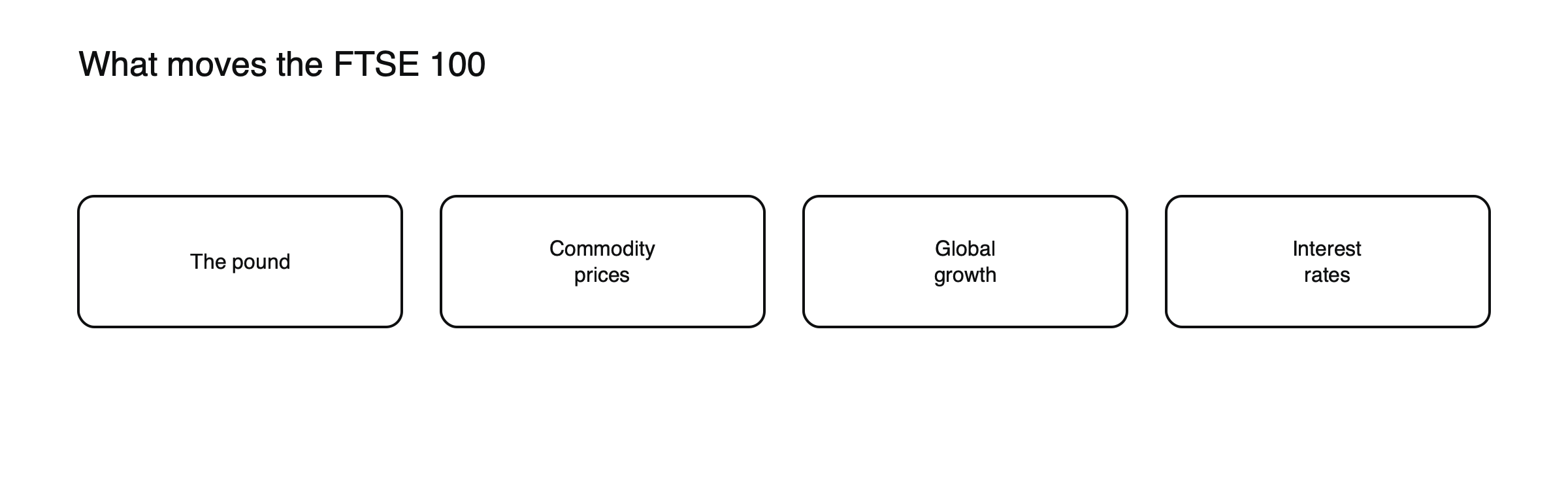
Figure: What moves the FTSE 100.
The pound effect, illustrated
Suppose a FTSE 100 company earns $1 billion a year in the United States. At GBP/USD 1.30, that is about £769 million; if the pound falls to 1.20, the same dollar earnings are worth about £833 million, roughly 8% more in sterling, with no change in the business. (Illustrative figures.) Because so many members earn abroad, a sharp fall in the pound tends to lift the index in sterling terms, as happened after the Brexit referendum in 2016, when the pound slid while the FTSE 100 rose in the following weeks.
History and reviews
The FTSE 100 was launched in January 1984 with a base level of 1,000. Its membership is reviewed quarterly, with companies entering if they rise high enough in the ranking of UK-listed companies by size and leaving if they fall far enough. Changes are announced in advance and can move the shares involved.
How it is traded
Through ETFs, futures and CFDs, often called “UK 100.” See how stock index CFDs work.
When good UK news is bad for the index
A strong UK economy does not necessarily lift the FTSE 100; a stronger pound that comes with it can weigh on the index’s overseas earners.
See what the DAX 40 is and what moves stock market indices.
Sector mix compared
The FTSE 100 has much more energy, mining, banking, tobacco, pharmaceutical and consumer staples exposure than the S&P 500 or Nasdaq 100, and very little technology. As a result, it has tended to do relatively well when commodity prices rise or when value shares lead, and to lag during technology-led rallies. Its dividend yield has typically been higher than that of US indices.
Trading a UK 100 CFD, worked through
With the FTSE 100 at an illustrative 8,000, a UK 100 CFD at £2 per point is a position worth about £16,000, needing about £800 of margin at 20:1. An 80-point move, about 1%, gains or loses £160. Because the index is priced in pounds, traders with accounts in other currencies take on sterling exposure as well. (Illustrative trade.)
Trading hours and dividends
The London cash session runs from 8:00 a.m. to 4:30 p.m. UK time, with CFDs often quoted for longer hours based on futures. Because the FTSE 100 is a price index, it falls when members go ex-dividend, and many large UK companies pay dividends twice a year, producing notable dividend adjustments on cash UK 100 CFDs on certain days. See how index dividends are adjusted.
FTSE 100 and FTSE 250
The FTSE 250 covers the next 250 largest London-listed companies after the FTSE 100. Its members earn much more of their revenue in the UK, so it tracks the domestic economy, consumer spending and UK interest rates more closely. When the UK economy improves and the pound strengthens, the FTSE 250 often outperforms the FTSE 100; when global commodity prices rise and the pound weakens, the FTSE 100 usually leads. Comparing the two shows whether a move is about Britain or about the world.
Commodity weights
Large oil, gas and mining companies make up a significant share of the FTSE 100, so commodity prices move the index more than they move US indices. A rise in oil and metal prices lifts these heavyweights, and a slump in commodities, as in 2014 to 2016, weighs on the whole index. That link makes the FTSE 100 a partial hedge for investors worried about inflation driven by commodity prices. See what moves crude oil prices.
Banks and rates
UK banks carry a meaningful weight, and their profits depend on the gap between the rates they charge borrowers and pay savers. Rising Bank of England rates have tended to support bank shares, while rate cuts or worries about loan losses weigh on them, so central bank decisions affect the FTSE 100 through banks as well as through the pound.
Companies leaving London
Some large companies have moved their main listings abroad or been taken over, citing lower valuations in London than in the United States. These departures have reduced the weight of certain sectors, especially technology, and are part of a debate about the competitiveness of the UK market. Index membership changes when such companies leave.
Common misreadings
- Treating the FTSE 100 as a measure of the UK economy.
- Ignoring the pound when comparing its performance with other indices.
A sterling shock, illustrated
In late September 2022, after the UK government announced large unfunded tax cuts, sterling fell to a record low of about $1.0359 and UK government bond yields surged. Domestically focused shares and the FTSE 250 suffered, while the FTSE 100 held up comparatively well, because the weaker pound raised the sterling value of its members’ overseas earnings. The episode showed again how the two UK indices can tell very different stories on the same day. See what moves GBP/USD.
Dividends
The FTSE 100 has historically offered a higher dividend yield than US indices, thanks to its mature, cash-generative energy, mining, banking and consumer companies. For investors, dividends have been a large part of the index’s total return. For CFD traders, the higher yield means larger dividend adjustments on cash UK 100 positions, credited to longs and debited from shorts.
A UK 100 checklist
- What is the pound doing, and why?
- Where are oil and metal prices heading?
- Are Bank of England decisions or UK inflation data due?
- Are large members going ex-dividend soon?
- How does the FTSE 250 compare, and what does that say about the UK economy?
Answering these before a trade explains most of the index’s day-to-day behavior. Keeping these notes alongside each trade makes later performance reviews much more useful and honest.
Frequently asked questions
Does the FTSE 100 reflect the UK economy?
Only partly. Many members earn most of their revenue abroad. The FTSE 250, which contains more domestically focused companies, is often seen as a better gauge of the UK economy.
Why can the FTSE 100 rise when UK news is bad?
Because bad UK news often weakens the pound, which increases the sterling value of members’ overseas earnings.
This article is educational content and does not constitute financial, investment, legal or tax advice. Digital assets are volatile and you may lose the amount you invest.
Sources
- All you need to know about the DAX (expanded to 40 in September 2021; much of FTSE 100 income from overseas; DAX less so) — Pepperstone
- What is the DAX index (dividends reinvested; FTSE 100 quoted as price return; FTSE heavier in energy, mining and financials; German data drivers) — CMC Markets
- Share index SMI (launch years and weighting methods; EURO STOXX 50, Hang Seng and FTSE 100 cap-weighted; Nikkei 225 price-weighted) — SIX Group
- ESMA adopts CFD measures (20:1 for major indices; 10:1 for non-major equity indices) — Finadium
- GBP/USD jumps after BoE intervention (record low 1.0359 in September 2022) — MarketPulse