
How Stock Splits Affect a CFD Position
In a split, CFD providers multiply your share count and divide prices, stops and limits by the ratio, leaving value unchanged. With Nvidia's 2024 example.
A stock split changes the number of shares and the price per share, not your position’s value. CFD providers multiply your CFD shares by the split ratio and divide your opening price, stop and limit levels by it. When Nvidia split 10-for-1 in June 2024, one CFD share near $1,096 became ten near $109.6.
How the adjustment works
| Before 10-for-1 | After | |
|---|---|---|
| CFD shares | 10 | 100 |
| Price | $1,200 | $120 |
| Position value | $12,000 | $12,000 |
| Stop-loss | $1,100 | $110 |
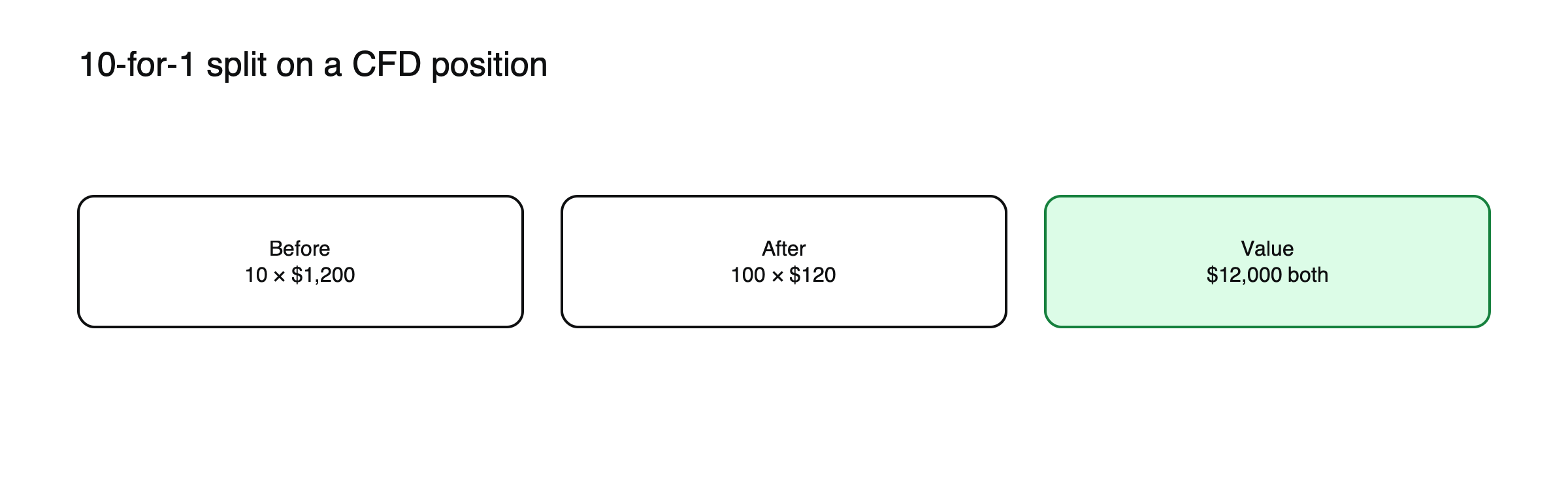
Figure: A split changes the count and price, not the value (example).
(Values above are an example.)
Why companies split their shares
Companies usually split their shares after a large rise in price, to make each share cheaper and easier to trade, especially for individual investors buying whole shares and for employees receiving stock. A split does not change the company’s value, profits or each holder’s share of ownership. It simply cuts the same company into more, smaller pieces.
Real example: Nvidia, June 2024
Nvidia announced a 10-for-1 split in May 2024; shares began trading on a split-adjusted basis on June 10, 2024, moving from over $1,200 to around $120. One provider credited nine extra CFD shares for each one held at the June 7 close and divided open prices, stops and take-profits by ten.
Worked example: a 3-for-1 split
A trader holds 30 CFD shares bought at $450, with a stop at $420 and a take-profit at $510. After a 3-for-1 split, the position becomes 90 CFD shares at an opening price of $150, with the stop at $140 and the take-profit at $170. The position’s value, about $13,500 at the split price, and the money at risk to the stop, about $900, are unchanged. (Illustrative figures.)
Reverse splits
A reverse split does the opposite: fewer shares at a higher price. Providers may round fractional CFD shares, sometimes settling the remainder in cash.
Worked example: a 1-for-10 reverse split
A trader holds 35 CFD shares of a struggling company at $1.20, a position worth $42. After a 1-for-10 reverse split, the position would be 3.5 CFD shares at $12.00. Many providers would keep 3 shares and settle the remaining half share in cash, about $6. Reverse splits are often used by companies whose share price has fallen very low, sometimes to meet an exchange’s minimum price rules, and they are often followed by further weakness, so they are not a sign of strength. (Illustrative figures.)
What to watch:
- Check adjustments after the split date.
- Pending orders may be cancelled or adjusted.
- Charts may show a gap unless adjusted for the split.
A split is neither good nor bad on its own, though it can attract attention. See how rights issues, mergers and spin-offs affect stock CFDs, how to calculate your exposure on a stock CFD and how stock CFDs work.
Splits on price charts
Most charting services adjust past prices for splits, dividing earlier prices by the split ratio so that the history looks continuous. Some do not, or apply the adjustment later, which can make a chart show a sudden 90% drop on the split date. Technical levels drawn before a split need adjusting by the same ratio, or they will no longer correspond to real prices.
Do splits move prices?
A split changes nothing fundamental, yet shares sometimes rise around the announcement. The usual explanations are that companies split after strong performance, so a split signals confidence, and that cheaper shares attract more individual buyers. The effect is inconsistent and usually small compared with earnings and market moves. A split is not, on its own, a reason to buy.
Splits and indices
For indices weighted by market value, such as most major indices, a split changes nothing, because the company’s value is the same. For indices weighted by share price, such as the Dow Jones Industrial Average, a split reduces the company’s weight, and the index provider adjusts its calculation to prevent the index level from jumping on the split day.
A split checklist
- Note the split date and ratio for any share you hold.
- After the split, confirm the new share count, opening price, stops and limits.
- Check whether pending orders were adjusted or cancelled.
- Adjust any chart levels drawn before the split.
Margin and leverage after a split
Because a split leaves the position’s value unchanged, the margin required stays the same, and so does the leverage. A provider might change the margin rate for a share at any time for other reasons, but the split itself does not affect it. If margin figures look different immediately after a split, it is worth checking whether the adjustment was applied correctly.
Bonus issues and stock dividends
Some companies issue extra shares to existing holders for free, called a bonus issue or stock dividend, for example one new share for every ten held. Economically this works like a small split: there are more shares, each worth proportionally less. CFD providers usually adjust positions in the same way, increasing the number of CFD shares and reducing the opening price.
Notable splits
Several of the largest US companies have split their shares after strong rises in recent years. Apple split 4-for-1 and Tesla 5-for-1 in August 2020, and Tesla split 3-for-1 in 2022. Nvidia’s 10-for-1 split in June 2024 brought its share price from above $1,200 to around $120. In each case, CFD positions were adjusted so that holders’ exposure was unchanged, even though charts and quotes looked very different.
Dividends per share after a split
If a company pays dividends, the dividend per share is divided by the split ratio, so that total payments to a given position are unchanged. A dividend that was $1.00 per share before a 4-for-1 split becomes $0.25 per share after it, paid on four times as many shares.
How a split appears on statements
Account statements often show a split as two entries: the old position closed and a new one opened with more shares at a lower price, or a single adjustment line. Either way, equity should be unchanged apart from any rounding of fractional shares. Checking the statement after a split confirms that the adjustment matches the announced ratio.
Companies that never split
Some companies choose not to split even when their share price is very high. Berkshire Hathaway’s original class A shares have never been split and trade at a price far above most other shares, while the company created a cheaper class of shares for smaller investors instead. Not splitting has no effect on a company’s value, which shows again that the share price alone says nothing about whether a share is expensive.
Frequently asked questions
Does a split change my profit or loss?
No. The number of CFD shares and the price change in opposite proportions, so the position’s value and your profit or loss are unchanged.
What happens to fractional shares after a reverse split?
Providers often round down to whole CFD shares and settle the fraction in cash, though policies vary.
Leverage, margin and cost figures in this article are example values for illustration. Actual terms depend on the provider, the instrument and the rules in your country.
This article is educational content and does not constitute financial, investment, legal or tax advice. Digital assets are volatile and you may lose the amount you invest.
Sources
- Big news: NVIDIA’s 10-for-1 stock split (nine extra CFD shares; prices, stops and take-profits divided by ten) — FXGlobe, June 2024
- Nvidia stock splits (June 10, 2024; from over $1,200 to around $120) — Capital.com
- Nvidia’s 10 for 1 stock split (neither good nor bad on its own) — Hargreaves Lansdown, June 2024