
Utility Tokens vs Governance Tokens
A utility token gives access to a product; a governance token gives a vote on protocol changes. Compare what each does, its source of value and risks.
The key difference in utility vs governance tokens is what holding one lets you do. A utility token is used to access or pay for something, such as network fees or a service. A governance token gives a vote on how a protocol changes, such as fees, upgrades or treasury spending. Many tokens do both, and neither guarantees value.
Utility tokens: paying to use something
A utility token is needed to use a product. Ether is the clearest example: every Ethereum transaction pays its fee in ether, so demand for the network creates demand for the token. Other utility tokens pay for storage, computing, data feeds or discounts inside a specific application.
A utility token holds value only if people actually need the thing it pays for, and if they cannot easily pay with something else.
Governance tokens: voting on the rules
A governance token lets holders propose and vote on changes to a protocol. Uniswap’s UNI, distributed widely in a 2020 airdrop, is a well-known example: holders vote on proposals affecting the protocol and its treasury. Voting power is usually proportional to the number of tokens held or delegated.
A governance token holds value if the decisions it controls matter, for example over a large treasury or a fee switch, and if holders can actually influence them.
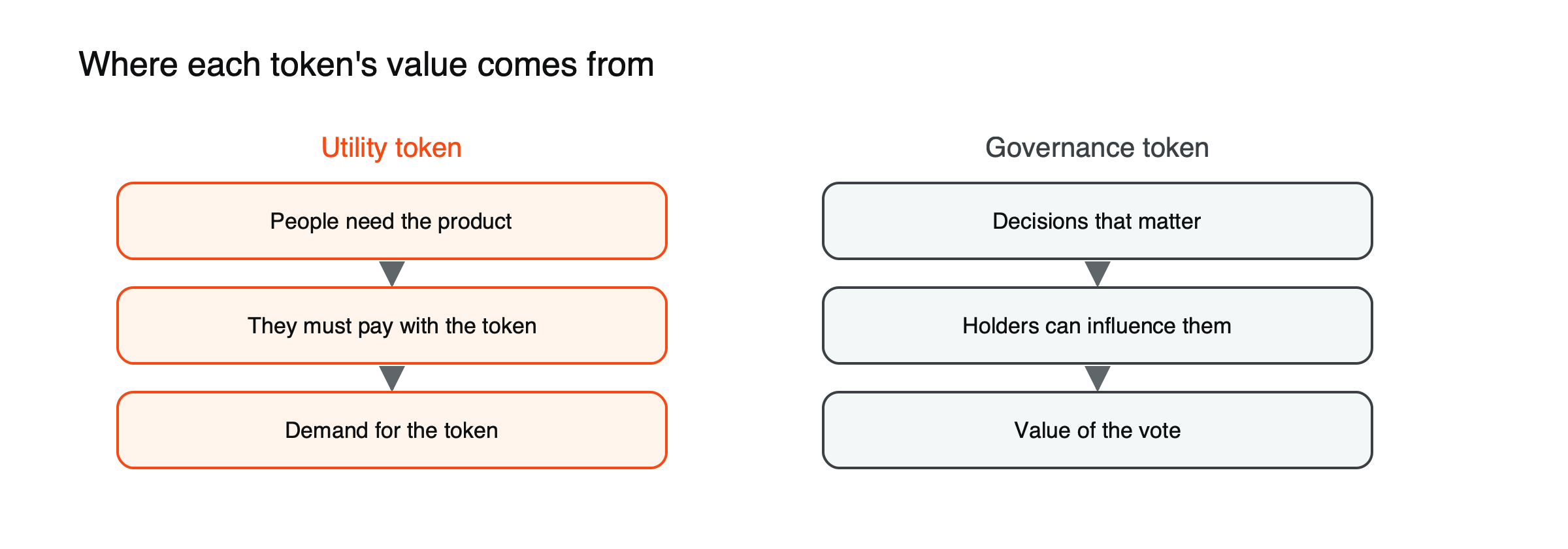
Figure: The two value paths compared. Neither path pays holders unless the protocol is designed to.
Side by side
| Utility token | Governance token | |
|---|---|---|
| What you can do with it | Pay for or access a product | Propose and vote on protocol changes |
| Where value comes from | Demand for the product | Value of the decisions it controls |
| Typical example | Ether paying gas fees | UNI voting on Uniswap proposals |
| Main weakness | Users can avoid it if alternatives exist | Low turnout; large holders dominate votes |
| Cash flow to holders | Usually none | Usually none, unless holders vote to add it |
Where utility tokens fall short
Utility tokens often face substitution. If an application can accept stablecoins instead of its own token, demand for the token weakens. A utility that only exists to justify a token rarely lasts.
Where governance tokens fall short
Governance tokens often face concentration. Founders, investors and a few large holders can control the outcome, while most holders never vote. A vote also does not equal a share of profits: unless governance chooses to direct fees to holders, the token earns nothing.
Power versus necessity
Many people assume governance tokens are more valuable because they carry power. In practice, a utility token tied to heavy, unavoidable usage can have stronger demand than a governance token whose votes rarely matter. The reverse also happens: a governance token controlling a large treasury can be worth more than any utility it claims. The label matters less than what the token is actually needed for.
Many tokens do both
The line between the two types is often blurred. Ether pays for gas and, through staking, secures the network. Many protocol tokens can be staked for a share of fees and also used to vote. Some application tokens grant discounts and carry governance rights. Rather than forcing a token into one box, it is more useful to list everything it does and ask which of those functions would keep people holding it if the price stopped rising.
Fee switches and value capture
A frequent debate in governance-token communities is whether to turn on a “fee switch,” directing part of a protocol’s revenue to token holders or stakers. Doing so gives the token a direct link to the protocol’s success, but it can raise costs for users and attract closer scrutiny from regulators, since payments to holders look more like returns on an investment. Many large protocols have discussed fee switches for years, which shows how central, and how contested, the question of value capture is.
How regulators look at the difference
Regulators generally look at substance rather than labels. A token sold to fund a project, marketed with the promise of profits from the team’s work, can be treated as a security whether it is called a utility or a governance token. A token that is genuinely needed to use a working network is in a different position. Calling a token “utility” does not settle the question, as the SEC’s actions against early token sales made clear. See what happened to the 2017 ICO boom.
Examples across categories
| Token role | What drives demand | What to check |
|---|---|---|
| Network gas token | Activity on the chain | Fees paid, active users |
| Staking and security token | Need to secure a service | How much is staked, what it protects |
| Application access token | Use of one product | Whether users could pay another way |
| Pure governance token | Value of the decisions it controls | Treasury size, voter turnout, fee rules |
How to read a governance proposal
If you hold a governance token, proposals are where its value is decided. Start with the summary, then look for what changes in practice: who receives money, which parameters move and whether anything becomes harder to reverse. Check who wrote the proposal and who supports it, since large holders often coordinate in advance. Look at the voting period and the quorum required. Finally, check whether the change takes effect immediately or after a delay, which gives time to react if something looks wrong.
A simple test helps when a token claims both roles. Imagine the token’s price fell by half tomorrow. Would people still need to buy it to use the product, or still want to hold it for the decisions it controls? If neither, the token’s value rests mainly on expectations of future buyers, whatever its documentation says about utility or about governance in theory.
Questions to ask about any token
- What can you do with it today that you could not do without it?
- Who holds most of the supply and the voting power?
- Do holders receive anything, or only rights?
- Could the product work just as well without the token?
For how tokens fit into crypto generally, read what a crypto token is. For the UNI distribution, see what a crypto airdrop is, and for the wider category, what an altcoin is.
This article is educational content and does not constitute financial, investment, legal or tax advice. Digital assets are volatile and you may lose the amount you invest.
Frequently asked questions
Do governance tokens pay dividends?
Usually not. Holders get votes, not a share of profits, unless governance chooses to direct revenue to stakers or holders. Any such payments can also change later by vote.
Can a governance token become a utility token?
Its role can change. Protocols sometimes add uses, such as staking to secure a service or discounts for holders, that give a governance token practical demand beyond voting.