
Where Does DeFi Yield Come From?
DeFi yield comes from borrowers, traders, staking, real-world assets, derivatives or newly printed tokens. How to tell which one pays you and why it matters.
DeFi yield comes from someone paying for something: borrowers paying interest, traders paying fees, a blockchain paying staking rewards, real-world assets paying interest, or derivatives traders paying funding. When none of those explain the return, it usually comes from newly printed tokens, and that kind of yield tends to shrink as the tokens are sold.
The main sources
Borrowers’ interest. Lending protocols pass interest paid by borrowers to depositors. It rises when demand for loans is high. See how DeFi lending works.
Trading fees. Liquidity providers earn a share of every swap through their pool. This depends on trading volume and comes with impermanent loss. See what a liquidity pool is.
Network staking rewards. Proof-of-stake blockchains pay validators in new coins and fees. Liquid staking tokens pass these on. See what staking is in crypto.
Real-world assets. Tokenized Treasury products and some stablecoin savings modules pass on interest from government debt and other assets.
Derivatives funding. Strategies that hold crypto and short futures, such as synthetic dollars, collect funding payments when traders are net long. See what a synthetic dollar stablecoin is.
Token emissions. Protocols print their own tokens and give them to users to attract deposits.
Why the source matters
The first five are paid by someone outside the protocol for a service. They can still fall, but they are tied to real activity. Emissions are different: the protocol creates the reward itself, and its value depends on the token’s market price. In the 2020–2021 DeFi boom, many high yields were paid mostly in such tokens; as farmers sold them, prices and yields fell together.
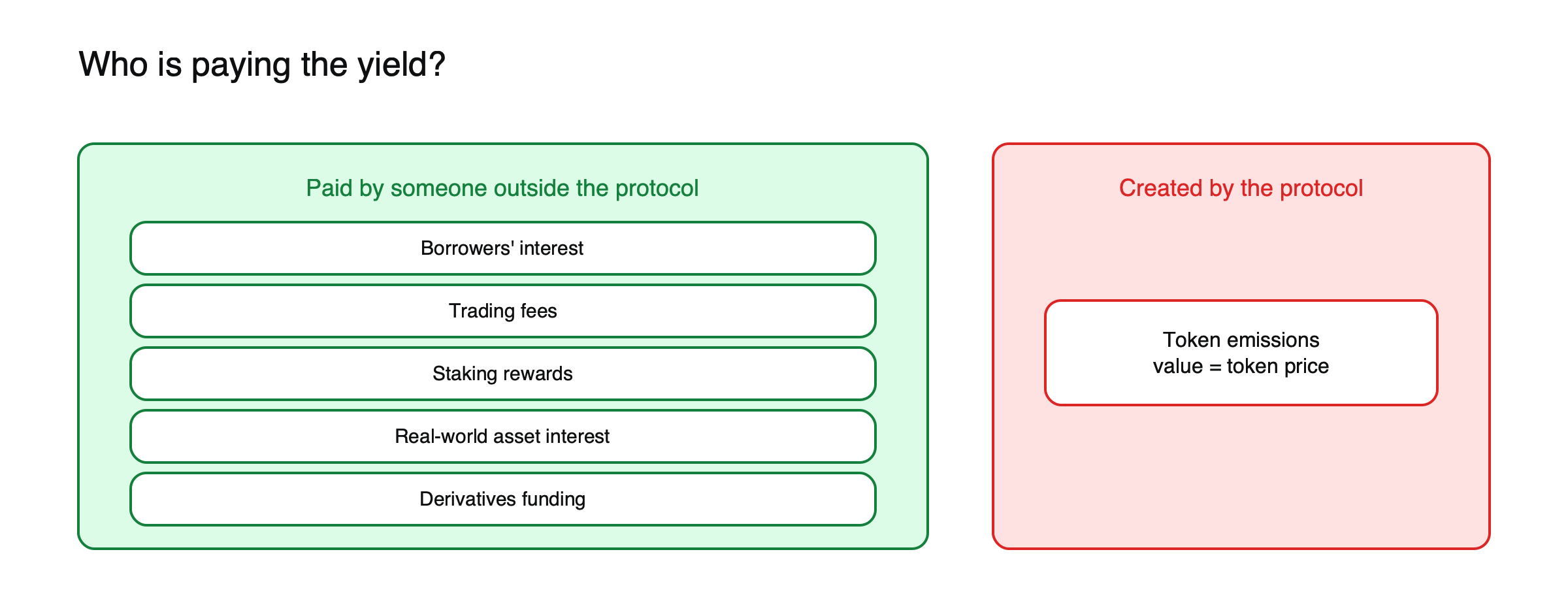
Figure: Ask who pays. External payers support a yield; newly printed tokens depend on the token’s price.
A yield, taken apart
Suppose a stablecoin pool advertises 12% a year: 4% from interest paid by borrowers and 8% from the protocol’s reward token. (Illustrative figures.) The 4% depends on borrowing demand and will move with it, but it is paid in the stablecoin you deposited. The 8% depends on the reward token’s price; if that price halves, the reward part falls to 4% and the total to 8%. If the rewards end, the total drops to whatever borrowers pay. Looking at a yield this way turns one attractive number into two very different promises.
How each source behaves in a downturn
| Source | What usually happens when markets fall |
|---|---|
| Borrowers’ interest | Falls as demand for leverage drops |
| Trading fees | Can rise with volatility, but impermanent loss rises too |
| Staking rewards | Fairly steady in coin terms; worth less in dollars |
| Real-world asset interest | Follows government rates, not crypto prices |
| Derivatives funding | Can turn negative when traders turn bearish |
| Token emissions | Lose value as reward tokens fall |
Yield on top of yield
Some strategies stack sources with borrowed money. For example, a user might stake ether, deposit the staking token as collateral, borrow more ether and stake that too, repeating the loop. If staking pays 3% and borrowing costs 2.5%, a position built to three times the original stake earns about 9% on the staked amount minus 5% on the borrowed amount, roughly 4% on the user’s own money. (Illustrative figures.) The extra return is small compared with the extra risk: if the staking token trades below ether or borrowing rates jump, the position can lose money quickly or be liquidated.
Fees along the way
Advertised yields are often shown before costs. Vault and protocol fees, network fees for depositing, claiming and withdrawing, and the cost of selling reward tokens all reduce what you keep. For small deposits, these costs can absorb most of a modest yield.
Comparing yields fairly
Two rates that look alike may not be. APR shows a simple annual rate, while APY includes the effect of compounding, so the same underlying return can look higher as an APY. Some dashboards show returns based on the last day or week, which can swing widely. And yields measured in a volatile token can hide losses in dollar terms. Comparing like with like means checking the rate type, the period it is based on and the currency it is paid in.
A rough ladder of risk
Sources of yield can be ranked very roughly by how much can go wrong. Tokenized government debt and staking on large networks sit near the lower end, with risks mostly in custody, smart contracts and price. Overcollateralized lending comes next, then liquidity provision in stable pairs, then in volatile pairs. Leveraged loops and new farms paid mainly in their own token sit at the top. The higher the rung, the more a yield depends on several things going right at once. Moving up the ladder is a choice, but it should be a deliberate one, with position sizes shrinking as risk rises. Many people keep most of their DeFi funds on the lower rungs and treat the upper ones as a separate allocation they could lose without changing their plans.
How to check a yield
- Find the breakdown: most dashboards split a rate into base yield and reward tokens.
- Ask who pays, and whether they would keep paying without incentives.
- Check the reward token: its supply schedule, who holds it and how much is sold daily.
- Compare with safer benchmarks: a rate far above short-term government yields needs a clear explanation.
Signs a yield may not last
- Most of the return is in the protocol’s own token.
- The rate is fixed and very high regardless of market conditions.
- Deposits and rewards depend on new users joining.
- The team cannot explain the source in a sentence.
A cautionary example
TerraUSD’s Anchor protocol offered depositors roughly 20% a year on a stablecoin before collapsing in May 2022. Our account of the TerraUSD collapse shows how a yield with no clear source ended.
The bottom line
Every yield is payment for a risk. If you can name who pays and why, you can judge whether the payment is worth the risk. If you cannot, assume the risk is yours. For the bigger picture, read what DeFi is and what yield farming is.
This article is educational content and does not constitute financial, investment, legal or tax advice. Digital assets are volatile and you may lose the amount you invest.
Frequently asked questions
What is “real yield”?
The term usually describes returns paid from a protocol’s actual revenue, such as fees, rather than from newly issued tokens. It is a useful idea, though the label is sometimes used loosely in marketing.
Can a yield be negative?
Yes, in some strategies. Funding payments in derivatives-based strategies can turn negative, and liquidity providers can earn fees yet still lose value through impermanent loss.
Sources
- The Harsh Reality of Real Yield (yields subsidized by native token emissions and prices; COMP liquidity mining June 2020) — Stovetop
- Yield-Bearing Stablecoins Compared (yield from protocol revenue, real-world assets or derivatives) — Spark
- Ethena Labs: How USDe Works (funding rates paid to shorts; can turn negative) — Portals
- The Terra/Luna Collapse (Anchor ~20% yield) — LearnSignal