
Ethereum Staking Risks and Mistakes
The Ethereum staking mistakes that cost the most, from slashing and token depegs to custody and exit queues, and what to do instead of each one.
Among Ethereum staking risks, the costliest mistake is treating staking rewards as safe income while ignoring that the staked ETH itself can fall sharply in price. Rewards rarely offset a large price drop. The other mistakes below, from double signing to stacking protocols, can each turn a modest reward into a permanent loss.
The risks at a glance
| Risk | What can happen | Most exposed | How to reduce it |
|---|---|---|---|
| Price | ETH falls far more than rewards add | Every staker | Stake only ETH you would hold anyway |
| Slashing | Part of the stake is destroyed | Solo stakers and their delegators | Never run keys in two places |
| Exit delays | Funds stuck in a queue during a crash | Anyone needing quick access | Plan exits well in advance |
| Depeg | A staking token trades below ETH | Liquid staking holders | Know both exit routes |
| Leverage | Liquidation of looped positions | Borrowers against staking tokens | Avoid loops or size them small |
| Custody | Platform failure or frozen withdrawals | Exchange stakers | Read terms; spread holdings |
| Concentration | One provider’s failure hits many | Users of the largest providers | Diversify operators |
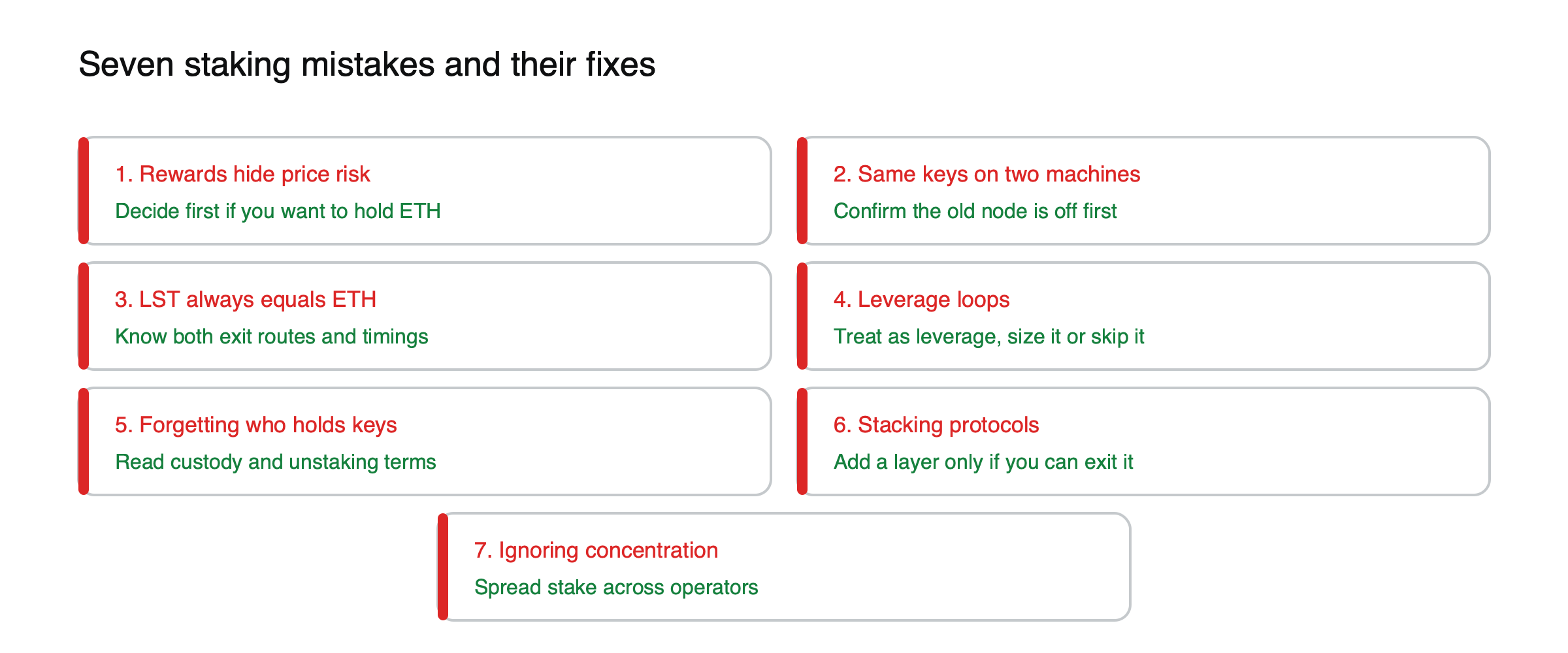
Figure: The seven mistakes in this article and the short version of what to do instead.
Market risk: the one rewards cannot fix
Staking changes how you hold ether, not whether you are exposed to its price. Suppose you stake 32 ETH at $3,000, a $96,000 position, and earn 3% a year. After a year you hold about 32.96 ETH. If ether has fallen 30% to $2,100, the position is worth about $69,200, a loss of nearly $27,000 despite the rewards. (Example values.) The rewards would need decades at that rate to make up a single fall of that size. The first decision is therefore whether you want to hold ETH at all; staking only matters after that.
Technical risks: slashing and downtime
For anyone running validators, the biggest avoidable risk is double signing. Most real slashings come from operators who start a backup or migrate to a new server while the old machine is still running, so both sign conflicting messages. Shutting down and confirming the old machine is offline before starting the new one, and carrying over the slashing-protection database, prevents it. Ordinary downtime costs far less, roughly the rewards that would have been earned, which is why a planned pause is always safer than a rushed failover. See what slashing is.
Liquidity risks: exit queues and depegs
Leaving staking is not instant. Validators exit through a queue that lengthens when many want out at once, which tends to be exactly when markets are falling. Liquid staking tokens avoid the queue by letting you sell on the market, but that price can slip below the value of the ether behind it when many holders sell together.
That happened in July 2025. Rising borrowing costs on the lending platform Aave made a popular strategy unprofitable: traders had been borrowing ETH against stETH to stake more, and as they unwound those positions, stETH traded below its peg, according to Glassnode. Holders who needed to sell immediately took a loss; those who could wait for the protocol’s redemption queue received full value.
Leverage: when extra yield becomes a liquidation
Borrowing against a staking token to stake more, and repeating the loop, multiplies the yield only as long as staking rewards exceed borrowing costs and the token holds its peg. When either assumption fails, the position can be liquidated, and forced sellers push the token’s price further down for everyone else. Treat looping as leverage rather than as extra yield, and size it accordingly, or avoid it. A simple test is to ask what happens to the position if the staking token trades 5% below ETH for a week; if the answer is liquidation, the loop is simply too large to be safe in practice.
Counterparty risks: who holds the keys
Staking through an exchange or custodian is simple, but the platform controls the keys and the terms. Its solvency, its rules on unstaking times and what happens if withdrawals are paused all decide whether you get your ether back. Lending products that advertise staking-like returns are different again: they pay because someone borrowed your coins, which adds credit risk. Reading the terms, checking where rewards come from and spreading larger amounts across arrangements reduce dependence on any one company.
Stacking risks
Each additional layer, from a liquid staking token to restaking to a liquid restaking token on top, adds its own smart contracts, its own slashing rules and its own chance of trading below value. The extra yield at each step is usually small compared with what can go wrong. See what restaking is.
Network-level risk: concentration
When a single provider runs a large share of validators, a bug or failure there affects all of its users at once and weighs on the network itself. Lido alone held about a quarter of staked ether in mid-2025. Spreading stake across smaller operators, or solo staking part of it, reduces exposure to any one provider and supports the network’s resilience.
Rules and tax
Staking also carries risks outside the protocol. In many countries, rewards are taxed as income when received, separately from any gain when the ether is sold, so a falling price can leave a tax bill on rewards worth less than when they arrived. Regulatory treatment is still settling: in May 2025, staff at the US Securities and Exchange Commission said certain protocol staking activities do not involve securities offerings, but that view does not cover every arrangement, and other countries apply their own rules.
Matching the method to the risks you accept
| Method | Main risks you take on |
|---|---|
| Solo staking | Slashing from setup errors, downtime, exit queue |
| Liquid staking | Smart contracts, depeg, concentration |
| Exchange staking | Platform solvency, terms, frozen withdrawals |
| Restaking | All of the above, plus extra slashing conditions and more contracts |
For the full list of routes, read how to stake ETH. For the network itself, see what Ethereum is.
This article is educational content and does not constitute financial, investment, legal or tax advice. Digital assets are volatile and you may lose the amount you invest.
Frequently asked questions
Is staking riskier than simply holding ETH?
It adds risks on top of holding: slashing, exit delays, and the risks of whatever protocol or platform you use. In return you earn rewards. Holding ETH in your own wallet carries price risk and the risk of losing your keys, but none of the staking-specific ones.
What happens to staked ETH if an exchange fails?
It depends on how the exchange holds customer assets and on the law where it operates. Staked ether held by a failed platform may be frozen while insolvency proceedings run, and customers can become creditors rather than owners. Reading the platform’s terms on custody and staking before you start is the only way to know where you would stand.
Sources
- Lido’s Share in Ethereum Staking Drops to 25% (July 2025 stETH depeg from leverage unwinds, per Glassnode) — ForkLog, July 2025
- Staking Penalties on Ethereum’s Consensus Layer (slashing; socialized losses for liquid staking tokens) — Aave Governance, April 2025
- Statement on Certain Protocol Staking Activities — US SEC Division of Corporation Finance, May 2025
- SEC Staff Declares Certain Protocol Staking Not A Security Transaction (excludes liquid staking and restaking; no legal force) — Mondaq, June 2025