
How Funding Rates Are Calculated on Perpetual Futures
The funding rate formula on perpetual futures, how its premium and interest parts work, worked examples of what a position pays or receives and what it signals.
A funding rate is a periodic payment between longs and shorts on perpetual futures that keeps the contract near spot. Most major exchanges set it every 8 hours as funding rate = premium index + clamp(interest rate − premium index, −0.05%, +0.05%), with interest fixed at 0.01%. You pay or receive position value × rate.
The parts of the formula
Premium index: how far the perpetual’s price is above or below the spot index, averaged over the funding period. Positive means the perp is trading above spot.
Interest rate: usually fixed at 0.01% per 8 hours.
Clamp: limits the interest adjustment to between −0.05% and +0.05%. As a result, whenever the premium index is between −0.04% and +0.06%, the funding rate is exactly 0.01%.
Payment = position value × funding rate. Positive: longs pay shorts. Negative: shorts pay longs. See what perpetual futures are for the basics.
Worked example 1: a calm market
Premium index +0.02%. Funding = 0.02% + clamp(0.01% − 0.02%) = 0.02% − 0.01% = 0.01%.
A $10,000 long pays $1.00 every 8 hours, $3 a day, about $90 over 30 days.
Worked example 2: a crowded long
Premium index +0.30%. Funding = 0.30% + clamp(−0.29%) = 0.30% − 0.05% = 0.25%.
The same $10,000 long pays $25 every 8 hours, $75 a day and $2,250 over 30 days. If that position used 10x leverage on $1,000 of margin, funding alone would consume 7.5% of the margin each day.
Worked example 3: a crowded short
Premium index −0.10%. Funding = −0.10% + clamp(0.11%) = −0.10% + 0.05% = −0.05%.
Now shorts pay longs: a $10,000 short pays $5 every 8 hours, and a $10,000 long receives $5.
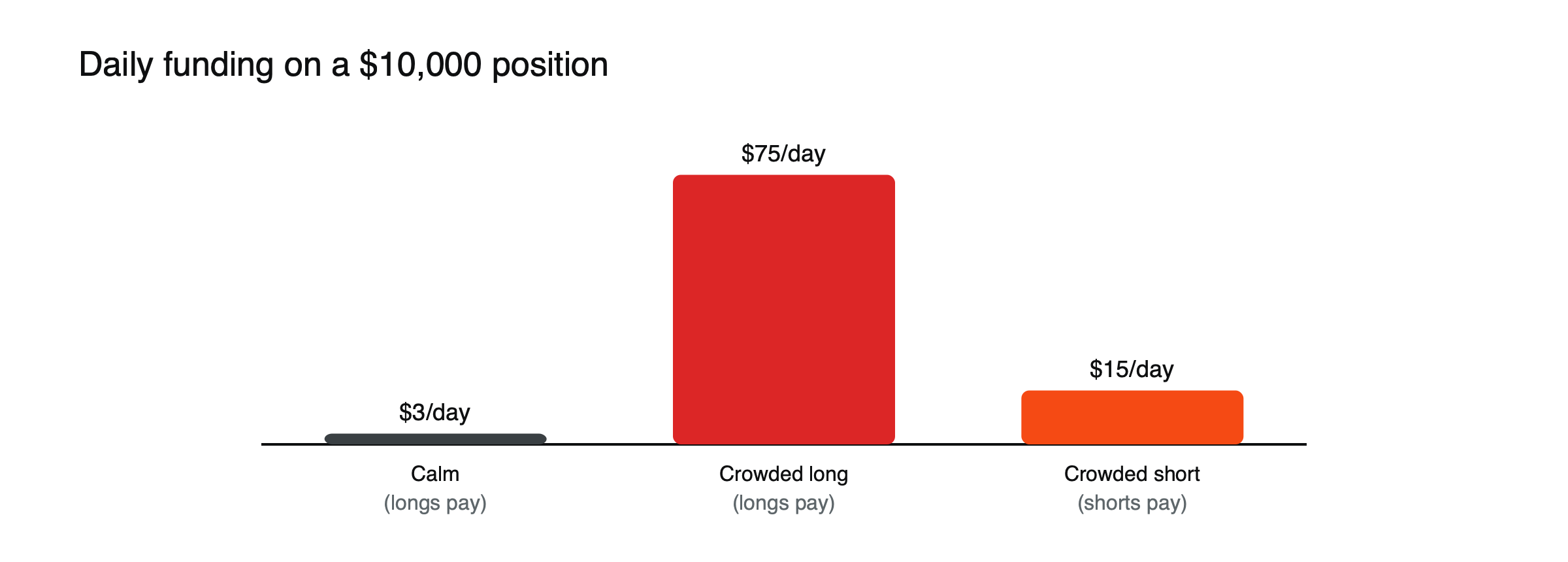
Figure: Daily funding on a $10,000 position in each worked example.
Worked example 4: funding against a price gain
A $10,000 long is held for 30 days while funding averages 0.05% every 8 hours. Funding costs $5 per period, $15 a day and $450 over the month. If the price rose 3% over the same period, the position gained $300. After funding, the trade lost about $150, even though the market moved in its favor.
Collecting funding instead of paying it
Some traders aim to earn funding rather than pay it. They buy the asset on the spot market and open a short perp of the same size, so price moves cancel out. When funding is positive, the short receives payments. At the baseline 0.01% every 8 hours, that adds up to about 10.95% a year before costs. (Illustrative.) The strategy loses money when funding turns negative, needs margin on the short leg that can be liquidated in a sharp rally, and depends on the exchange holding both positions safely. It is the same idea behind some synthetic dollar products.
Settlement times, intervals and caps
Most large exchanges settle funding every 8 hours, often at 00:00, 08:00 and 16:00 UTC, but some contracts settle every 4 hours or even every hour, and exchanges set different caps on how high funding can go. You usually pay or receive funding only if you hold a position at the moment of settlement. Checking the interval and cap in the contract’s specification avoids surprises.
Predicted and settled funding
Exchanges show a predicted funding rate for the next settlement, which changes as the premium moves during the period. The rate actually charged is fixed only at settlement. A position opened just before settlement on the strength of a low predicted rate can face a higher charge if the market moves in the meantime.
Funding in extreme markets
During sharp crashes, funding often swings from positive to negative within hours, as long positions are liquidated and traders rush to short. At the peak of euphoric rallies it can sit at its cap for days. These extremes rarely last: high funding attracts traders who collect it by holding spot and shorting the perp, and liquidations reset crowded positions. Extreme readings are therefore often closer to turning points than to the start of a trend, though they can persist long enough to be costly for anyone betting on an immediate reversal.
Funding in a trading plan
For anyone holding perps for more than a few hours, funding belongs in the plan from the start. Estimate the cost over your expected holding period at the current rate and at a higher one, and compare it with the price move you are aiming for. If funding would consume a large part of the expected gain, a shorter holding period, a dated future or a spot position may suit the idea better. Setting an alert for unusually high funding can also prompt a review before costs build up.
Funding also differs between exchanges at the same moment, because each venue has its own traders and order book. Large and lasting gaps between exchanges can attract arbitrage, with traders going long where funding is negative and short where it is positive. For an ordinary trader, the practical point is simpler: check the current rate on the exchange you actually use, not a market average quoted by a site elsewhere.
What funding tells you
- High positive funding: many traders are long with leverage, which can precede sharp drops if they are forced out.
- Negative funding: shorts are crowded.
- Normal state: BitMEX found funding was positive more than 92% of the time over nine years, partly because of the fixed 0.01% interest term.
Some exchanges settle more often or cap rates differently, so check the contract specification.
Why funding matters to traders
On long holds, funding can matter as much as price moves. It also feeds strategies such as synthetic dollars that collect funding. See what a synthetic dollar stablecoin is and what causes liquidation cascades.
Trading with leverage magnifies losses as well as gains and can lead to the rapid loss of your entire margin.
This article is educational content and does not constitute financial, investment, legal or tax advice. Digital assets are volatile and you may lose the amount you invest.
Frequently asked questions
Do I pay funding if I close before the settlement time?
Usually not. Funding is generally paid or received only by positions open at the settlement moment, though rules vary by exchange.
Is funding a fee to the exchange?
No. Funding passes between traders on opposite sides. The exchange charges its own trading fees separately.
Sources
- Funding Rate (formula; 0.01% per 8 hours; clamp ±0.05%; exactly 0.01% when premium is between −0.04% and +0.06%; positive 92% of the time per BitMEX) — Spark
- Funding rate (Binance formula and worked example) — BIT Knowledge Hub
- Why is the Funding Rate higher or lower than I expect? (BitMEX formula) — BitMEX Support